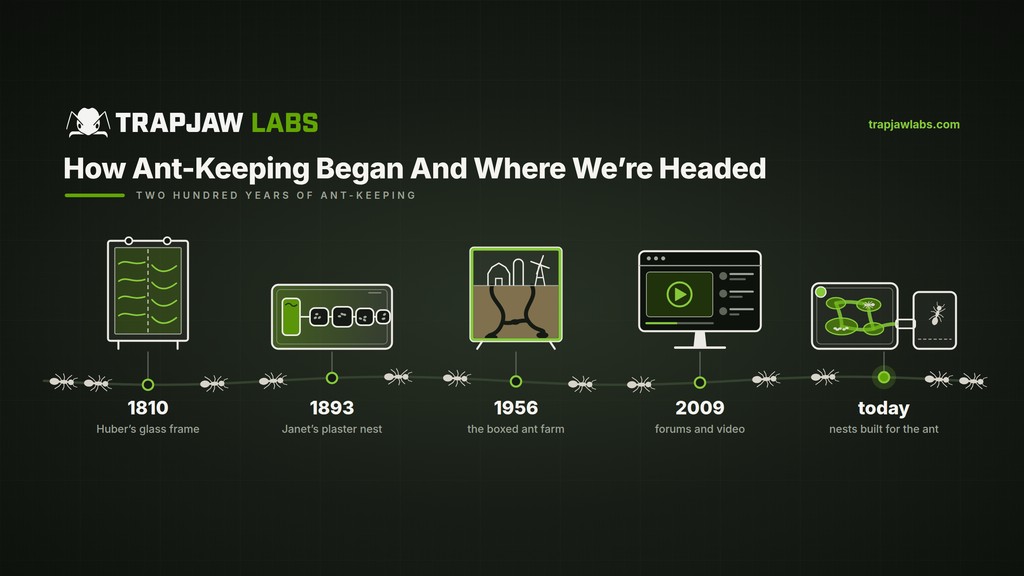
How Ant-Keeping Began And Where We're Headed
Some of my earliest memories are of ants. I kept my first colony at 8 years old, and immediately I was hooked. I hope, after reading, you'll agree with me that the hobby is only getting started.
It Started As Lab Equipment
Every formicarium sold today is a descendant of an apparatus somebody built to answer a research question.
Pierre Huber published the first one in 1810. Two vertical frames glazed on both sides and set about 22 mm apart, with a perforated tin sheet down the middle splitting the earth into two thin layers, shutters to keep the light off, holes drilled in the top for honey and water. He put "Amazon ants" (Polyergus rufescens) in it and watched a mixed colony assemble itself.
John Lubbock took that idea and laid it flat. In "Ants, Bees and Wasps" (1882) he wrote that "no one before had ever kept an ants' nest for more than a few months." He ran two panes of glass with soil between them, set the stand in a water moat, and kept colonies going for years. A Formica fusca queen he collected in December 1874 lived until August 1888, laying worker-producing eggs every year of it.
Charles Janet finished it in 1893. He cast the chambers directly into a block of plaster, covered them with a pierced sheet of glass, and put a water reservoir in one corner so moisture would wick through the plaster and let the ants choose their own humidity. Read that back. That's a nest you can buy right now.
Then Somebody Put It In A Box
The version most people picture, sand between two panes, was patented in 1929, and it never had a queen in it.
Frank Austin, a retired Thayer School professor in Hanover, New Hampshire, filed a patent on a glass-sided 'ant house' on June 21, 1929. It granted on June 16, 1931. By 1936 they sold for five dollars apiece and went out the door 400 in an ordinary month, 2,000 in one December, with local kids paid four dollars a quart to collect the ants.
Milton Levine got his version at a Fourth of July picnic in 1956, and a USPTO filing puts the first sale on September 3, 1957. Uncle Milton has sold north of 20 million. You had to buy the ant farm, mail in a coupon, wait three to six weeks to receive a vial of "Harvester Ants" (Pogonomyrmex). No queen. The company's own manual told you the workers would live one to three months.
This was both good and bad for the hobby. It popularized the notion of ant-keeping, and got people interested in ants, but it established the precedent that "Ant-Keeping" was buying a simple, plastic ant farm that ants would dig in some before dying.
The Community Built Everything Else
It's the year 2000. Antstore just opened in Berlin, and the Ant Farm and Myrmecology Forum has been running since February. Myrm's Ant Nest was up in the UK by early 2001 and Ameisenforum.de popped-up late 2001.
The next big step was YouTube videos. Mikey Bustos uploaded "The Story of My Ant Colony: Myrmica rubra" on July 15, 2009. That channel is at seven million subscribers now. Whatever anyone makes of it, it's the reason most Ant-Keepers know the hobby exists.
Formiculture.com came online on September 21, 2013. It sits at over 250,000 posts of Ant-Keeping info and is completely free to use. It's still a phenomenal source of information relative to what else is available for hobbyists.
Fun-fact, nobody knows where the test tube setup originates. It was already 'what everybody does' by 2013 and nobody can truly tell you who did it first.
In 2012, the first American ant vendors arose. They were nothing compared to what they are today, effectively just random guys offering online what they had jerry-rigged together that kept their ants alive. Things kept growing in scope and sophistication as the hobby got more popular.
Where We Are Now
The hobby is better supplied than it has ever been, and the thing most likely to stop you now is paperwork.
National Geographic put it at tens of thousands of hobbyists worldwide in 2021, and the hobby has only continued to grow since then.
In the US, moving ants across a state line requires a USDA PPQ 526 permit, and it's specific to the species. You need one even when the species is already common in the destination state. APHIS says to budget four to six months and that they do not expedite. So the American market is local by necessity, not by preference.
Where We Come In
We built TrapJaw Labs to continue advancing the hobby as a whole.
There are close to a thousand described ant species in North America and the hobby has husbandry information for only a small fraction of them. We've published over 95 care guides, 7,620 nuptial flight records across 161 species, and have recently reared the first captive Pheidole littoralis colony. Taking a species that was relegated to obscurity and bringing it into the limelight never gets old.
We've also created innovative nests, allowing species to be kept that were previously unavailable to hobbyists. Since nobody knew how to make, let alone sell, a setup that met many species' needs.
Two hundred years in, and we've barely scratched the surface when it comes to the Ant-Keeping hobby. We're just getting started.