The TrapJaw Labs Shop
High-quality Ant Nests, Colonies, and Ant-Accessories for every level of ant-keeper.
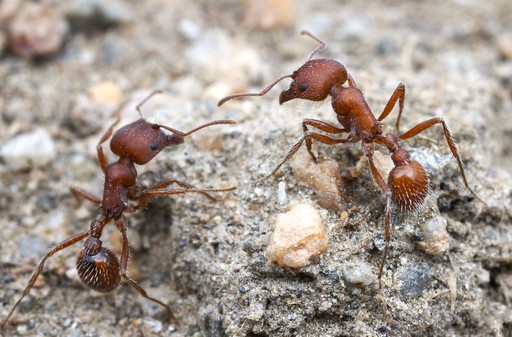
Pogonomyrmex occidentalis
Western Harvester Ants Pogonomyrmex occidentalis is an iconic mound-building harvester of the Great Plains and Intermountain West, ranging from the western Dakotas and Nebraska south through Wyoming, Colorado, and New Mexico and west into Utah, Nevada, and east-central California, holding to higher-elevation grassland, sagebrush, and pinyon-juniper clearings rather than true desert. Colonies raise a conical mound up to 135 cm across and shingle it with gravel carried in from the surrounding surface, substituting freely where gravel is scarce: gypsum, selenite, lignite, petrified wood, snail shells, and, in North Dakota, the teeth of small extinct mammals (Wheeler and Wheeler 1963).
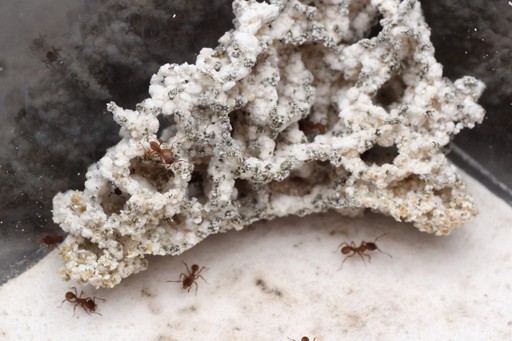
Trachymyrmex septentrionalis
Northern Fungus-farming Ants Trachymyrmex septentrionalis has the widest distribution of any fungus-farming ant in the United States, ranging from Texas and Florida up through central Illinois, southern Ohio, and Long Island, always on sandy, open, lightly shaded ground, and it marks its nests with a crescent of excavated soil that turns conspicuous during the spring and fall digging. Colonies at the two ends of that range keep entirely different calendars: New York and New Jersey populations are active only from early May to September and let the fungus garden go dormant through the winter, while Florida colonies work straight through, foraging on any day that clears about 18°C (Weber 1972). Workers are monomorphic and colonies monogyne, with adults farming gathered plant detritus rather than cut leaves; in north Florida sandhills they reach better than a thousand nests to the hectare, and the largest and most productive sit in open treeless ground rather than under canopy (Seal and Tschinkel 2006).
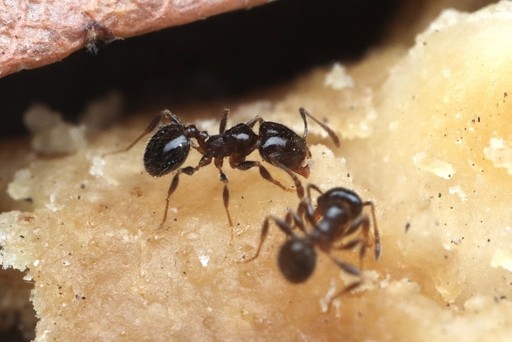
Pheidole bicarinata
Variable Big-headed Ants Pheidole bicarinata is a small, strongly dimorphic ant distributed across much of the United States, from New Jersey south to northern Florida and westward through Nebraska, Colorado, and Texas to Utah and Nevada, with a preference for open sandy sites at the moister end of the xeric spectrum, grasslands, arid valley bottoms, and ruderal habitats including lawns and road shoulders. Colonies are small, often just a few hundred to few thousand workers, nesting under ground-covering objects, in rotten downed wood, or in open soil beneath a small crater that is typically incomplete and crescent- or wedge-shaped.
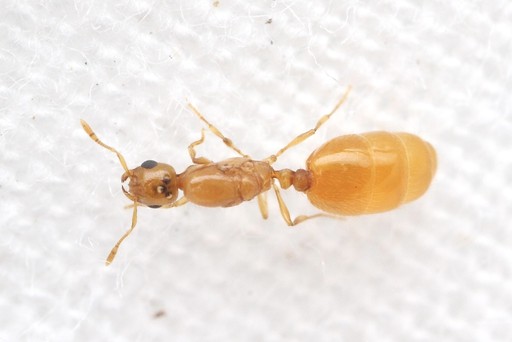
Solenopsis carolinensis
Carolina Thief Ants Solenopsis carolinensis is a thief ant of the molesta complex, described by Forel from Faisons, North Carolina, and recorded spottily from New Jersey and Maryland south through the Carolinas and west into Arkansas and Texas, most of it by accident: berlese samples of hardwood leaf litter, stumps and bark on dead trees, the nests of other ants and of termites, a black light in July. Workers run 1.3 to 1.5 mm, usually concolorous yellow and sometimes brown, the eye reduced to three to five ommatidia, against queens of about 4.1 mm carrying large black eyes and darkly pigmented ocelli; colonies are polygyne.
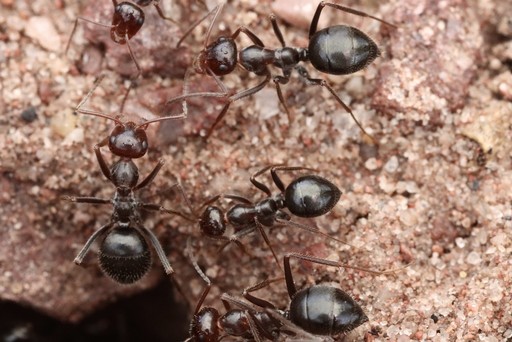
Myrmecocystus mimicus
Common Honeypot Ants Myrmecocystus mimicus
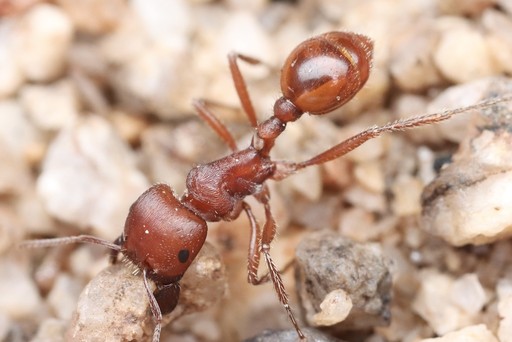
Pogonomyrmex barbatus
Red Harvester Ants Pogonomyrmex barbatus is the large red harvester of the southwestern United States and Mexico, around 10 mm and quick to sting, clearing a bare disc around a nest that can run a meter across. Gordon has followed a single New Mexico population for more than three decades, and the record shows a colony living 20 to 30 years, exactly as long as the queen who founded it, and regulating its foraging by the rate at which returning foragers meet ants in the chamber inside the entrance, a valve set against the water a forager loses to dry air.
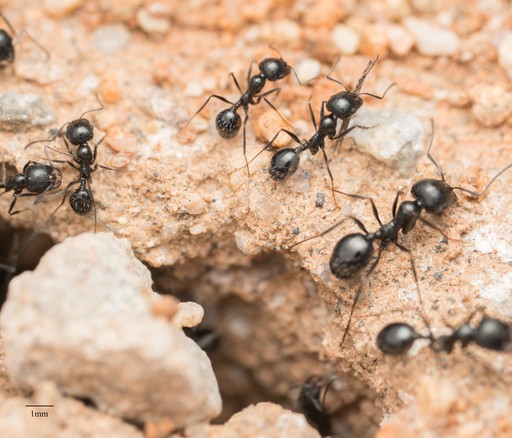
Veromessor pergandei
Black Harvester Ants Veromessor pergandei is the glistening black harvester of the Mojave and Sonoran deserts, strongly polymorphic and improbably dark for the heat it works in, throwing up 30 cm craters ringed by crescents of discarded seed husk that are among the more conspicuous features of the desert floor. It forages as a single column: thirty to forty-five minutes after the sun reaches the nest a file of workers pushes out and runs forty meters or more before breaking into a fan, where each ant leaves the trail, hunts seed alone, and rejoins the column to carry it home.
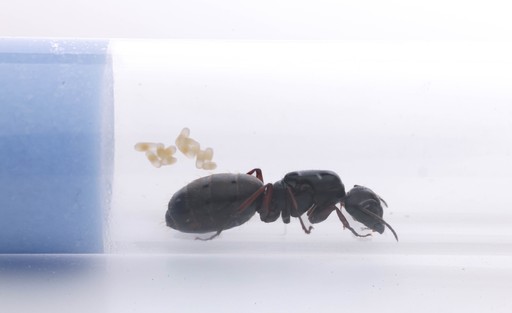
Camponotus modoc
Western Black Carpenter Ants Camponotus modoc is the black carpenter ant of western North America, dull and unmarked, working nearly every wooded habitat on that side of the continent, from grassland and sagebrush through juniper and pinyon, riparian cottonwood, burned lodgepole, and up into subalpine fir and spruce. Nests go under bark and into logs, stumps, and standing dead conifers, usually wood already going soft, though in Colorado Gregg found more colonies under stones than in logs. Colonies get rather enormous and can contain more than one queen, in the right circumstances.
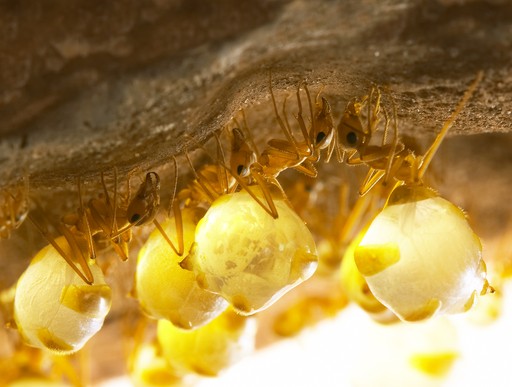
Myrmecocystus mexicanus
Mexican Honeypot Ants Myrmecocystus mexicanus
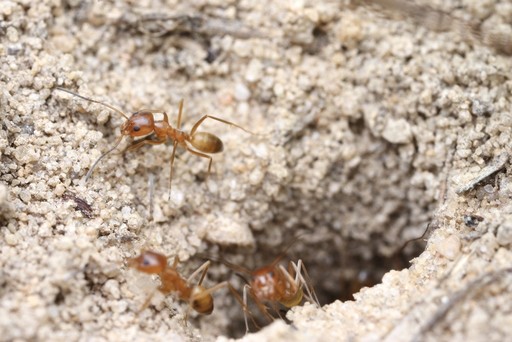
Dorymyrmex bureni
Buren's Pyramid Ants Dorymyrmex bureni is the common yellow pyramid ant of disturbed southeastern soils, ranging from Maryland and Virginia south through Florida and west to Mississippi and Texas, holding roadsides, pastures, lawns, and fallow fields wherever the ground runs sandy. Color varies across that range from mousy brown in coastal Georgia to clear orange-yellow in south-central Florida. It is among the first ants into freshly tilled soil and an avid predator of small arthropods in citrus and soybean rows, harmless enough to the crop that Trager proposed farming practices be tuned to favor it (Whitcomb et al. 1972, Trager 1988), and its foragers work every hour but the hottest, coming out even on warm sunny days in winter.
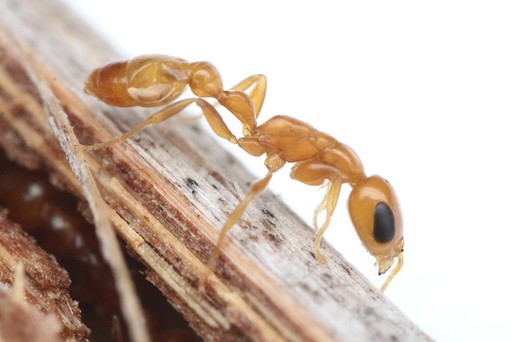
Pseudomyrmex pallidus
Pallid Twig Ants Pseudomyrmex pallidus is a small orange-brown twig ant with the long eyes and quick, wasp-like carriage of its subfamily, ranging from the southern United States far down into South America and nesting in whatever dead hollow stem is going: ragweed and beggarticks in an old field, sawgrass at the marsh edge, sea oats on the dune, and the twigs of chinaberry, hoptree, and oak. What counts as a colony is hard to pin down. Colonies can be seemingly very large or tiny, with the driving forces being habitat availability and food availability.
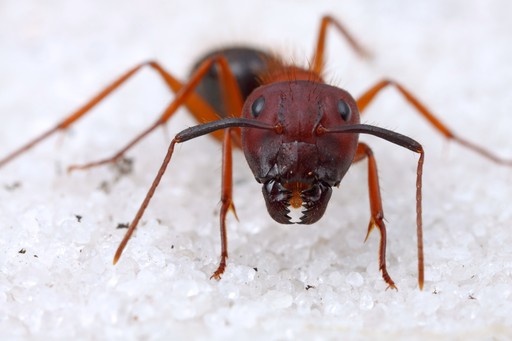
Camponotus floridanus
Florida Carpenter Ants Camponotus floridanus is the abundant bicolored carpenter ant of the southeastern coastal plain, ranging throughout Florida and north to North Carolina, west into Mississippi and Louisiana, turning up in nearly every habitat in the state, natural or disturbed, nesting in rotting stumps, logs, tree cavities, and soil, and taking to containers left standing outdoors readily enough to make it an easy stowaway (Deyrup, Davis & Cover 2000). Workers are strongly polymorphic, majors at 8 to 10 mm against minors of 5.5 to 7 mm, the forebody red-orange against a black gaster; colonies are monogyne, largely nocturnal, pugnacious on contact, and run to several thousand workers. It is among the most heavily kept ants in the laboratory, one of the first to have its genome sequenced, and the species in which trophallactic fluid was shown to carry juvenile hormone to developing larvae (LeBoeuf et al. 2016).
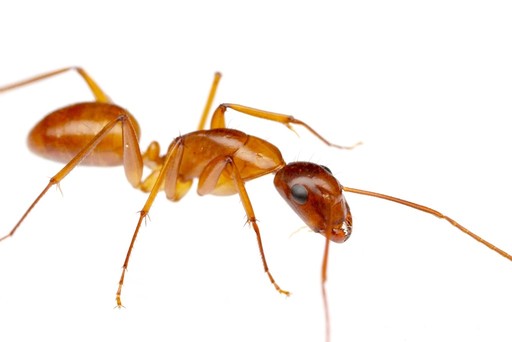
Camponotus castaneus
Chestnut Carpenter Ants Camponotus castaneus is a warm-climate forest dweller of the eastern United States that departs from the typical carpenter-ant nesting pattern: it commonly nests in soil or under stones, or in rotten stumps, logs, and fallen branches in contact with the ground, forming moderately populous colonies that are notably timid and apparently primarily nocturnal. It has been recorded from a wide range of habitats, deciduous and mixed forest, oak and longleaf pine sand barrens, pine flatwoods, hardwood hammock, sand pine scrub, recently burned stands, and urban sites, with increased abundance in disturbed areas.
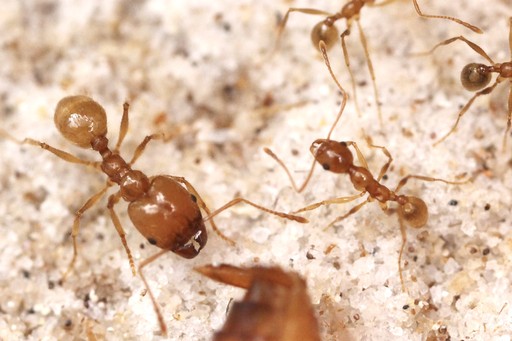
Pheidole morrisii
Morris' Big-headed Ants Pheidole morrisii is a strongly dimorphic sand specialist ranging from Long Island south through peninsular Florida and west to Illinois, Missouri, Oklahoma, and Texas, the most abundant ant of the longleaf pine flatwoods of north Florida, where it builds crater mounds in open sand or nests at the base of grass clumps. Colonies are large, censused as high as 49,000 workers (Murdock & Tschinkel 2015), and vary in social structure across the range: northeastern populations found pleometrotically and retain multiple queens, one of the very few documented cases of primary polygyny in ants, while southeastern colonies are monogyne and frequently polydomous.
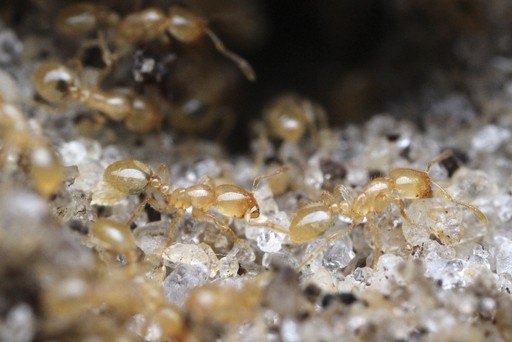
Solenopsis pergandei
Pergande's Thief Ants Solenopsis pergandei is a hypogaeic thief ant of the southeastern coastal plain, ranging from North Carolina south through Florida and west into Texas and New Mexico, taken far more often in buried bait vials than on the surface and presumed, like the rest of the fugax complex, to tunnel into the nests of larger ants and carry off brood, a behavior nobody has yet observed in situ (Thompson 1980, Ohyama et al. 2018). It is the only Florida thief ant known to raise tumuli, loose soil turrets that appear before dawn after a night of moderate to heavy rain and release alates 30 to 60 minutes ahead of sunrise, the brood chambers below left inconspicuous and joined to the turret by tunnels a few grains of sand wide. Workers are concolorous pale yellow and under 2 mm long, the eye reduced to two ommatidia, against a black-eyed queen of 6.5 mm.
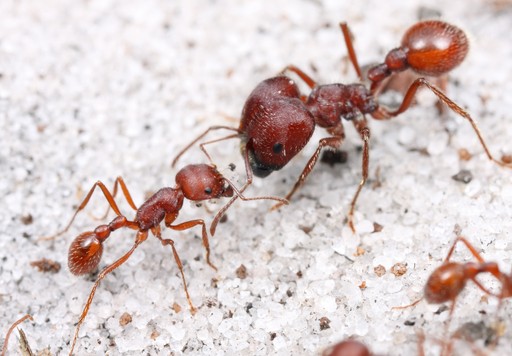
Pogonomyrmex badius
Florida Harvester Ants Pogonomyrmex badius is the only Pogonomyrmex east of the Mississippi, held to the coastal plain from Louisiana to North Carolina and apparently never sympatric with a congener anywhere in that range (Cole 1968), nesting in open sandy ground under a low crater littered with detritus and bits of charcoal. It is also the only dimorphic member of the genus in North America, producing majors whose heads are hugely enlarged and their mandibular teeth are blunt or worn away entirely; their majors primarily stay deep in the nest, rarely forage, and appear to specialize in milling the seeds that foragers drop into the topmost chambers for a separate crew of workers to relay downward to granaries 20 to 80+ cm below the surface.
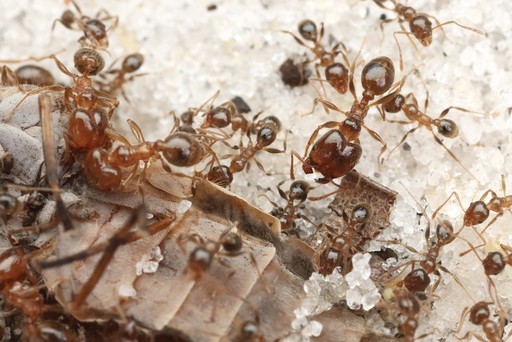
Pheidole dentata
Toothed Big-headed Ants Pheidole dentata runs from Maryland south to the Florida Keys and west to Kansas and the Davis Mountains of Texas, nesting by preference in rotting logs and stumps but taking nearly anything else on offer. It is best known as the subject of Wilson's work on enemy specification: one Solenopsis scout is enough to trip a full alarm, and majors can tell a minor who has just touched a fire ant recruiting to sugar, apparently by the odor she carries home, and runs a trail in looping-aggressive sweeps rather than a straight line (Wilson 1975, 1976). Under heavier invasion the colony gives up the fight and absconds with its brood; Wilson kept dentata for years and found it among the easiest ants to manage in the lab, feeding voraciously and reaching maturity inside a year.
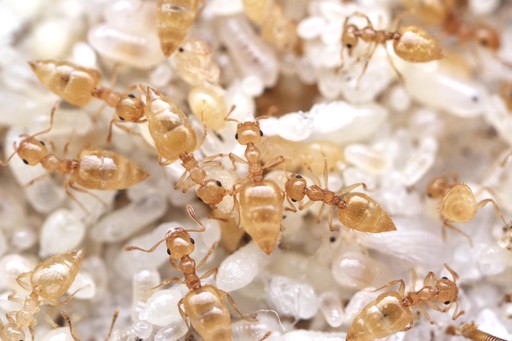
Crematogaster minutissima
Forest Floor Yellow Acrobat Ants Crematogaster minutissima is a diminutive yellow acrobat ant that lives on and in the forest floor rather than up a trunk, nesting in soil and in downed wood, acorns, and fallen nuts from the southern United States south to northwestern Costa Rica. Most of their nests hold multiple queens.
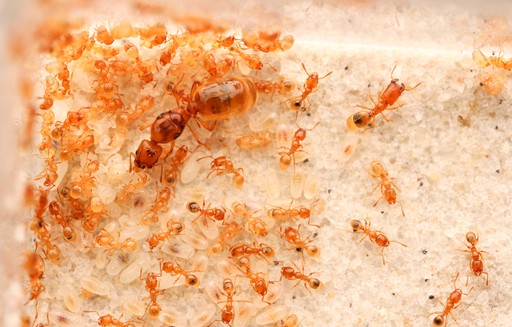
Pheidole lamia
Pheidole lamia Pheidole lamia is a reclusive soil-nester ranging from northern Florida west to at least Austin, Texas, building directly into soil beneath leaf litter with no mound or crater to give the nest away, which is likely why it has a reputation for being rare. Mature colonies in Florida and Texas hold 500 to 1,500 minors against a much smaller number of majors, and the majors are the point of the species: the head is elongate, deeply scrobed, and truncated flat across the front, and Buren et al. (1977) watched laboratory colonies work it like a bulldozer blade against raiding Solenopsis thief ants. Both castes are concolorous yellow, the major faintly reddish, her head nearly twice the length of a minor's.
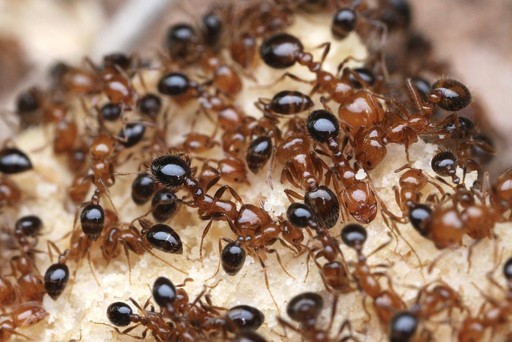
Solenopsis xyloni
Southern Fire Ants Solenopsis xyloni is the native fire ant of the southern United States, ranging from the Carolinas west to California and south into northern Mexico, nesting in open soil or under stones and raising loose, untidy craters rather than the dense mounds of its imported relatives. Workers are polymorphic, usually amber across the head and mesosoma against a black gaster though some populations run concolorous dark, and they sting hard but with markedly less appetite for it than Solenopsis invicta (Mackay & Mackay 2002).
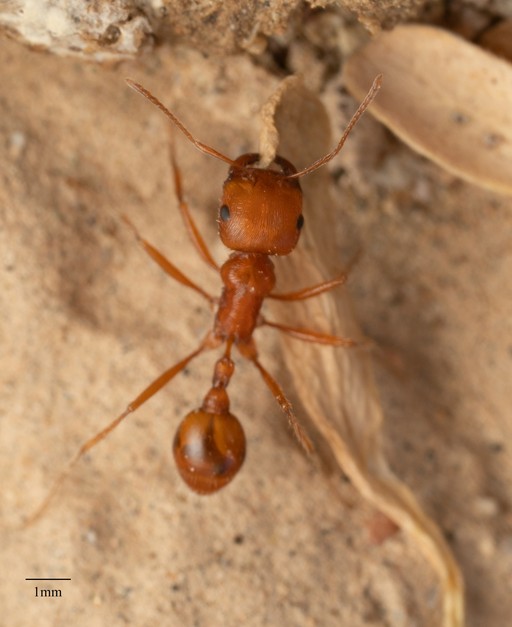
Pogonomyrmex maricopa
Maricopa Harvester Ants Pogonomyrmex maricopa is a seed-harvesting myrmicine of the Sonoran and Chihuahuan desert regions, where colonies build conspicuous cleared discs around a central nest entrance and forage on a diurnal, heat-tolerant schedule. It's best known for having among the most acutely toxic insect venoms ever measured, with a murine LD50 in the neighborhood of 0.1–0.12 mg/kg, driven largely by proteinaceous hemolytic and neurotoxic components rather than the alkaloids seen in Solenopsis. Colonies are monogyne with a single physogastric queen, and founding is fully claustral following late-summer monsoon nuptial flights.
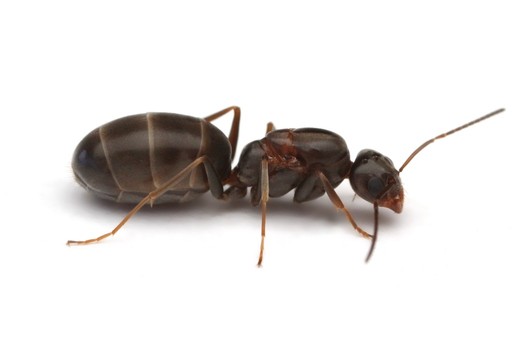
Dorymyrmex insanus
Crazy Pyramid Ants Dorymyrmex insanus is a pyramid ant of the hot, open-ground across the southwestern United States and northern Mexico, running long trails of workers over bare soil between clustered crater mounds, taking honeydew, any nutritious liquid it finds, and vertebrate carrion with equal interest, and swarming food and enemies alike.
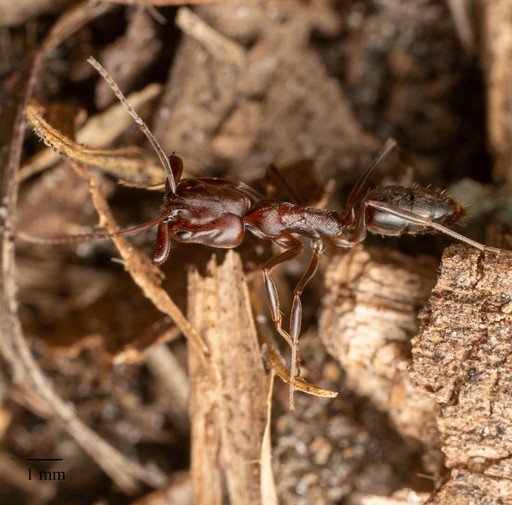
Odontomachus brunneus
Floridian Trap-Jaw Ants Odontomachus brunneus is the trap-jaw ant of the southeastern coastal plain, ranging through Florida into southern Georgia and Alabama, nesting in leaf litter, rotting logs, tree bases, and open sand, the nest a single vertical shaft off which simple horizontal chambers open, 100-1,000 workers to a colony. The jaws are used less freely than the name suggests: prey are approached tentatively and the ant recoils the instant the strike lands, retrieving only after a pause.
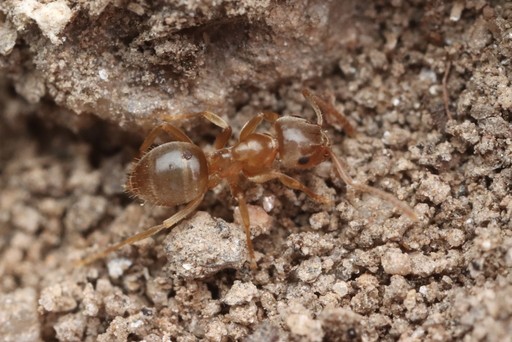
Lasius pallitarsis
Pale-legged Fuzzy Ants Lasius pallitarsis is the common boreal and cold-temperate Lasius sp. of North America, running from eastern Québec across Canada to southeastern Alaska and south down the western mountains into California, nesting in rotten logs and stumps and under stones and taking plant debris, small insects, and honeydew from the aphids and scales it tends (Ellison et al. 2012).
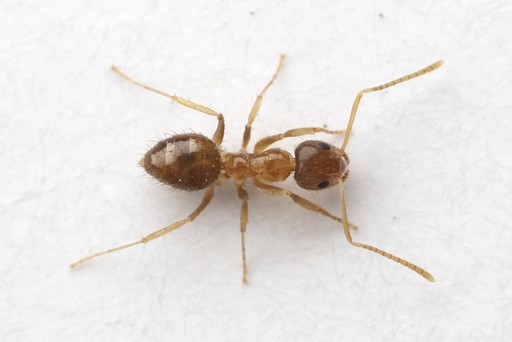
Nylanderia arenivaga
Sand-loving Crazy Ants Nylanderia arenivaga is a sand specialist of the eastern United States, from Massachusetts south to Florida and west along the Gulf, holding almost exclusively to deep sand deposits and working at night. Where it meets its sister species in Georgia and Florida the two divide the ground by color, arenivaga taking the yellow sands and Nylanderia phantasma the white (Deyrup, in Kallal & LaPolla 2012). Workers are monomorphic.
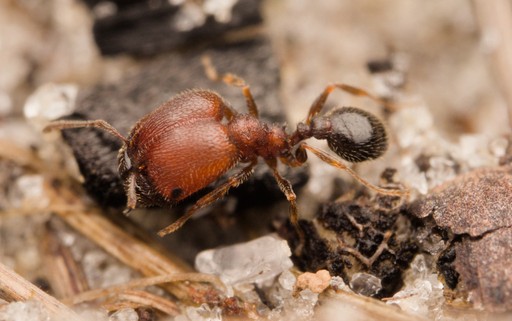
Pheidole littoralis
Seaside Big-headed Ants Pheidole littoralis colonies stay small but excavate deep, we think, and every nest holds a single granary chamber packed with seed 10 to 20 cm down, at the same depth every time. The majors are large for a Floridian Pheidole, the head three times the length of a minor's.
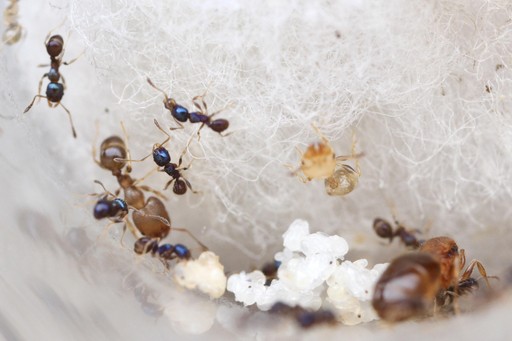
Pheidole metallescens
Metallic Big-headed Ants Pheidole metallescens runs from central Florida through the Gulf States to Oklahoma and southern Texas, nesting in soil in the shade of trees behind a small crater of excavated earth, its chambers strung along a single vertical gallery that can drop 40 cm, one queen to a colony; in Texas it takes to rotting logs as readily as soil. Emery named it for the minors, whose blackish bodies throw blue and purple reflections heaviest across the head, a gun-metal sheen the majors almost entirely lack, and those majors are small for the genus at about 2 mm and reddish brown over the head. Minors forage with majors in tow for small grass seeds and dead arthropods.
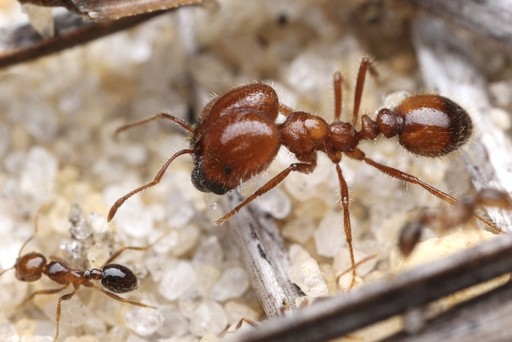
Solenopsis geminata
Tropical Fire Ants Solenopsis geminata is the native fire ant of open, sunny, sandy ground across the southeastern United States, nesting under loose irregular craters and avoiding the shade of closed woods, and it works the ground beneath as much as the surface, running long subterranean foraging tunnels out from the nest and surfacing along them at intervals rather than trailing in the open. Its majors are millers in a genus of hunters: a squared head with parallel sides and a deep longitudinal groove, powering blunt black mandibles built to grind seeds rather than cut prey and worn toothless with age, and that caste is old rather than opportunistic. Before people reached the Southeast, geminata stood among the region's principal granivores and arguably at the head of them, and the mandibles are the record of it. What survives of it holds on in the drier habitats, on a fraction of the ground it once worked.
Temnothorax pergandei
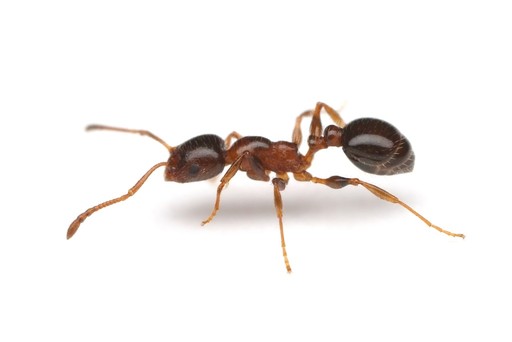
Pergande's Acorn Ants Temnothorax pergandei is a quick, pugnacious hunter of open sparsely vegetated ground from the eastern United States west to Arizona and south into Hidalgo, and its rapid movements and constricted mesosoma make it read in the field as Pheidole-like rather than as an acorn ant, running in full sun after aphids and small heteropterans (Prebus 2021, Wheeler 1903). Colonies are monogyne and hold 100-1,000 (roughly) workers, and the species is variable enough that a given colony may produce uniformly dark brown, uniformly yellow, or bicolored workers.
Lasius neoniger
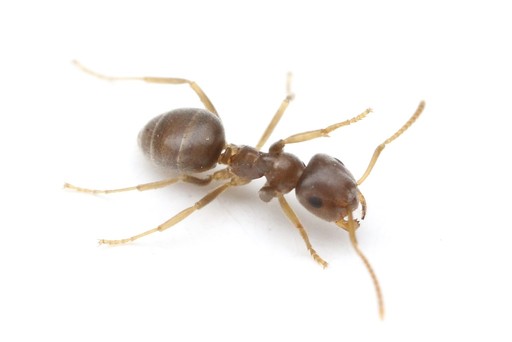
Turfgrass Ants Lasius neoniger is the open-ground Lasius of eastern North America, west to the Dakotas and Kansas and thinning fast beyond the Great Plains, nesting under stones or in bare soil craters and never going into forest, which is why Wilson credited its ruderal habit with making it one of the most abundant and conspicuous insects in its range: road strips, lawns, pastures, cultivated fields, and, where the land is still wild, prairie and old beach dune (Wilson 1955). It keeps livestock.
Forelius pruinosus
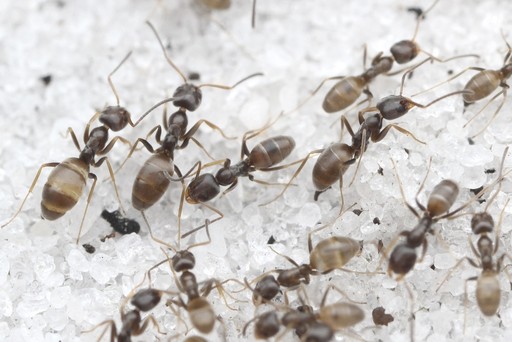
High Noon Ants Forelius pruinosus is a small dolichoderine of open, arid, and broken ground from the southern United States into Mexico and the Caribbean, polygyne, monogyne nesting in bare soil behind untidy little craters and running trunk trails over ground and vegetation for nectar, honeydew, and whatever it can scavenge. It works the shift nothing else will take. On Sonoran barrel cactus the other three ants tending the plants came down in the heat of the day and returned when the surface cooled, while pruinosus never abandoned a plant anywhere in the range recorded, 13.8 to 57°C, and held a lethal threshold of 53.4°C in the lab, more than three degrees clear of the next species (Fitzpatrick et al. 2014).
Tetramorium immigrans
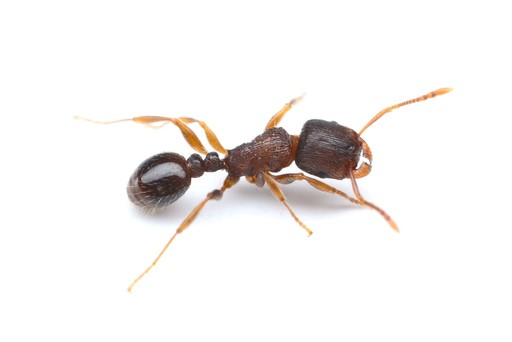
Immigrant Pavement Ants Tetramorium immigrans is the ant of the city sidewalk in eastern North America, European by origin and probably the ant most North Americans have actually watched, nesting in cracks of concrete and asphalt and under paving stones and foundations, pushing up little tailings of soil, recruiting in mass along a scent trail to nearly anything edible though it prefers meat and grease, and taking subterranean termites when it can get them. It is best known for the wars: in late spring whole colonies pour onto the pavement and grapple with the neighbors for hours, in numbers that stop pedestrians.
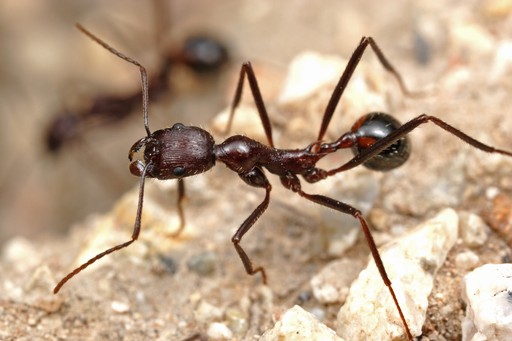
Novomessor cockerelli
Novomessor cockerelli Novomessor cockerelli is a large, long-legged, elongate ant of the rocky soils of the southwestern deserts, the most common Novomessor in New Mexico. It forages early and late, sometimes at night, and all day once the year cools, taking dead and dying insects, plant matter, and seed, and it cannot sting, though it is aggressive enough that the bites tell when enough of them are on you. It also sabotages the competition.
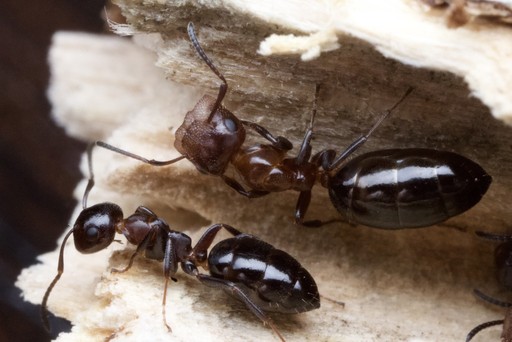
Colobopsis impressa
Common Gate-keeper Ants Colobopsis impressa nests in dead twigs and hollow stems across the southeastern United States and into the Bahamas, running its galleries through the abandoned tunnels of wood-boring beetle larvae under the bark of dead limbs, and it cuts a single round hole to the outside that is exactly filled by the head of a major standing behind it. The majors' head is truncated flat and pale across the front where the rest of her is dark, and the queen carries the same door-face.
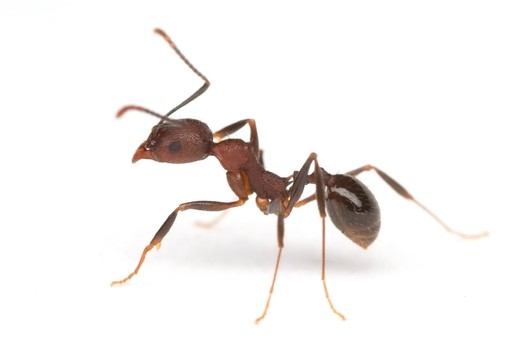
Aphaenogaster fulva
Tawny Collared Ants Aphaenogaster fulva is a long-legged tawny ant of mesic eastern forest, from Vermont south into Florida and west to Louisiana and Colorado, nesting in logs and stumps and under stones, and it wears the feature it is named for: a welt thrown up across the front of the mesonotum, standing abruptly above the pronotum and dished in the middle so that from behind it reads as two low tubercles. It is one of the eastern woodland Aphaenogaster, and that genus does most of the seed-carrying in the spring woods. They are also considerable termite predators, should the opportunity present iself.
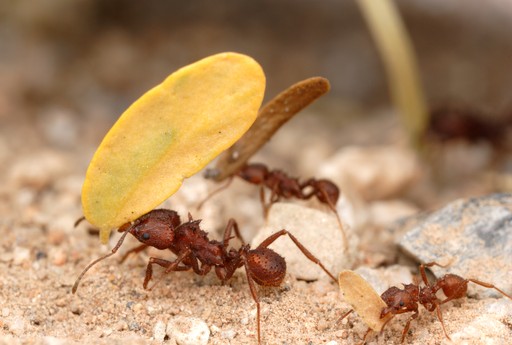
Acromyrmex versicolor
Desert Leaf-cutter Ants Acromyrmex versicolor is the leafcutter of the Sonoran Desert, throwing up broad multi-crater nests in the sandy ground along washes over colonies of several thousand, and unlike the fungus-growers that scavenge dead litter it cuts: columns of workers going out for mesquite and creosote and jatropha and buffalo gourd, clipping leaf and carrying it home to feed the garden.
Pogonomyrmex rugosus
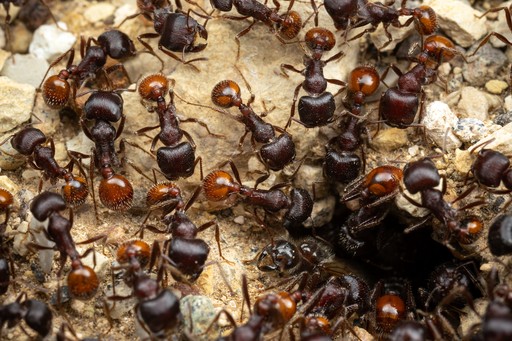
Rough Harvester Ants Pogonomyrmex rugosus is the large dark harvester of the southwestern deserts, over 8 mm with a near-black head and mesosoma against a paler gaster, ranging from southern California and Nevada east through New Mexico into west Texas and south well into Mexico, raising broad crater mounds over colonies of several thousand and collecting seeds, dead insects, etc. whenever the ground is cool enough to cross. The mound rim serves as its midden, hulls and husks piled at the edge.
Pogonomyrmex californicus
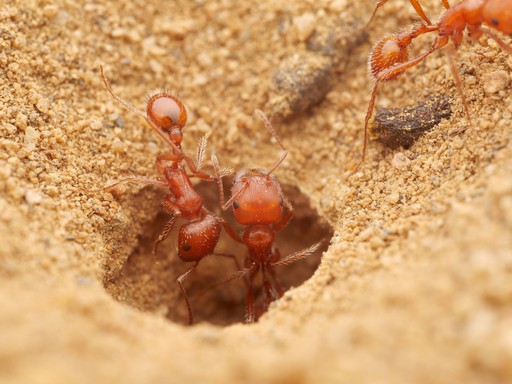
California Harvester Ants Pogonomyrmex californicus is a harvester of sandy ground from southern California and Baja east through Arizona into western Texas, raising a loose crater about 20 cm across and leaving the vegetation around it standing rather than clearing the bare disc its larger congeners keep, over a nest two meters deep holding some two thousand workers. It works through the heat of the day, and you can read the cost in how it moves: stiff-legged with the gaster hoisted clear of the sand, climbing onto pebbles and small stones to get up off the surface and wave its legs in the air (Mackay & Mackay 2002).
Camponotus pennsylvanicus
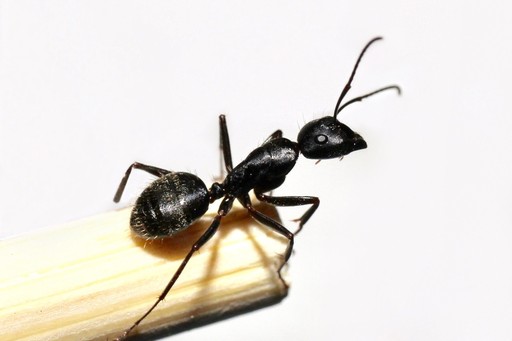
Eastern Black Carpenter Ants Camponotus pennsylvanicus was the first North American ant described, by De Geer in 1773, and it remains a species most people in the Eastern US encounter, nesting in living and dead trees, rotten logs, and stumps, and in the timbers of fences, poles, and houses. Wheeler and Wheeler called it probably the most destructive carpenter ant on the continent; Creighton thought that overstated and held that it only tunnels wood already rotten. Its aphid tending is done in relay, the smaller workers milking honeydew from the herd and handing it to larger ones that carry it home.
Myrmecocystus navajo
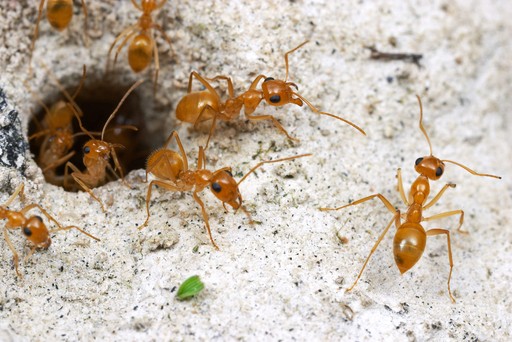
Navajo Honeypot Ants Myrmecocystus navajo
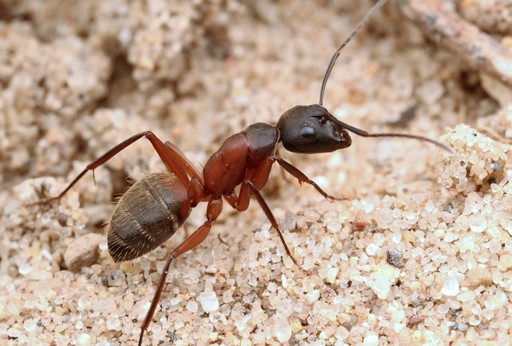
Camponotus chromaiodes
Ferruginous Carpenter Ant Camponotus chromaiodes is the red-bodied carpenter ant of eastern woodland, black in the head and gaster with a deep red mesosoma and legs and a wash of red across the front of the gaster, which is the only reliable thing separating it from Camponotus pennsylvanicus in the field. It nests in and under well-rotted logs and stumps, in standing dead trees, and at the bases of oaks, running its galleries down out of the wood and into the soil beneath, often heavy clay. Where the ground is already warm it takes the warmest chambers on offer (Diamond et al. 2012).
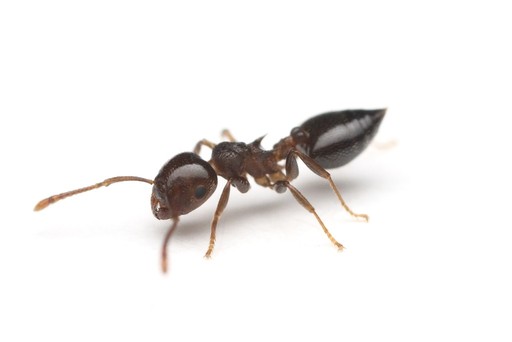
Crematogaster cerasi
Cherry Acrobat Ants Crematogaster cerasi is the acrobat ant that will live nearly anywhere, from Nova Scotia and Quebec across most of the United States and southwest into Baja California, from sea level up into the Huachucas, nesting in soil and sometimes throwing a small mound, under stones, under sagebrush in the west and in hardwood hammock in the southeast, in twigs and hollow stems and rotten stumps, and in hickory nuts. Despite Crematogaster's typical reputation, it doesn't really go up trees.
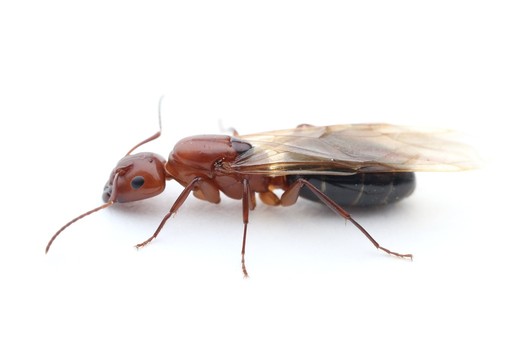
Camponotus decipiens
Deceptive Carpenter Ants Camponotus decipiens is a small Myrmentoma of the Southeast, 3.5 to 7.5 mm, reddish over the head, mesosoma, legs, and petiole with a black and notably glossy gaster, and it keeps small colonies, a few hundred workers at the outside and often under a hundred. Almost nothing it lives in was made by itself: it moves into the vacated galleries of Colobopsis and other carpenter ants in ash and oak twigs, old gall-wasp chambers, cavities in plant stalks, loose bark, and dry seedpods.
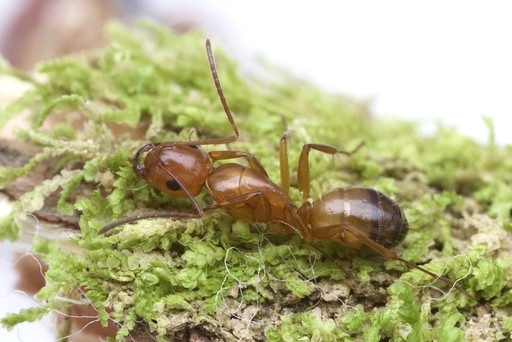
Camponotus snellingi
Snelling's Carpenter Ants Camponotus snellingi is a Myrmentoma of the southeastern woods, 3.5 to 8 mm, orangish-red over the head, mesosoma, legs, and petiole, with the first two segments of the gaster that same orange and everything behind them black. It nests in dead twigs and branches, under the bark of living and dead trees, and in partly rotten logs, stumps, and standing snags, and unlike the small-colony carpenter ants it resembles it can grow to thousands of workers, though whether it does depends on who else is in the wood.
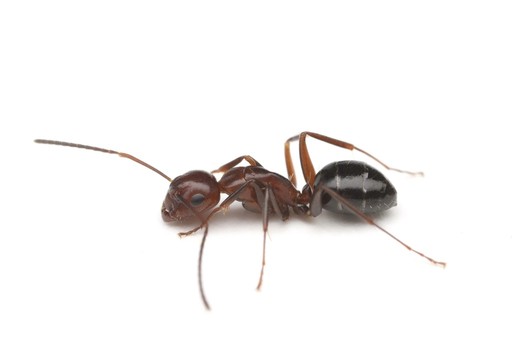
Camponotus discolor
Bicolored Arboreal Carpenter Ants Camponotus discolor is a small Myrmentoma carpenter ant, 3.5 to 7.5 mm, red across the head, mesosoma, and petiole against a blackish gaster, ranging from Ohio and the Carolinas south to Florida and west to the Dakotas, Kansas, and Texas. It is rarely collected and almost always from natural habitat, nesting like the rest of its subgenus in a wide range of small cavities and forming colonies too few and workers too slight to trouble a house, which sets it apart from the big carpenter ants people know.
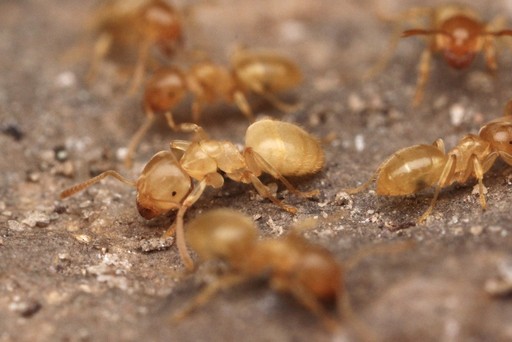
Lasius brevicornis
Short-horned Meadow Ants Lasius brevicornis is the yellow subterranean ant of eastern North America, abundant from New England west through the Dakotas, scarce along the Gulf and thin across most of the West, nesting under stones in open ground and dry woodland and flying in late August and early September. Generally thought to subsist entirely underground on root aphids and other sap-suckers they tend.