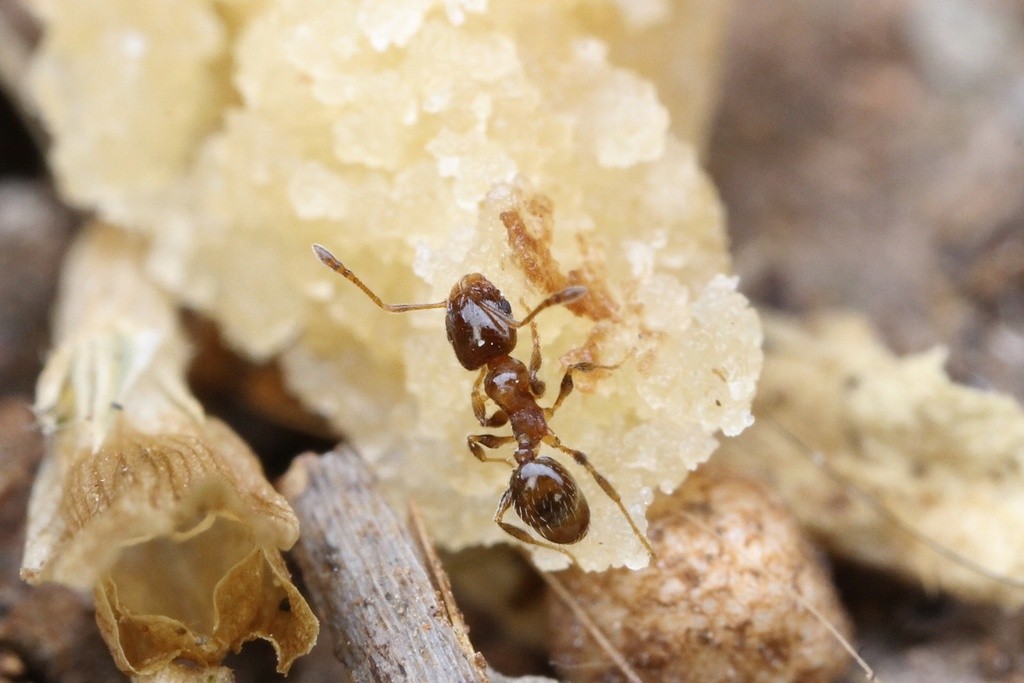
Species Spotlight: Pheidole bicarinata
Pheidole bicarinata is the big-headed ant most keepers meet first, and the one most of us underrate. They live in lawns, sidewalk cracks, golf courses, and the sandy disturbed ground nobody bothers to look at. Wild colonies stay small. Give them heat and protein in a captive setup and they turn into one of the fastest-growing ants you can keep.
They're also the most scientifically important ant in this genus. Nearly everything the field knows about how a colony decides to build a soldier came out of lab colonies of bicarinata in the 1980s.
Taxonomy
Kingdom: Animalia
Phylum: Arthropoda
Class: Insecta
Order: Hymenoptera
Family: Formicidae
Subfamily: Myrmicinae
Tribe: Attini
Genus: Pheidole
Species: Pheidole bicarinata Mayr, 1870
Mayr described them from Illinois. The name refers to a pair of carinae, most likely the ridges on the clypeus rather than anything on the head proper. Worth knowing, because 'two ridges on the head' gets repeated as a field mark and it isn't one.
A note on 'vinelandica'. You'll still see Pheidole vinelandica on old labels and in older forum posts. Forel described it as a race of bicarinata in 1886, Naves raised it to full species in 1985, and Wilson sank it back into bicarinata in 2003. So it isn't a species and it isn't a subspecies. It's one end of a very variable ant. Half a dozen other names went the same way: laeviuscula, longula, buccalis, nebrascensis, hayesi. If you bought a colony labeled vinelandica, you bought bicarinata.
A note on common names. There isn't a settled one. We use 'Variable Big-headed Ant' on our care guide and so does iNaturalist. Elsewhere you'll see 'Common Big-headed Ant' and 'Shiny Big-headed Ant' for the same animal. None of them are official. Use the scientific name if you want to be understood.
Identification
Getting to Pheidole is easy. Getting to bicarinata is hard, and Wilson himself called it a taxonomically difficult species, possibly a complex of closely similar species.
Minor workers. Small, slender, around 2 mm. Head width 0.54 mm, head length 0.58 mm on Wilson's Indiana material. Humerus obtusely subangulate seen from above and behind. The petiole is variable, running from a small equilateral triangle to moderately elongate.
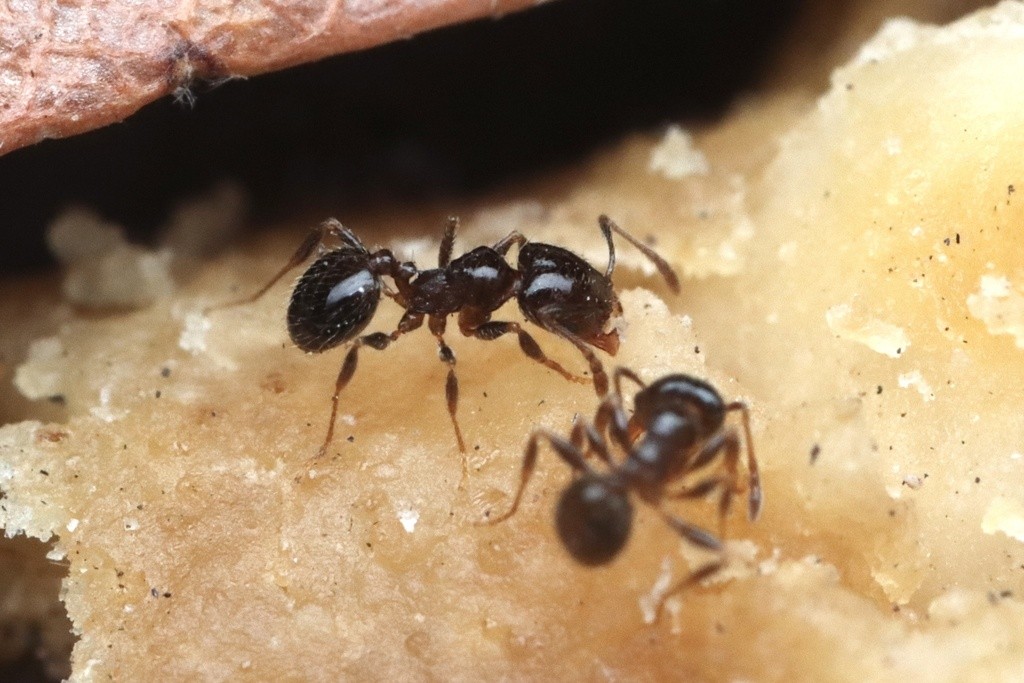
Major workers. The disproportionate head is the whole point of the genus. Head width 1.04 mm, head length 1.14 mm. The back half of the head capsule is smooth and shiny, and the occipital lobes carry no sculpturing. Humerus dentate to subangulate. Propodeal spine moderately long and stout. The postpetiolar node has acute-angular lateral margins from above.
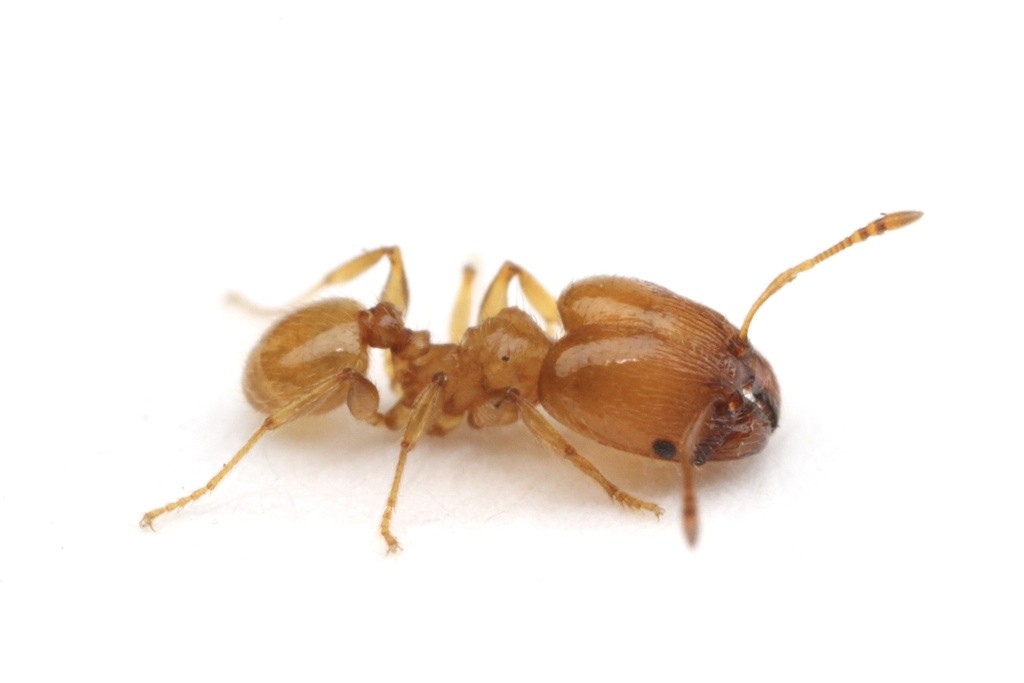
Coloration. This is where the current field guides mislead people. They aren't reliably reddish-brown. Wilson's account has majors running clear yellow in the west, through brownish yellow, to dark brown in the east. Minors go clear yellow to medium brown. Judge locality first and color second.
Queens. Larger, robust mesosoma, wing scars after founding, colored much like the workers.
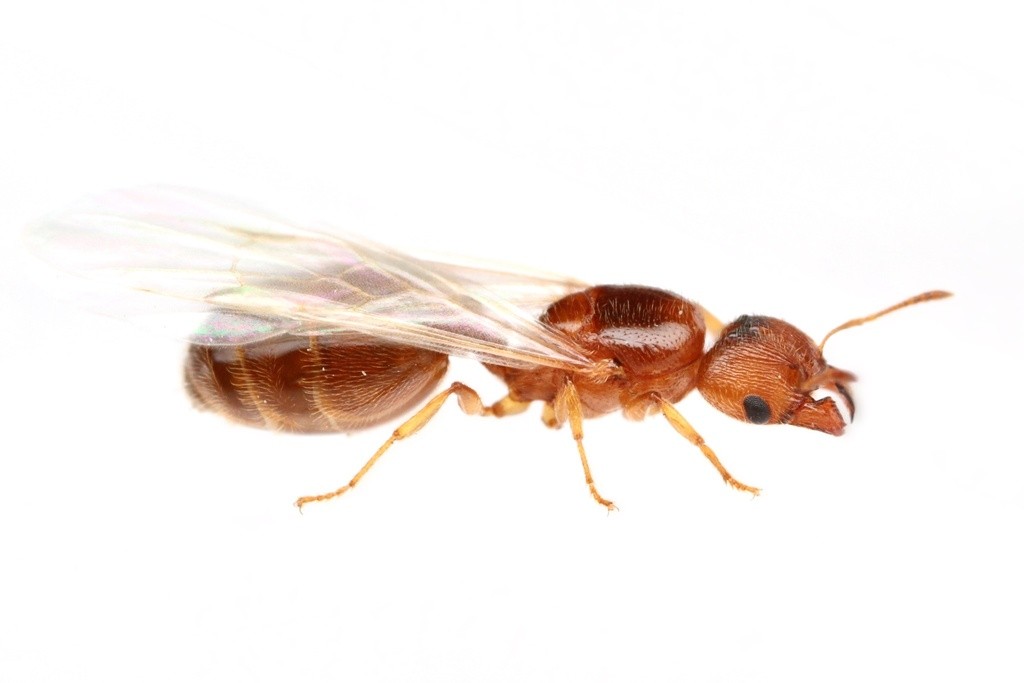
Males. Nobody has described them. Wilson's entire account of the male caste is one sentence noting that males were found in one Colorado nest in early July. No size, no color, no wing description. The photo below is more than the published literature offers.
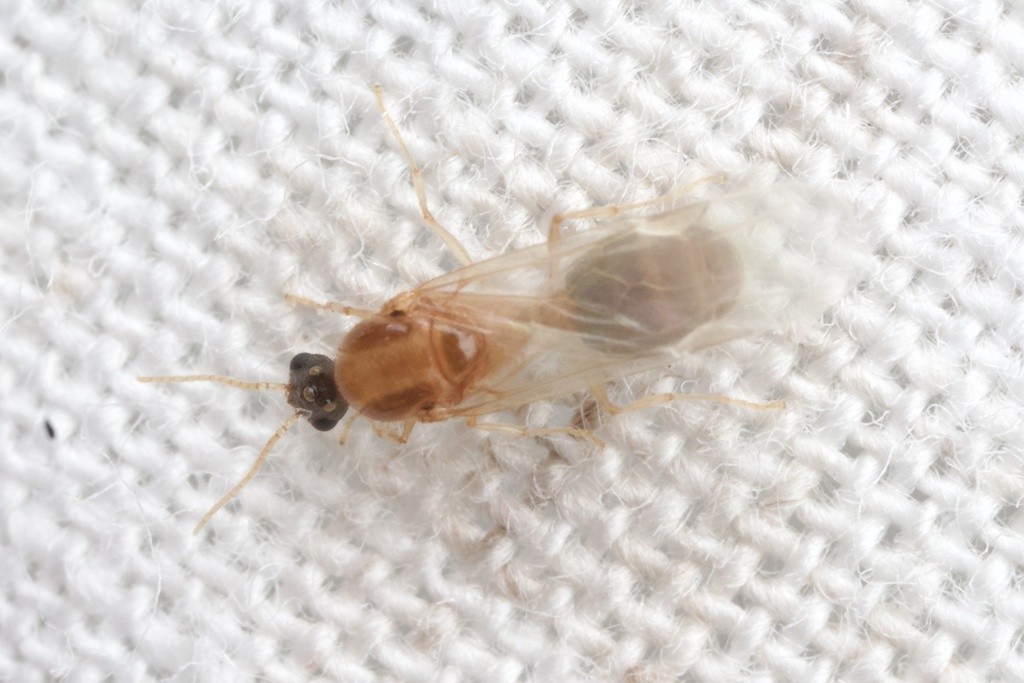
Look-alikes. Two segments in the waist and a 3-segmented antennal club get you to Pheidole. After that:
P. tysoni is often sympatric. The minor's propodeum is unsculptured on the sides in tysoni, sculptured in bicarinata.
P. pilifera is simply much bigger. Major head width 1.60 mm against 1.04 mm, better than half again as large.
P. cerebrosior has a densely punctate vertex on the minor. In bicarinata it's smooth and polished, or finely striolate.
P. marcidula has clavate hairs on the mesosomal dorsum of the minor. Bicarinata has none.
Sculpturing, spine development and color all vary geographically, with intermediates throughout the range. Get a major under magnification, note where it was caught, and accept that some individuals won't key cleanly.
Distribution
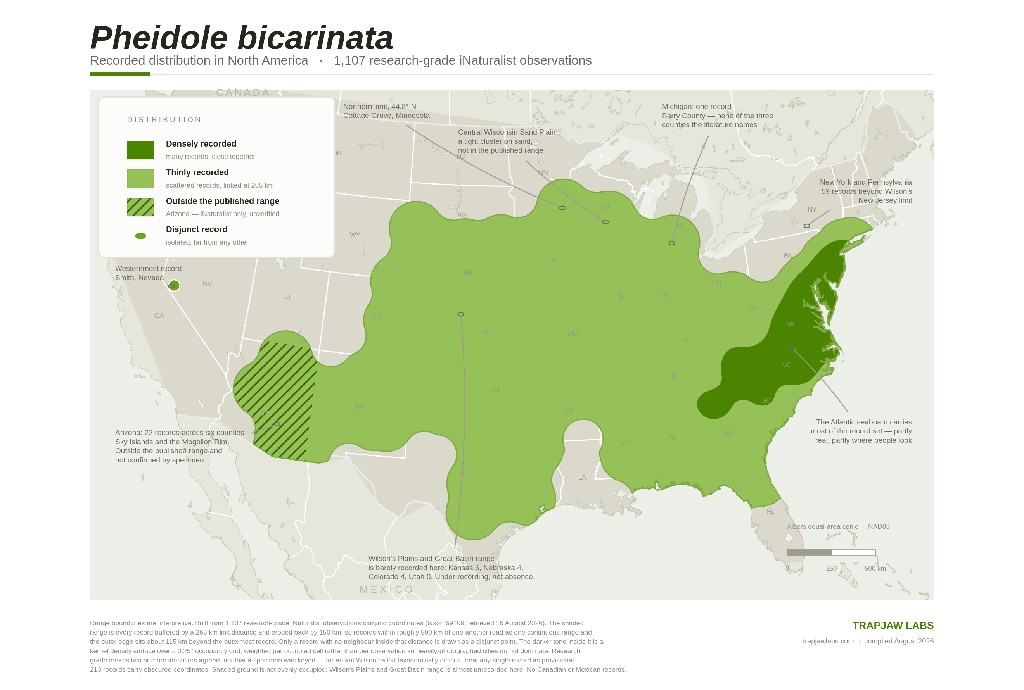
Wilson gives the range as New Jersey to northern Florida, and west through Nebraska, Colorado and Texas to Utah and Nevada, with records running south into Mexico.
The record set tells a different story. We pulled all 1,107 research-grade iNaturalist observations carrying coordinates in August 2026, and the weight of it sits on the Atlantic seaboard: Florida 151, North Carolina 120, Virginia 119, New Jersey 102, Maryland 72. Wilson's western arm is close to empty — Kansas 6, Nebraska 4, Colorado 4, Nevada 1, Utah none. Some of that is real and some of it is that nobody photographs ants in western Kansas. There are no Mexican records at all.
Beyond the published range. New York 33 and Pennsylvania 26, both past the New Jersey limit. Wisconsin 20, in a tight cluster on the Central Wisconsin Sand Plain, which is exactly the habitat you'd predict. And Arizona 22, across six counties in the Sky Islands and along the Mogollon Rim. Treat the Arizona set as provisional — research grade means two identifiers agreed, not that anyone put a specimen under a scope, and this is a hard genus.
The northern edge. The northernmost research-grade record is Cottage Grove, Minnesota, at 44.8°N, short of the 45.9°N figure that circulates. Michigan turns up exactly once, in Barry County, which is none of the three counties the literature reports — Arenac, Berrien and St. Joseph. Canada comes up occasionally, usually as a maybe near Point Pelee, but there's no confirmed specimen and no iNaturalist record either.
On cold tolerance. You'll see them called one of the most cold-tolerant Pheidole in the world all over the hobby, and it may well be true. We can't find a study behind it. No supercooling point, no critical thermal minimum, and Wilson's account doesn't discuss cold at all. What we have is geography, and the Michigan records that get cited are a handful of counties of warm sand dune and sand ridge habitat. AntWiki also reserves its most-northward-reaching-Nearctic-Pheidole line for P. pilifera, a similar-looking relative, so some of this reputation may have been borrowed. Until somebody runs the numbers, treat it as hobby folklore rather than fact.
Habitat
Wilson calls them highly adaptable across their range in both habitat and nest site, and the collection records back it up.
East. Sandy soils with some clay content. Often abundant in open disturbed grassy ground: lawns, golf courses, abandoned fields.
Colorado. 1000 to 2100 m, in rotten logs and under stones, across pinyon-cedar woodland, canyon meadows, shortgrass prairie and sagebrush desert.
Utah and Nevada. Sagebrush desert up into montane woodland.
West Texas. Xeric and opportunistic. Open soil, under stones, under cow dung, in a hay bale, in cracks in asphalt.
The Nest
Nest architecture changes with geography. Western populations build proper open-soil crater nests. Eastern ones build incomplete mounds, described as resembling a wedge or a crescent.
Seed granaries sit underground as part of the nest structure. Everywhere else the nest site is opportunistic: under stones, in rotten logs, under debris, in asphalt cracks. That flexibility is most of why they turn up in so much disturbed ground.
The Soldier Caste
Four larval instars. Caste fate is decided in a narrow window while a larva is roughly 0.9 to 1.3 mm, and this species is where the field worked out how that decision gets made.
Diana Wheeler and Fred Nijhout used P. bicarinata to pin the role of juvenile hormone in caste determination, starting with a 1981 paper in Science. Applying methoprene during that window pushes larvae toward the major caste.
The better finding came next. Existing adult majors actively suppress the production of new majors through contact, raising the hormone threshold a larva has to cross. Cage the majors away from the larvae and the suppression weakens. Remove the majors entirely and the colony overshoots its normal ratio before settling back down. That's a self-regulating caste system, demonstrated in a lawn ant.
Colony Structure
Queen count. Monogynous. There's no polygyne report for this species that we can find, and every source we checked agrees.
Colony size. There's a real gap between the field and the shelf here, and it's worth naming. Wilson describes wild colonies as small, often just a few hundred workers. Heated captive colonies routinely reach a few thousand, and keepers commonly report a few hundred workers inside the first year. Both numbers are correct. One of them just has a heating cable behind it.
Castes. Queen, minor workers, major workers, males.
Major ratio. Lab work put soldier production around 5% of adults. Captive colonies often run higher, into the 8 to 12% range. Colony age and feeding almost certainly account for some of that, but the gap hasn't been resolved.
Behavior
Foraging. Omnivorous scavenger, bold and active, out day and night. Workers tend aphids for honeydew, including Aphis asclepiadis and Thecabius populimonilis. They come to lights, which is how at least one keeper pulled a large number of queens off a flight with a blacklight.
Defense. No sting worth mentioning and a bite most people can barely feel. Majors handle nest defense alongside seed and food processing, which is the more common job.
Escaping. Minors are small enough to exploit gaps you wouldn't think twice about. Fluon is not optional with this species.
Diet
Wilson puts it plainly: omnivorous, and regularly harvesting seeds. That's genuine granivory rather than incidental collection, and stored seeds go into underground granaries.
Everything else is opportunistic. Arthropods and other protein-rich organic material, nectar, honeydew from sap-feeding insects, and carrion, which a Utah scavenging study recorded down to workers feeding on dead rodents.
One caution. There's a specific list of preferred seeds circulating online, naming evening primrose, dandelion, Kentucky bluegrass and a few others. Every version of it traces back to a single vendor page. No ecological seed-preference study exists for this species that we could find. Offer seeds by all means, but don't treat that list as data.
Reproduction
Nuptial flights. Records cluster in June through early August, mostly evening into night. Keeper-submitted records include Chesterton, Indiana on 29 June at 22:00, 75°F and 64% humidity, and Cumberland County, North Carolina on 26 June at 20:00, 90°F. Hot and humid after rain is the pattern keepers describe. The sample is small, so don't plan a whole season around it.
Founding. Fully claustral. The queen seals in and raises the first workers on body reserves alone, with no outside food required.
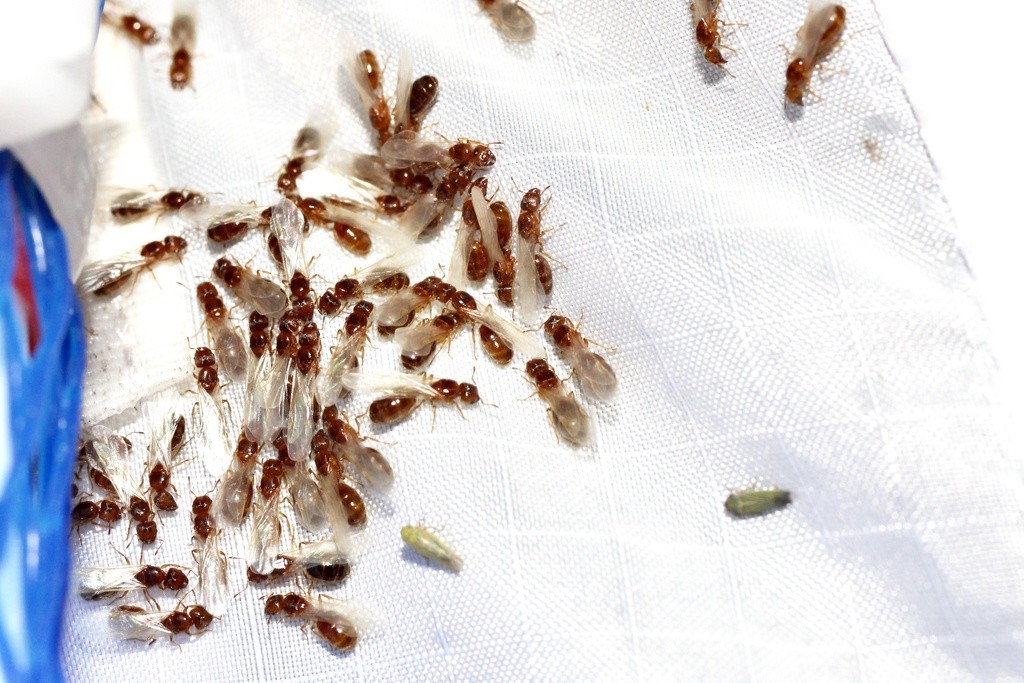
Development. Egg to worker runs roughly four to six weeks with heat.
Diapause
Not required. A colony kept warm will work straight through winter, and there's nothing to gain from engineering a cold period for this species.
A colony sitting in a cool room may slow down on its own, foraging less and stalling out brood development. That's the ants reading their conditions, not a problem to fix. Warm them back up and they pick up where they left off.
Keeping Pheidole bicarinata
They're a beginner species and they deserve the reputation.
Temperature. A 75 to 85°F gradient. Heat is the single biggest lever on growth rate here.
Humidity. Moderate. They're forgiving and good at making do, which is part of why they make a good first colony.
Nest. Substrate or hydrostone both work. A clear nest with thin chambers shows off the caste contrast, which is the reason to keep them in the first place. 3/8" entrance.
Water. A liquid feeder with water in the foraging area at all times. Distilled, purified or spring.
Protein. The main driver of growth. Two to three times a week, and more is better. We feed our own colonies pre-killed D. melanogaster and D. hydei, plus pre-killed and cut mealworms.
Carbohydrates. A minor part of the diet. A small drop of honey now and then, or a liquid feeder with sugar water.
Seeds. Optional. Once a week if you offer them at all, and small enough for the minors to handle.
One thing worth setting expectations on. You will not see majors for a while. The first workers out of a founding chamber are all minors, and majors don't start appearing until the colony has some size behind it. That's normal. Wait for them.
Founding is the one stage where people lose queens, and it's almost always a hydration problem rather than a food problem. A claustral queen can't go and get water. This is one of the reasons we use the TJL Test Tube Sponges during founding. They're PVA rather than cotton, so they hold their water without breaking down or molding on their own.
Full care guide here: Pheidole bicarinata care guide.