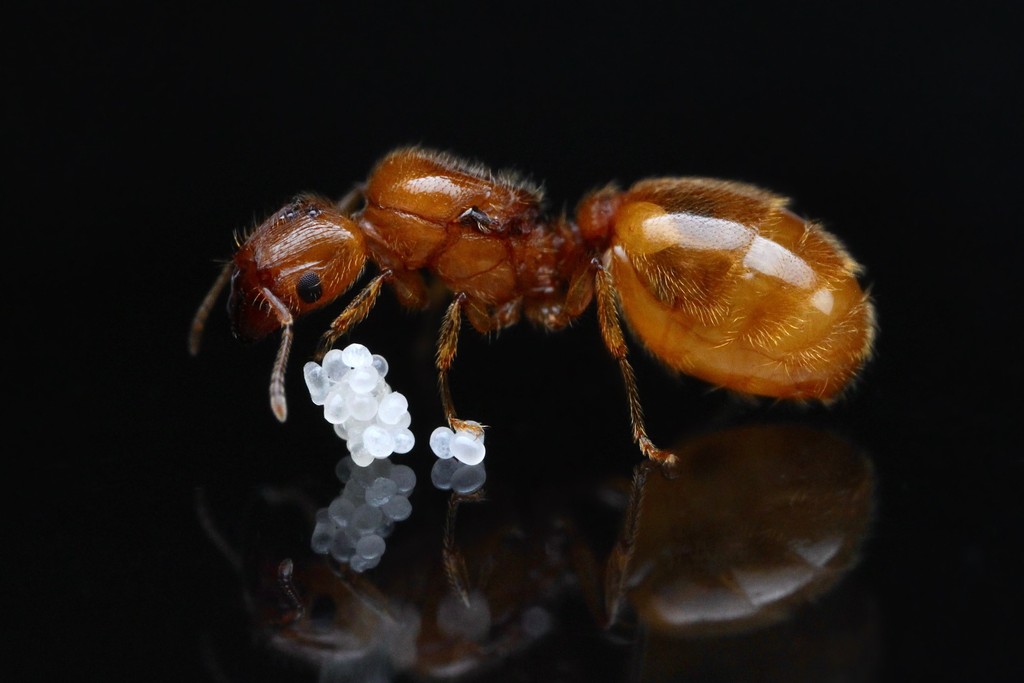
How long a founding queen takes to produce her first workers, which queens need feeding, and what's actually worth worrying about.
You have a queen in a test tube and are wondering if things are going well. Founding is the longest stretch of doing nothing in the hobby.
The Short Answer
Two to twelve weeks for founding, and how long is almost entirely a species question.
Weeks to first workers
Nearly all Pheidole. Dorymyrmex, Forelius pruinosus, Monomorium, Liometopum occidentale, Solenopsis.
Aphaenogaster, Crematogaster minutissima, Dorymyrmex grandulus, Temnothorax pergandei, Tetramorium immigrans, both Pseudomyrmex.
Southeastern Camponotus: americanus, decipiens, discolor, floridanus, snellingi, subbarbatus, castaneus. All six Pogonomyrmex, both Novomessor, both Veromessor, both Formica, Colobopsis impressa, Nylanderia flavipes, Odontomachus brunneus, Tapinoma sessile.
The fungus growers. Acromyrmex versicolor, Atta texana, Trachymyrmex septentrionalis.
Crematogaster missouriensis, Lasius americanus.
The bigger Camponotus: chromaiodes, fragilis, novaeboracensis, pennsylvanicus, sansabeanus, modoc. Crematogaster cerasi, the rest of Lasius, all three Myrmecocystus.
Camponotus ocreatus and semitestaceus at 8 to 10. Camponotus vicinus, the slowest thing we sell, at 8 to 12.
All measured from a settled queen at the right temperature.
Look up your species before you start counting. A Pheidole keeper at week five has a real problem. A Camponotus vicinus keeper at week five is right on schedule. Cold slows all of it down, and 68F when she wants 80F can double these numbers.
Claustral or Semi-Claustral
Find out whether your queen is supposed to be fed.
Fully claustralFeed nothing
Raises the first generation on stored body reserves. Do not feed until nanitics arrive.
Semi-claustralMust be fed
Needs to be fed during founding.
The ten we keep
Pogonomyrmex californicusP. maricopaP. occidentalisVeromessor andreiV. pergandeiAcromyrmex versicolorTrachymyrmex septentrionalisPseudomyrmex gracilisP. pallidusOdontomachus brunneus
V. pergandei is the one that gets missed.
When To Act
NormalKeep waiting
No eggs in the first week.
There is mold in the tube.
Pulling at the cotton.
Stands in one spot.
Act on these four
The tube has flooded and the queen is standing in water.
The tube has run dry.
Eggs appear to never mature into larvae or pupae.
No eggs after 2 weeks.
That's the list. For the first two, get in touch with us rather than attempting your first tube swap at eleven at night. Otherwise, stop looking. Once or twice a week, briefly.
When Founding Is Over
Founding ends when the nanitics arrive. They eclose pale, darken over several days, and they're smaller than later workers.
There's no way to speed founding up that doesn't also risk it. Correct temperature and being left alone are the whole intervention. Our Care Advisor walks through both, species by species. A founding tube has to hold water for two to twelve weeks unopened. That's where the TJL Test Tube Sponges earn their keep. They held 92.6 to 96.7% humidity across a 53 day test, and won't mold like cotton.