What Do Harvester Ants Eat?
What to feed harvester ants across Pogonomyrmex, Veromessor, Novomessor, Pheidole, Solenopsis and Tetramorium, how much, and how often.
Harvester ants are the seed-eaters of the hobby, and feeding them works differently than anything else you'll keep. If you're coming to Pogonomyrmex from Camponotus, most of what you know still applies.
'Harvester' is a feeding habit, though, not a group of related ants. Roughly 18 ant genera harvest seed worldwide. Six of them are on our Care Advisor, and they don't all eat the same way.
The Six Genera
Know which one you have before you plan a feeding schedule.
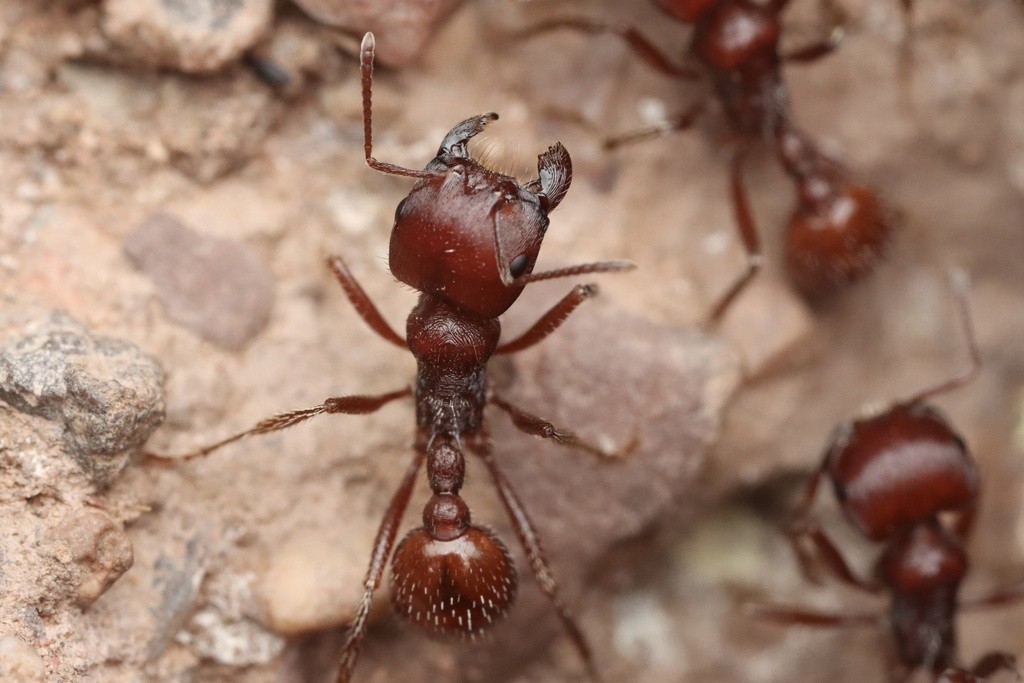
Pogonomyrmex is the classic harvester, and most of this article is built around it. We keep six: badius, barbatus, californicus, maricopa, occidentalis, and rugosus.
Veromessor (we keep andrei and pergandei) feeds close to Pogonomyrmex on a little less insect protein. Founding is where they differ, and it matters.
Novomessor (we keep albisetosus and cockerelli) carries the harvester name and barely earns it. Both will harvest seed, but it's a relatively minor part of the diet. These are omnivorous scavengers first.
Pheidole is the surprise for most keepers. Seventeen of the Pheidole on our Care Advisor take seed, and ten of those are true granivores with seed as the main component of the diet.
Solenopsis (we keep geminata and xyloni) earns its place here on geminata alone. S. geminata was one of the primary granivores across the southeastern US, and a colony will build expansive seed stores if you let it. S. xyloni stores seed too but doesn't need it. Both prefer small seed, and for both, protein is the bigger driver at 2 to 3 times a week.
Tetramorium immigrans takes small seed when it turns up and does fine when it doesn't. Sugar is what it actually wants, a feeder out around the clock, which is the opposite of how Pogonomyrmex and Veromessor run.
Seeds
Seeds are the foundation of a Pogonomyrmex, Veromessor, or granivorous Pheidole diet, and for most of the year they're close to all of it.
Workers haul seed home and pack it into dry storage chambers called granaries. To eat one, a worker strips the husk and chews the endosperm into a paste, sometimes called 'ant bread'. You'll see all three stages in a formicarium: seed going in, a heap of chaff in the foraging area, larvae consuming the processed seed.
Size Is The Whole Game
Your colony can only eat the seeds its workers are physically able to open.
This is the number one reason a new keeper decides their harvesters "won't eat seeds." Tschinkel's excavations of Florida harvester ant (Pogonomyrmex badius) nests found workers can't crack seed wider than about 1 to 1.4 mm. Foragers still bring home a full range of sizes, so the big ones pile up untouched until they make up 70% or more of the granary by weight.
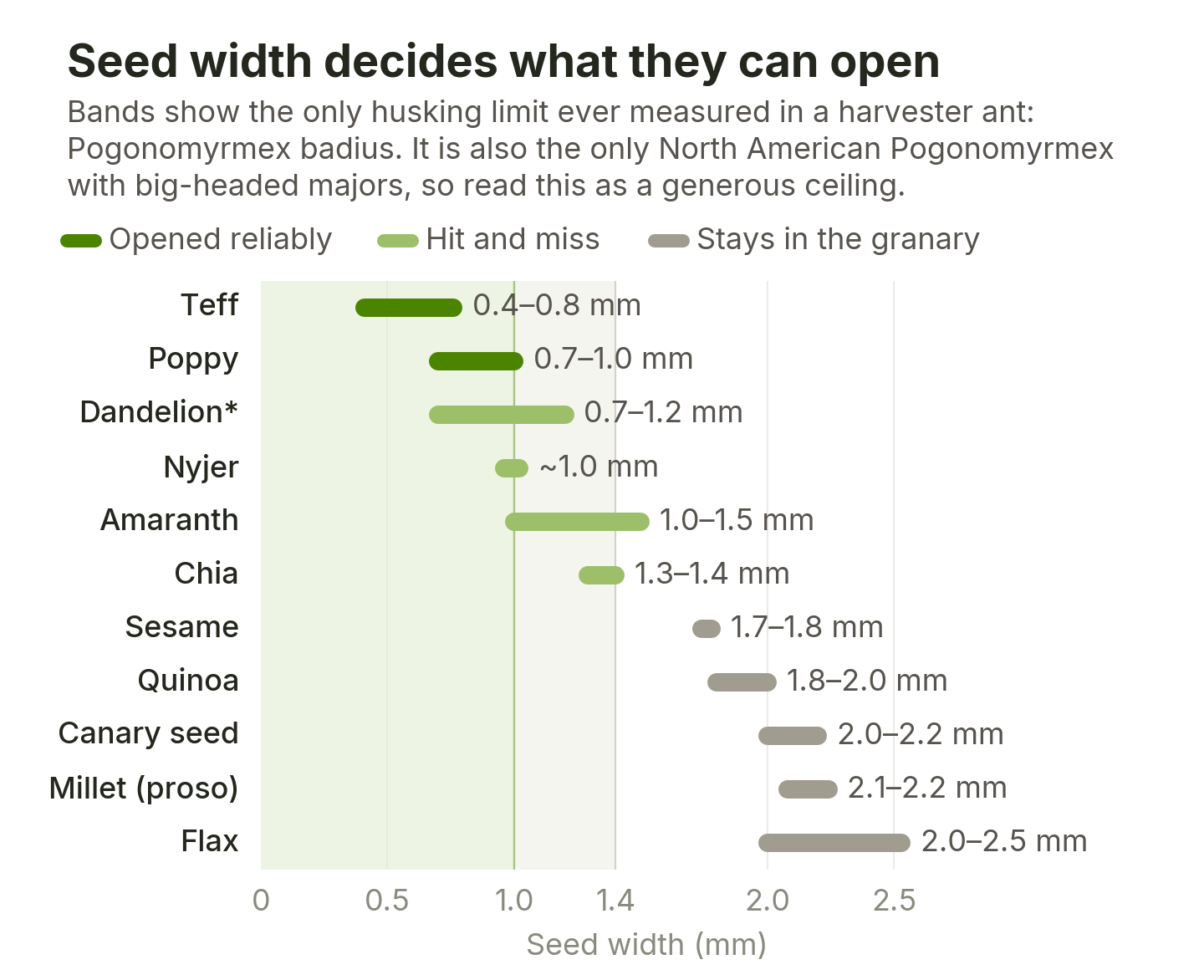
Pogonomyrmex majors open small and medium seed faster but don't extend the range, and most Pogonomyrmex you'll keep don't have majors at all. Pheidole majors are usually food-processing specialists.
Preference varies by colony.
Buy Untreated Seed
Anything you feed needs to be untreated and pesticide-free.
Lawn and garden seed is routinely coated with fungicide. Birdseed is often treated. It's not worth risking a colony over. Organic culinary seed works fine, as does a blend sold for ants. Store what you buy in a cool, dry place or in the freezer.
How Often To Feed Seed
Once a week covers most of what you'll keep, and most of the exceptions are Pheidole.
Protein
Offer protein to any colony with brood, and remove whatever they don't eat.
Pogonomyrmex aren't strict granivores. They scavenge dead arthropods in the wild, and take the most when there's brood to feed. We suggest pre-killed feeder insects 2 to 3 times a week for Pogonomyrmex and for the granivorous Pheidole, scaling the amount with brood development. P. badius in particular wants a lot of it. Veromessor runs lighter, at 1 to 2 times a week.
Novomessor is the outlier, and it isn't close. Protein is a major component of the diet for both albisetosus and cockerelli, 2 to 3 times a week and the more the better. They also lack the social stomachs most ants possess, so instead of passing a meal around by trophallaxis they dismantle the prey item and carry pieces back themselves.
Mealworms, small crickets, roach nymphs, and fruit flies all work. Freeze them first, to pre-kill them and knock down any mites.
Sugar And Water
Pheidole and Novomessor sometimes want a sugar feeder in the outworld 24/7, depending on the species. Pogonomyrmex and Veromessor don't.
Set a feeder out for Camponotus and it gets mobbed. Set one out for Pogonomyrmex and it may sit untouched for a week. Much of their carbohydrate comes from the seed itself. Offer it anyway, a few drops of 1:3 sugar water every few days, and don't read anything into it going ignored. Thin slices of organic fruit with sugar work too, and most of our Pogonomyrmex and Veromessor guides recommend it. Pull it before it molds.
This one catches people. Pogonomyrmex and Veromessor come from arid country, so keepers conclude they should be kept dry. The nest, somewhat. The colony still needs constant drinking water, and in a formicarium there's no dew or deep soil to pull from. Keep a hydrated test tube or liquid feeder in the foraging area, well away from the seed.
Founding Queens
Check your species before you do anything, because founding strategy isn't uniform inside a genus, let alone across six of them.
P. badius, P. barbatus, and P. rugosus are claustral. They raise the first brood on stored nutrients and metabolized wing muscle, and need nothing from you.
P. californicus and P. maricopa are usually semi-claustral. Those queens forage to supplement that first brood, and a semi-claustral queen sealed in a bare tube is one you're likely to lose. P. californicus is frequently pleometrotic too. Several queens found together and may or may not stay multi-queen.
P. occidentalis varies from semi-claustral to claustral across populations. Treat it as semi-claustral, and don't read anything into the food going untouched.
Both Veromessor are semi-claustral. Give them a few seeds during founding. This one gets missed constantly.
Novomessor queens are claustral but will still accept food while founding. Granivorous Pheidole are claustral and need nothing from outside the chamber for the first generation.
Solenopsis geminata, S. xyloni and Tetramorium immigrans are claustral too, and all three are usually pleometrotic. Several queens can start a nest together, and once the workers arrive they fight until one is left.
For any semi-claustral queen: a few small seeds, a drop of sugar water, and a small insect once larvae appear.
Novomessor albisetosus, N. cockerelli (will still take food if offered)
Granivorous Pheidole
Solenopsis geminata, S. xyloni, Tetramorium immigrans (usually pleometrotic)
P. occidentalis (varies by population, treat as semi-claustral)
Veromessor andrei, V. pergandei (a few seeds in the founding tube)
What Not To Feed
Conclusion
Small untreated seed on a schedule that matches the species, water always, insect protein 2 to 3 times a week for most of them, a little sugar, and clean up whatever they don't eat. Novomessor wants far more insect and far less seed than the name suggests, and the Veromessor queens want seed in the founding tube.
If you'd like species-specific guidance for whatever you're keeping, our Care Advisor will walk you through it. Our Premium Seed Mix is blended for the size range described above, pesticide-free and heat-treated so your granary doesn't sprout on you.