Army Ants: They're Found in the United States!
When most people think of army ants, they picture the giant swarms of Eciton burchellii in Central and South American rainforests, or Africa's "driver ants," whose colonies can number in the millions. Neither reaches the US, but we do have army ants of our own. Here's which ones live here, how they live, and where you might run into them.
What Is An Army Ant
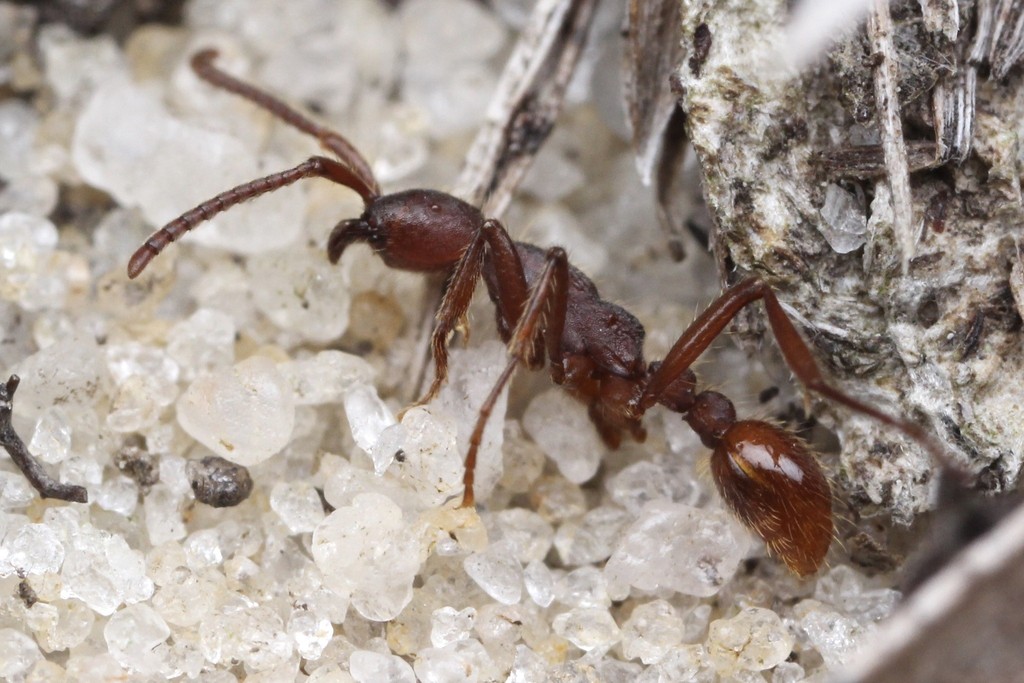
Scientists define army ants by three traits: they hunt in groups, move constantly and have ergatoid (wingless) queens.
Most ants find food one forager at a time, but army ant workers raid together in large groups and overwhelm their prey as a team. Rather than a permanent nest, a colony settles into a temporary camp, called a "bivouac," and moves on when it needs to. The queens never have wings, so colonies multiply by splitting in two.
Which Army Ants Live In The US
Three genera of army ants reach the US, and one of them makes up most of the sightings.
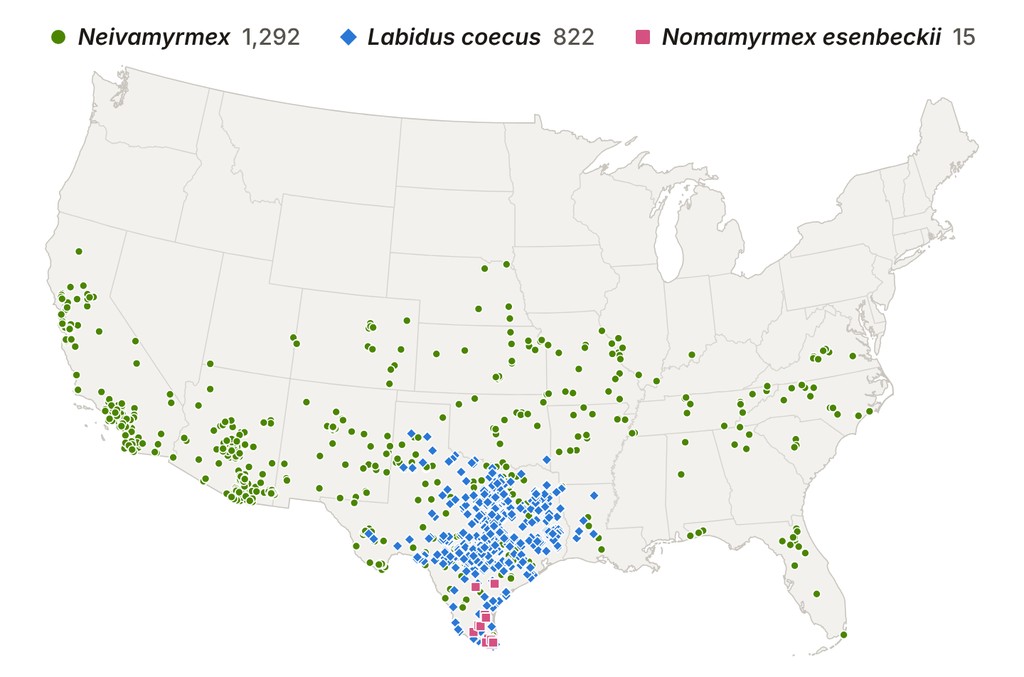
Neivamyrmex spp., which iNaturalist calls "legionary ants," are only ones most Americans will see. Neivamyrmex is the largest army ant genus, with well over 100 species, and the only one that is found in temperate North America. More than two dozen species live in the US, they can be found in the Southern half of the country, from California to the Carolinas and as far north as Nebraska. The workers are usually reddish brown to orange, and most are only a few millimeters long. Their eyes are reduced to a tiny dot, or missing entirely, so they get around by smell and touch.
Labidus coecus lives in Texas, Louisiana, Oklahoma and Arkansas, and its range runs all the way south to Argentina. It spends almost all of its time underground, and unlike most army ants, it isn't picky. It preys on other ants' brood but also scavenges.
Nomamyrmex esenbeckii is the rarest of the three here, with only a handful of US sightings, all in South Texas. It appears to specialize in raiding colonies of Atta, the leafcutter genus that includes Atta texana. In Panama, researchers found it was the only known predator able to kill a mature leafcutter colony.
How They Hunt
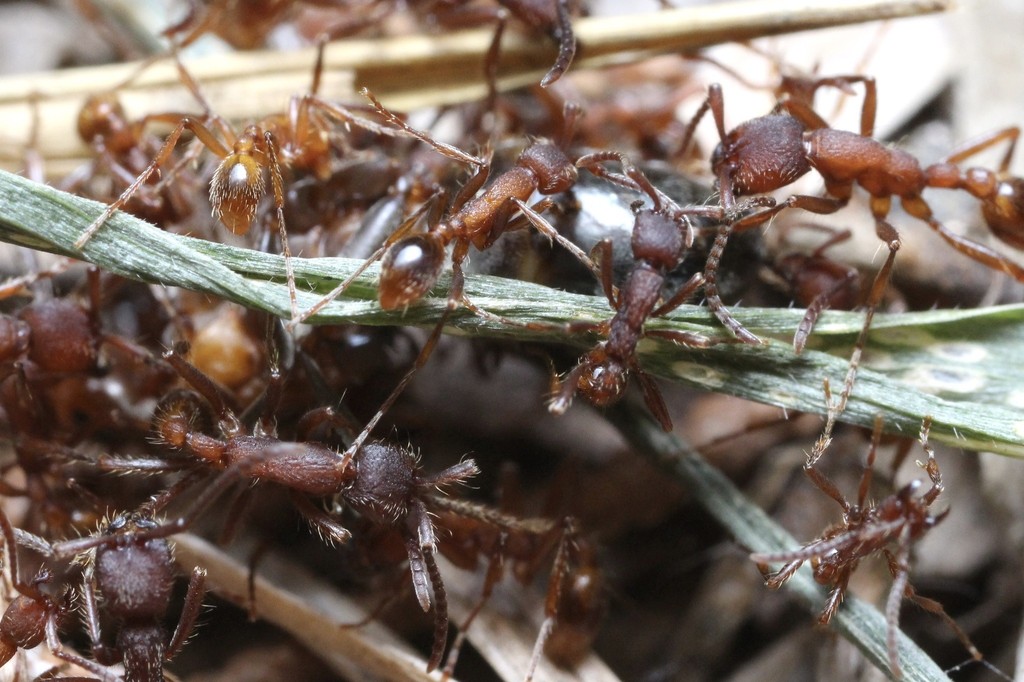
Most US army ants hunt other ants, raiding their nests and carrying off the brood.
Neivamyrmex spp. do most of their raiding at night, which is partly why so few people notice them. The workers pour into another colony's nest and kidnap their larvae and pupae. In a study of N. nigrescens in the desert grasslands of Arizona and New Mexico, the colonies ate nothing but ants and termites. Pheidole spp. were their main target. By late summer, when Pheidole was harder to come by, the army ants switched to raiding Novomessor cockerelli.
How They Move
Many army ants alternate between a few weeks on the move and a few weeks staying put.
This cycle is best known in N. nigrescens. In the "nomadic" phase, the colony is full of hungry larvae. It raids heavily and moves to a new bivouac almost every night, usually in a natural cavity or in a nest it just raided. Once the larvae pupate, the colony enters the "statary" phase. It stays put, raids less, and the queen lays a huge batch of eggs. When those eggs hatch and the pupae become new workers, the colony hits the road again. Each phase usually lasts around two to three weeks.
Queens And Males
The queens are built for laying eggs, and their gaster swells enormously during the statary phase. Most Doryline colonies have one queen, but Neivamyrmex carolinensis can have multiple.
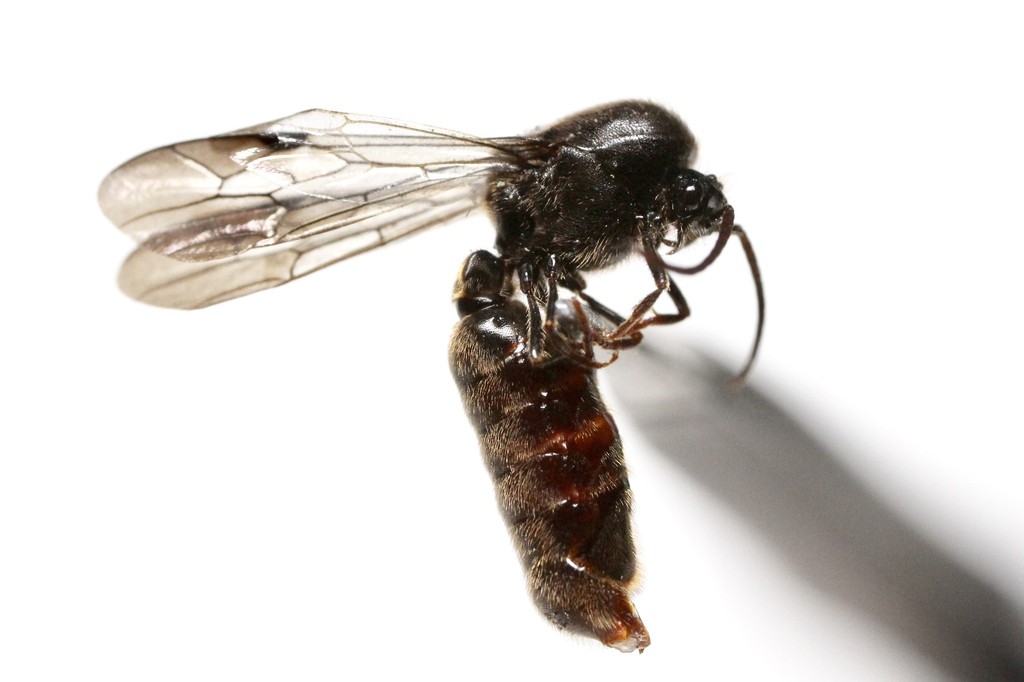
Males, however, do have wings. They leave home to mate with a queen from another colony, and they're much bigger than the workers, with thick, hairy, wasp-like bodies. They're drawn to lights, so a male at a porch light is often the first army ant someone notices. On iNaturalist, most Neivamyrmex males were photographed in June, July and August, while most Labidus coecus males turned up in March and April.
Are Army Ants Dangerous?
Not really, though the workers can sting.
They're small, they mostly stay underground or out at night, and they're after other insects, not you. If a colony ends up inside a house, it'll typically leave on its own once it starts moving again, so there's usually no need to be alarmed.
Can You Keep Army Ants?
It's been done, but it's a lot harder than keeping other ants.
Since army ant queens can't fly, you can't catch one after a nuptial flight the way you would with most species. You'd have to find a colony and collect the queen with a big chunk of the workers. They also need a constant supply of live insects, especially other ants' brood, to keep their larvae growing. A 2009 review of army ant biology even noted that colonies can't be kept in the lab for long periods.
Some Ant-Keepers have pulled it off, briefly. In 2020, one keeper on Formiculture collected an N. nigrescens queen with several hundred workers from under an old stump and kept the colony long enough to raise a new batch of workers on roaches, termites, crickets and plenty of ant brood, before releasing it.
If you've found army ants and aren't sure what you've got, get in touch and send us a photo. We're happy to help you figure it out.