Do Ants Sleep? Yes, Just Not The Way We Do
Yes, ants sleep. They just don't do it in one long stretch the way we do. Instead, they take a lot of short naps spread across the day and night.
Much of what we know comes from one careful study of Solenopsis invicta.
What Sleep Looks Like In An Ant
A sleeping ant goes still, folds up and stops paying attention to its nestmates.
In 2009, researchers at the University of South Florida filmed a small lab colony of S. invicta, with three queens, 30 workers and 30 large larvae, around the clock for almost five days. They told two levels of sleep apart. In light sleep, an ant's antennae stayed partly raised and it still reacted fairly easily. In deep sleep, the antennae folded down, the body settled into a different posture and the ant stopped responding when its nestmates touched it.
During deep sleep, the queens' folded antennae sometimes quivered rapidly. The researchers called it "rapid antennal movement" and suggested it might be comparable to REM sleep, the stage of sleep most linked to dreaming. Whether ants experience anything like a dream is anyone's guess, though.
How Much Ants Sleep
S. invicta workers get about 4.8 hours of sleep a day, in tiny pieces.
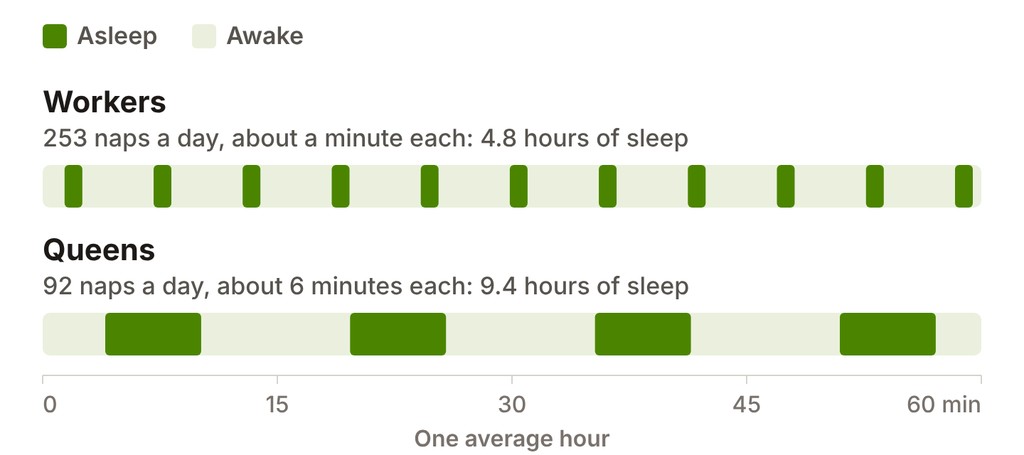
The workers in the study took about 253 naps a day, each lasting a little over a minute on average. That adds up to roughly a fifth of the day spent asleep. At any given moment, about 80% of the workers were awake and busy grooming, feeding or digging.
The queens slept a lot more. They took about 92 naps a day, averaging around 6 minutes each, for about 9.4 hours in total. That's close to twice as long spent sleeping as the workers!
Where a worker slept made a difference, too. About half of the sleeping workers lay on the nest floor, and their "naps" averaged only about half a minute. Workers hanging from the ceiling "slept" for closer to a minute and a half, and the ones tucked against the walls "slept" for nearly two minutes. It's probably no coincidence that the floor was where most of the grooming and feeding happened.
Why Queens Sleep More
One explanation is that a colony can afford to wear out their workers, but not their queen.
The researchers explained the extra sleep with what's called the "parental exploitation" hypothesis. Workers are short-lived and replaceable, so the colony runs them hard, and their constant activity keeps the queen and brood safe. In that view, with most of the workers awake at any moment, there's always someone on guard and someone tending the brood, so the queen can rest.
They also pointed out that S. invicta queens can live for about six years, while workers live anywhere from a month to a year. Fruit fly research has linked less sleep to shorter lives, but this study didn't test whether sleep has anything to do with how long ants live.
Do Ants Sleep At Night?
Some species keep a daily schedule, but inside the nest a lot of ants work around the clock.
In this study, the lights went on and off on a day-night schedule, and it didn't change how long the ants stayed active. Naps were about the same length at every time of day, though more workers were asleep at night than in the morning.
A 2017 study of the South American Camponotus rufipes found something similar with that species' nurses. Inside the colony, the nurse workers were active around the clock in short bouts, with no daily rhythm at all. When isolated, the same nurses settled into a nighttime schedule. The foragers, however, shifted their hours to match whenever food was available.
Out in the wild, plenty of species do have a preferred time of day. Pogonomyrmex barbatus is strictly day-active and seals up its nest at night, while Camponotus floridanus does most of its foraging after dark.
What This Means For Your Colony
An ant standing still in your nest is usually just resting.
You'll often see workers parked motionless with their antennae folded or the queen sitting still for minutes at a time. That's normal. In the S. invicta study, a queen's typical nap ran about six minutes, and the workers dozed off hundreds of times a day.
You also don't need to turn the lights off for them to rest. In both studies, the ants' activity didn't simply follow the lights, which fits what we've seen keeping established colonies in the light around the clock. Keep Your Ants Illuminated explains further.
Sleep isn't the same as diapause, either. A colony in diapause slows down for weeks or months over the winter, and a chilled colony can look dead for a while after it warms back up. How To Diapause Your Ants covers that topic.
If you can't tell whether an ant is asleep or dead, give it a few minutes and watch its nestmates. A sleeping ant will usually be up and moving again soon, and workers tend to carry dead nestmates out to the colony's trash pile. If you're still unsure, get in touch. We're happy to help you figure out what's going on.