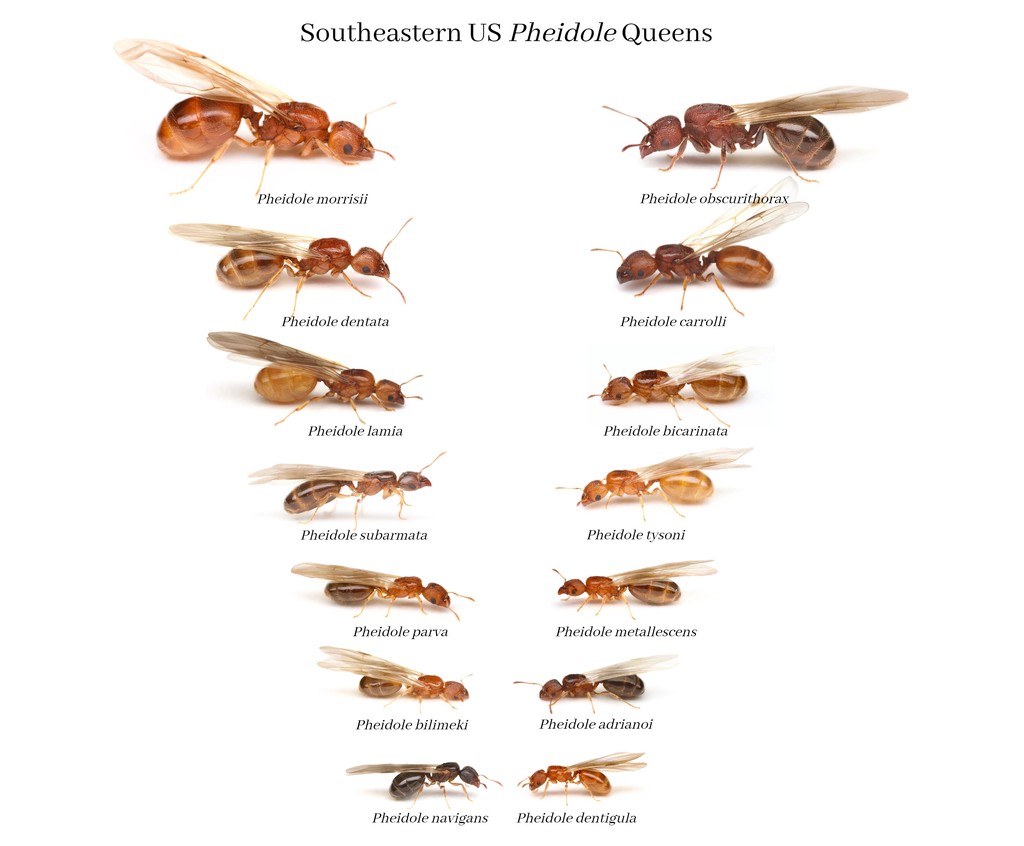
How to Identify Pheidole Queens in the Southeastern US
Pheidole is one of the largest and most diverse ant genera in North America. While workers can often be difficult or impossible to identify without examining majors, queens have distinctive body proportions, coloration, and overall size that make many species recognizable visually.
This guide focuses on the southeastern United States and includes species that ant-keeping hobbyists are most likely to encounter there.
Before You Start
Queen-level taxonomy in this genus is rough, to say the least.
Only P. obscurithorax has a modern diagnostic queen description. A few of the others were described a century ago by Forel, Mayr or M. R. Smith, in notes far too brief to key from. Everything else rests on size, color, proportion and locality. That gets you to one or two candidates. It rarely finishes the job. For a confident ID, rear the colony until majors appear and work from those.
Flight seasons are another gap. I've given them where there's a published record, and for most of these species there isn't one.
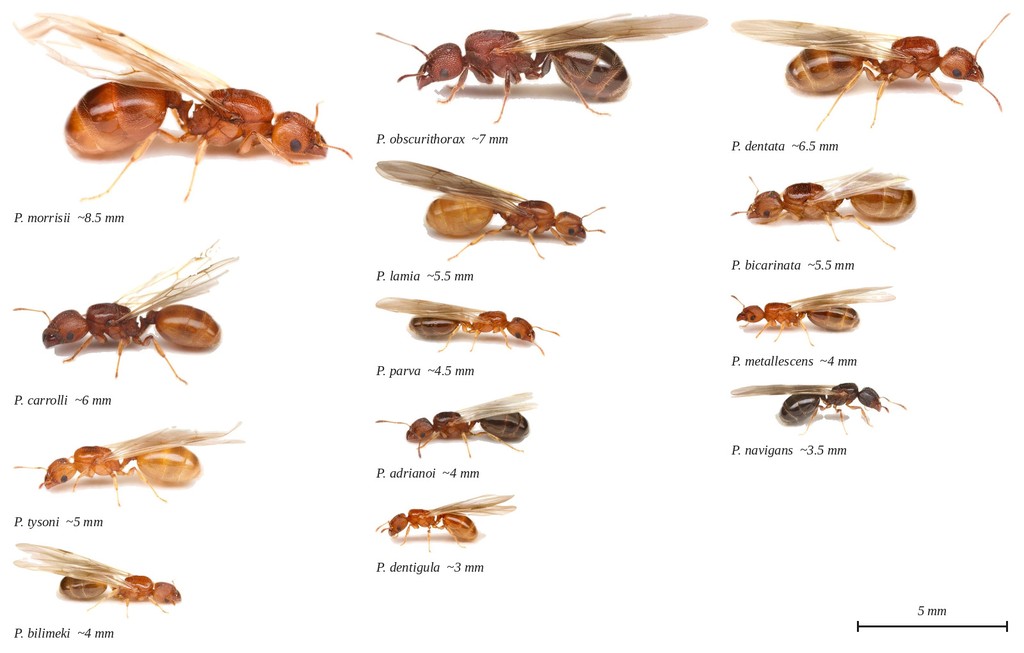
Start With Size
Size is the first thing I often check, and one of the few characteristics you can confidently judge with nothing but your eyes.
A Quick Working Key
Here's how to work through a queen you don't quickly recognize:
Large, 7 mm and up. Bright orange-red and glossy is P. morrisii. Dark, dull, with a net-sculptured head is P. obscurithorax.
Medium, 4.5–6.5 mm. Evenly reddish-brown is P. dentata and pale golden-yellow is P. lamia. A dark front half against a bright orange gaster is P. carrolli. Uniform yellow-orange is P. tysoni. Reddish-brown with an amber gaster and big forward-set eyes is P. bicarinata. Reddish with a near-black gaster is P. parva. Confirm that one.
Small, under 4.5 mm. This is where it gets hard. Clean orange is P. dentigula, reddish-brown with a dark gaster is P. metallescens, plain brown is P. bilimeki, uniformly dark brown is P. adrianoi, and the darkest of the lot is P. navigans.
Then check locality, because several of these barely overlap. P. carrolli is known from three northern Florida counties, P. adrianoi from central and northern Florida, and P. obscurithorax from a coastal strip between Mobile and Tallahassee. A catch well outside those is probably something else.
Color
Color is the next thing I look at.
Judge the mesosoma. The gaster is partly translucent and its shade tracks her last meal.
A callow queen runs a shade or two light. Give her a few days.
Warm indoor light pushes browns toward orange. That one has caught me out. Use daylight, or a neutral LED.
P. dentata and P. bicarinata also shift across their ranges. A pale western P. bicarinata and a dark eastern one barely look related.
One thing that does help is that queens and their workers run broadly similar in color. Where no queen description exists, the worker descriptions are a reasonable stand-in.
Species Accounts
Large · 7 mm and up
Pheidole morrisii — Forel, 1886
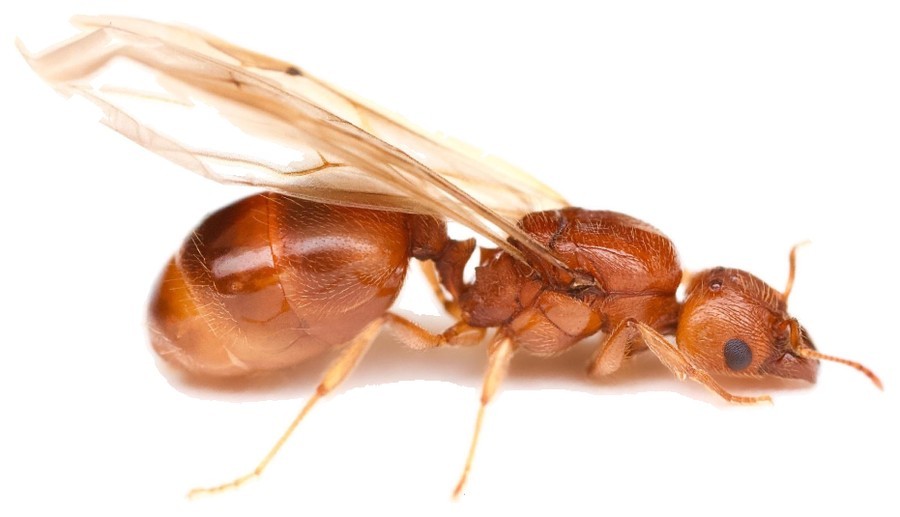
~8.5 mm · Native
Big and unmistakably orange-red, with a glossy amber gaster. Hairy, too. Many of the hairs are longer than her eye. Put her under 10× and look along the gaster. Her head is smooth, and that's what separates her from P. obscurithorax, the only other queen in her weight class.
A sand specialist that builds crater mounds in wet sandy soil or tucks in at the base of a grass clump. Widespread across the Southeast, down to south Florida and west to Texas. Founding is claustral, down a shaft she plugs behind her, with the first majors arriving around day 50. Alates sit in nests from May in Florida and July further north.
TrapJaw Labs stocks this species as a live colony — see it in the shop.
Pheidole obscurithorax — Naves, 1985
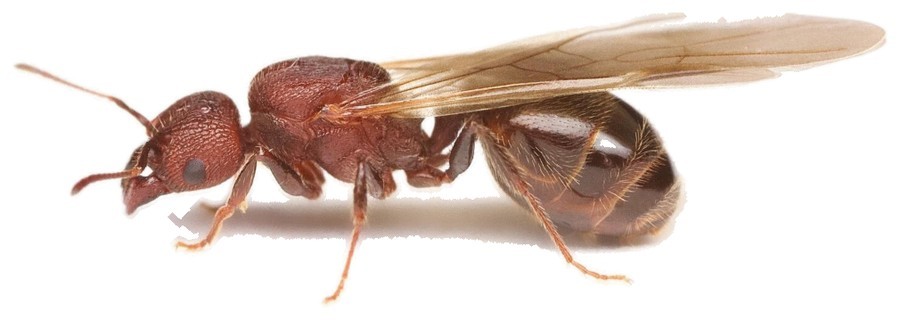
~7 mm · Introduced
Dark reddish-brown, and dull where P. morrisii is glossy. The head carries a coarse net of ridges. Nothing else this size in the Southeast does.
She's also the only queen in this guide anyone has properly described. MacGown published the measurements in 2015: head 1.36–1.42 mm long, 1.58–1.64 wide, mesosoma 2.53–2.55, forewing 7.40–7.80.
Introduced from northern Argentina and first found at Mobile in the 1950s. She now holds a coastal strip from there to Tallahassee. Colonies stay relatively small, a few thousand workers, but they get there fast. Most reach full size inside the first year. Small doesn't mean timid. They'll hold their ground against fire ants.
Medium · 4.5–6.5 mm
Pheidole dentata — Mayr, 1886
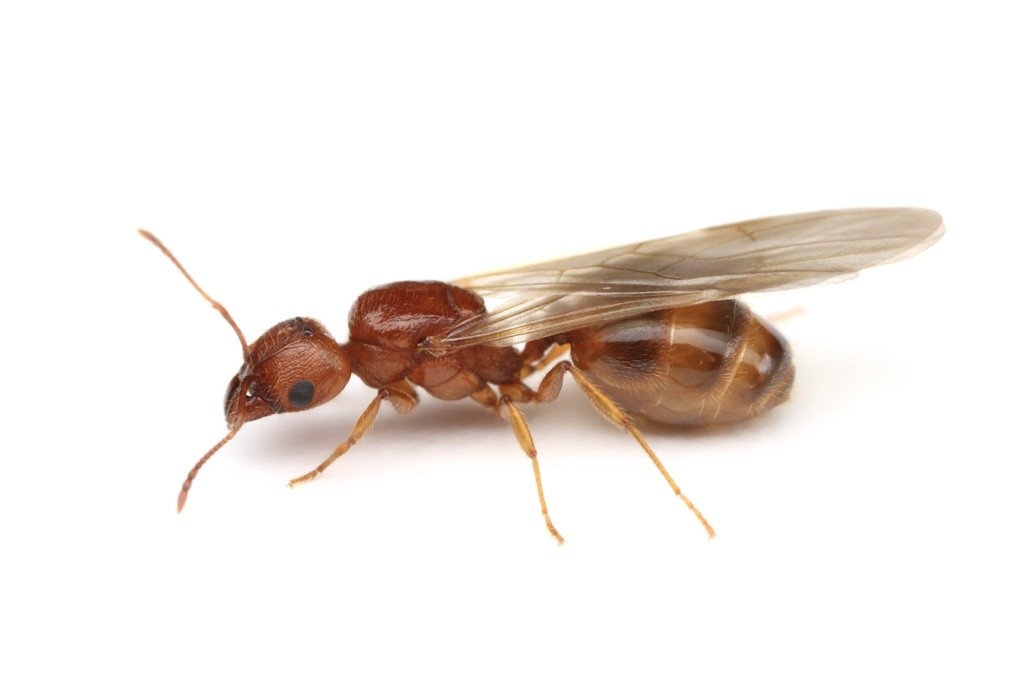
~6.5 mm · Native
Reddish-brown, smooth, glossy. No heavy sculpture anywhere. This is the one you'll catch most often.
She varies, though. Open-ground forms run light, forest forms dark, and the two differ in colony size and queen number. Most people now treat P. dentata as several sibling species wearing one name.
Maryland to the Keys, west to Kansas and Texas. Rotting logs and stumps by preference, though she'll take a crack in a sidewalk. Wilson kept lab colonies going for decades on the strength of how forgiving she is.
TrapJaw Labs stocks this species as a live colony — see it in the shop.
Pheidole carrolli — Naves, 1985
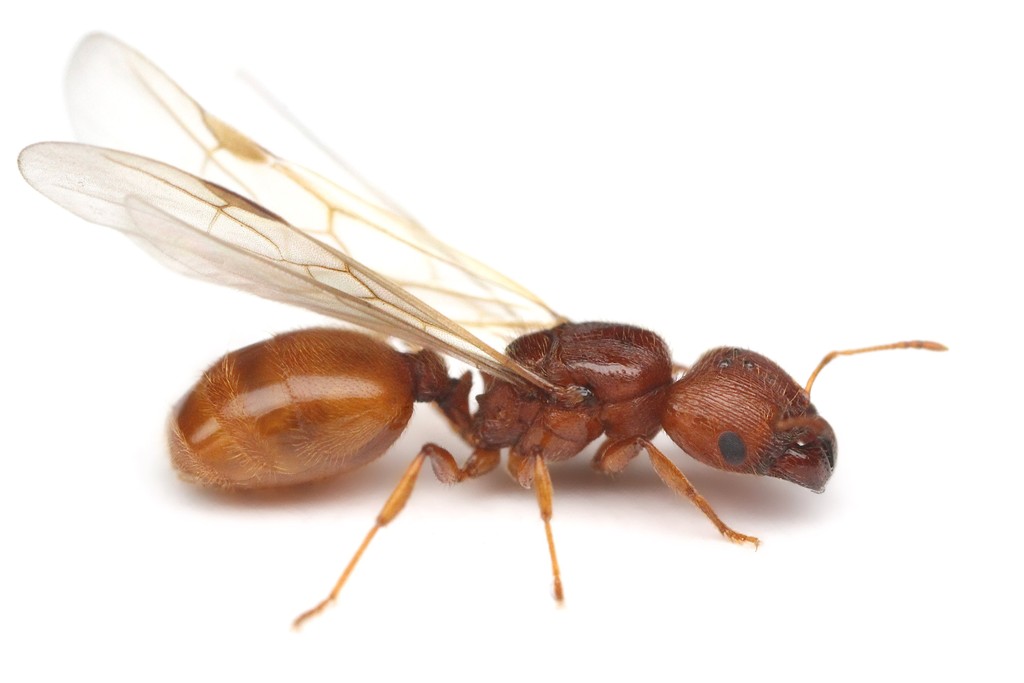
~6 mm · Native
Dark reddish front half, bright orange-amber gaster. That contrast is the whole field mark. It also separates her from P. pilifera, which runs brown.
Known only from Alachua, Citrus and Leon Counties, in open disturbed sandy ground. Nest entrances are hard to spot and drop into surprisingly deep vertical galleries, one of them traced to 1.7 m, with a seed granary about 30 cm down. Her minors play dead when disturbed, curling around soil grains. Wilson thought that habit might be unique in the genus.
Pheidole lamia — Wheeler, 1901
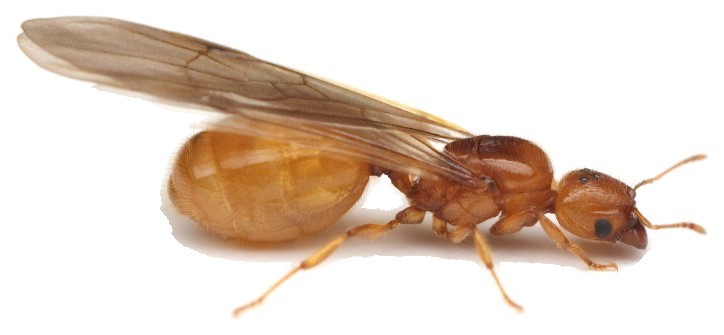
~5.5 mm · Native
The palest queen here by a wide margin. Washed-out golden yellow, with a gaster so large and glassy it makes her head look undersized. Nothing else in the Southeast is both this big and this pale.
Their majors are phragmotic: the front of the head sheared flat, like a cork cut to fit the entrance. They plug the nest with it against raiding thief ants.
Northern Florida west to Austin. She nests in bare soil under leaf litter, which is a hard thing to find on purpose. Collections badly under-represent her.
TrapJaw Labs stocks this species as a live colony — see it in the shop.
Pheidole bicarinata — Mayr, 1870
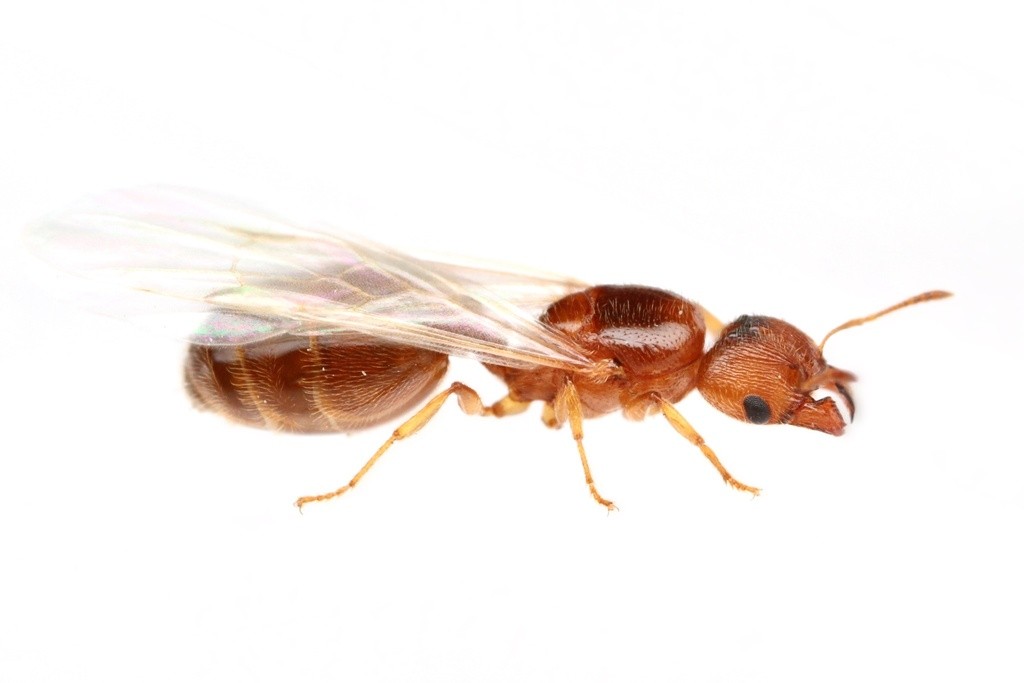
~5.5 mm · Native · Variable Big-headed Ant
Reddish-brown with a clear amber gaster, though she runs yellower in the west and browner in the east. Their eyes are large, set well forward, easy to see in profile.
You'll see her called one of the most cold-tolerant Pheidole in the world, and it may well be true. We can't find a study behind it. Widespread across the eastern and central US, with research-grade records north into New York and Pennsylvania. Open sandy soil with a bit of clay suits her: lawns, sidewalk cracks, field edges. Colonies are monogynous and run from a few hundred to a few thousand workers, harvesting seeds into underground granaries. Flights come in warm, humid weather.
TrapJaw Labs stocks this species as a live colony — see it in the shop.
Pheidole tysoni — Forel, 1901
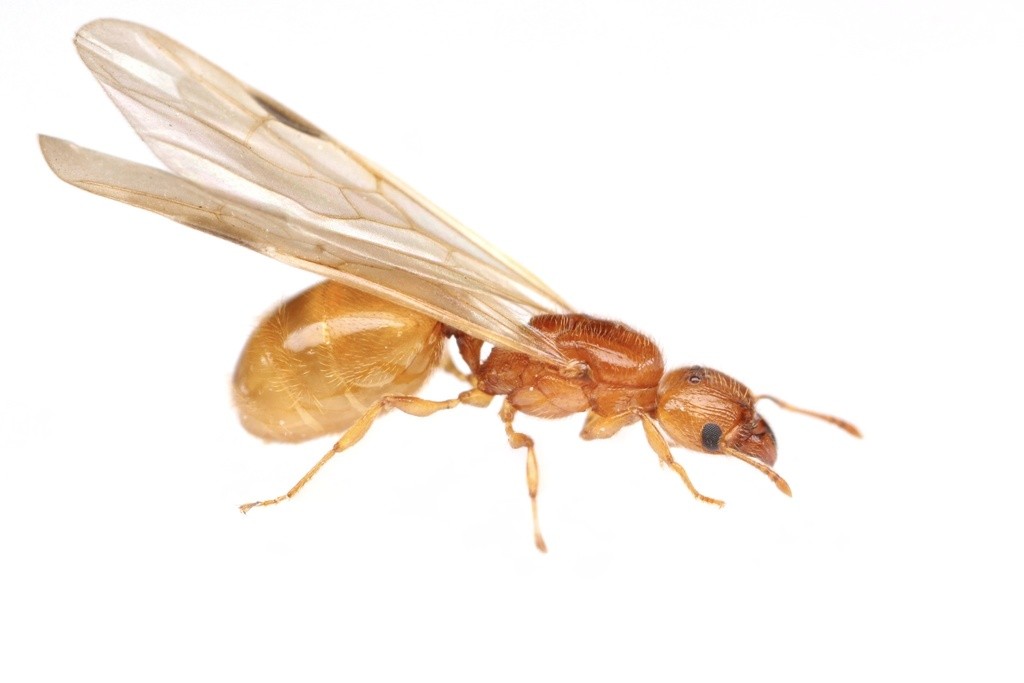
~5 mm · Native
The brightest queen in the guide. Clear yellow through orange-yellow, no dark gaster, and almost no sculpture anywhere on her.
She overlaps with P. bicarinata, so if you're stuck, check the sides of the propodeum on the minors: smooth in P. tysoni, pitted in P. bicarinata. Open dry ground on poor soils. Her minors are small enough to pass for thief ants at a glance.
Pheidole parva — Mayr, 1865
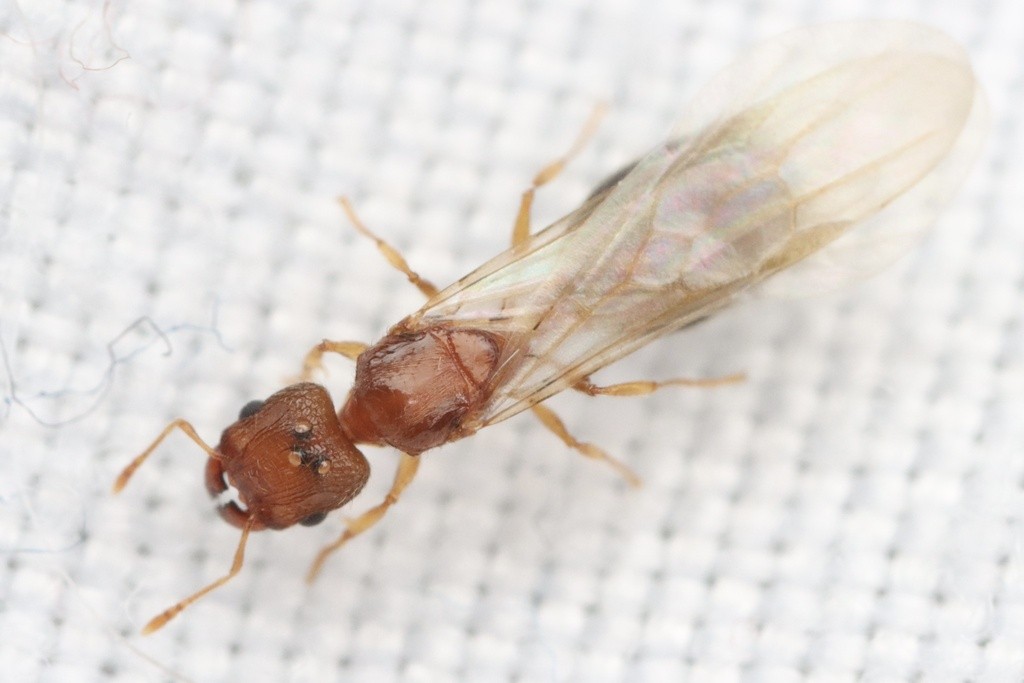
~4.5 mm · Uncertain
Orange-brown with lighter legs and a distinctly darker gaster. Check this one carefully before you commit to it. P. parva is a South and Southeast Asian species, it isn't on the Florida checklists, and recent Southeastern material has only ever been reported as Pheidole sp. cf. parva.
She travels in potted plants. That is how most of these arrivals happen. If you've got her, photograph the majors and report the record.
Small · under 4.5 mm
Pheidole metallescens — Emery, 1895
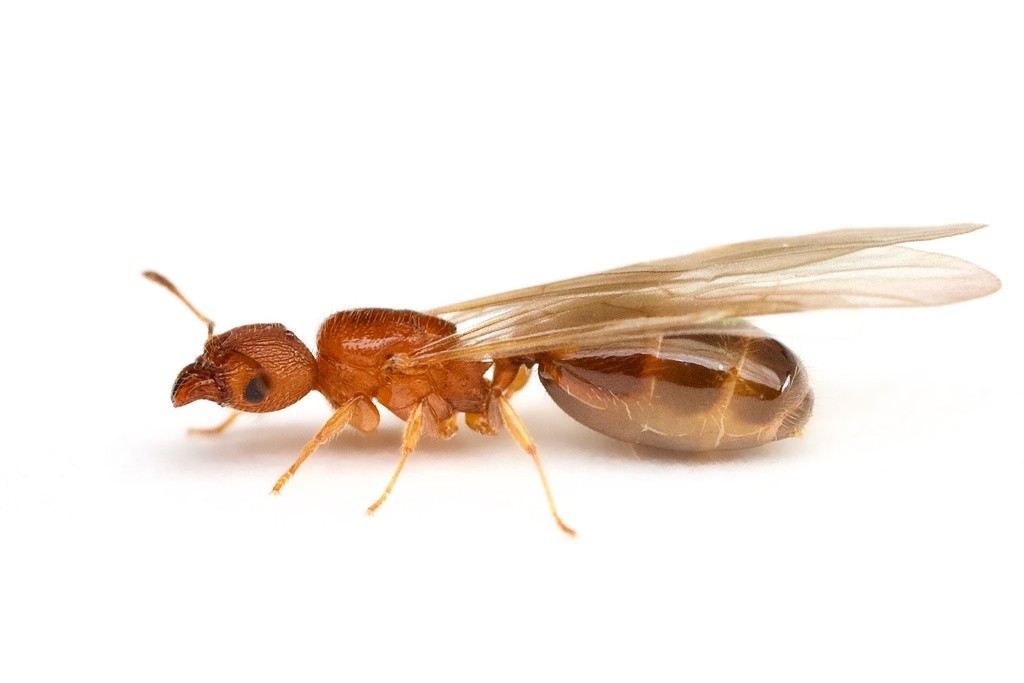
~4 mm · Native
The queen is an unremarkable small bicolored Pheidole and I wouldn't try to call her on her own. Wait for workers. The minors settle it immediately, coming out blackish-brown with a metallic blue-purple sheen that's obvious on the head. Very few North American ants do that.
Open sandy uplands and scrub.
TrapJaw Labs stocks this species as a live colony — see it in the shop.
Pheidole bilimeki — Mayr, 1870
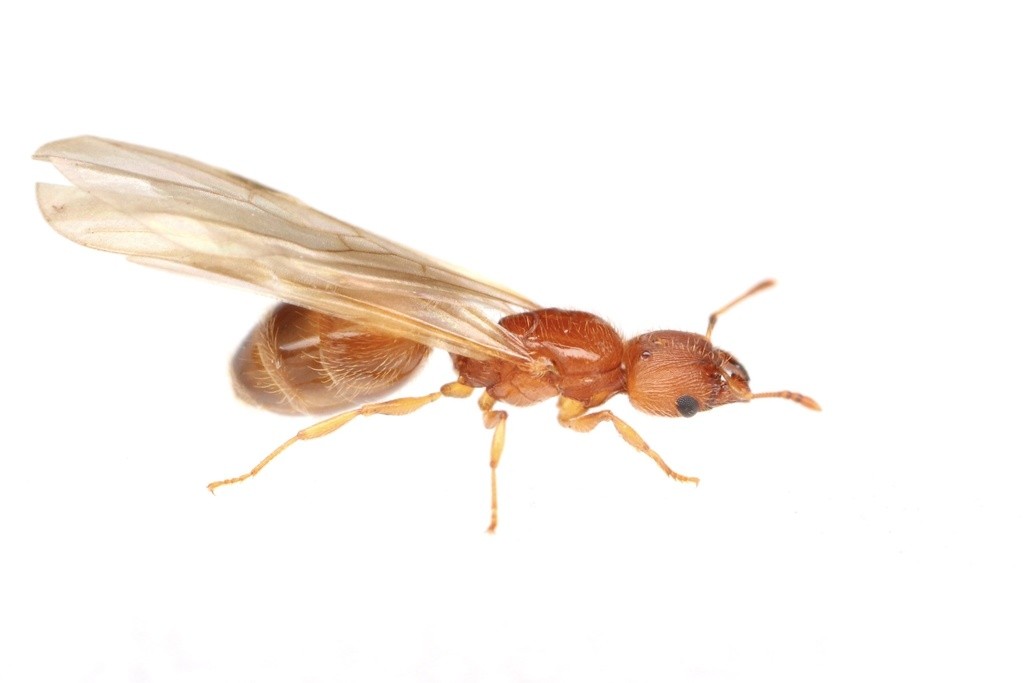
~4 mm · Introduced
Medium brown with a darker gaster, and honestly no reliable queen-level field mark at all. Treat any call as tentative until you have workers, then check scape length on the minors.
P. anastasii sit close to her. Ecology helps a little, in that P. bilimeki takes open disturbed ground while P. anastasii nests in plant cavities in wet forest. She's a common indoor pest and cold-intolerant enough to stay in the far south.
Pheidole adrianoi — Naves, 1985
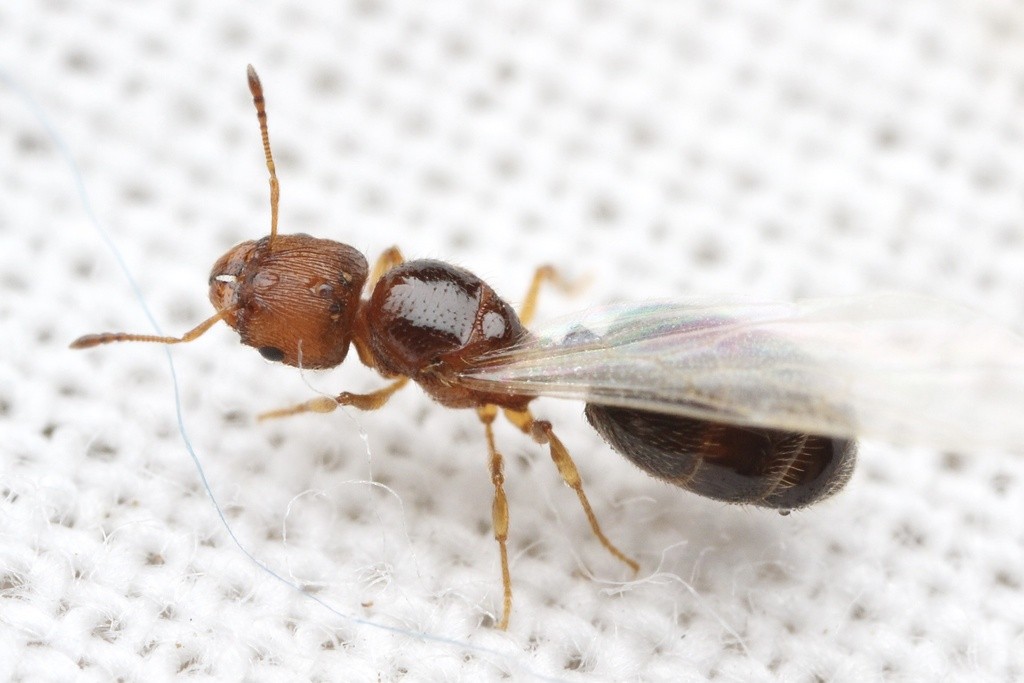
~4 mm · Native
Uniformly dark brown, without P. dentigula's orange cast or P. navigans's near-black gaster. Sandy uplands of central and northern Florida, west to Okaloosa County.
Her workers are tiny, with a minor head width of 0.38 mm. Mature colonies run about 60 majors to 300-odd minors, forage strictly by day, and unusually for the genus the majors come out to help carry food.
Pheidole navigans — Forel, 1901
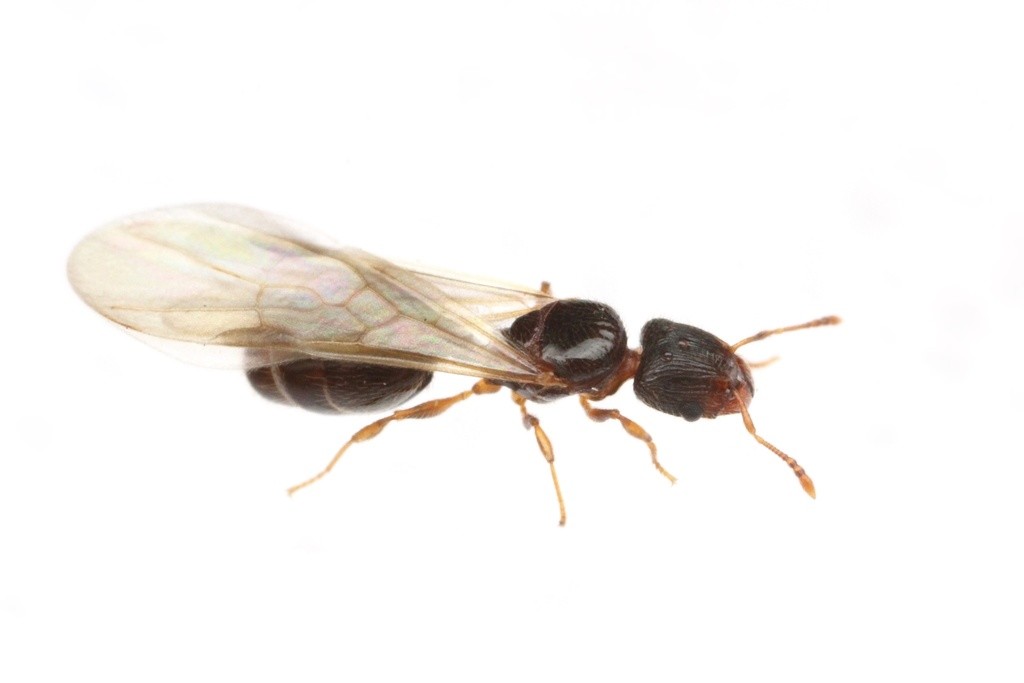
~3.5 mm · Introduced
Darkest here, which is most of the identification done. Blackish gaster, slightly lighter mesosoma.
Watch the name on this one. Wilson sank it into P. flavens and Sarnat restored it in 2015, so older labels and forum posts will still call her P. flavens. The small brown P. flavens-group species are genuinely hard, so plan on rearing majors. Disturbed and urban ground throughout Florida and the Gulf states.
Pheidole dentigula — M. R. Smith, 1927
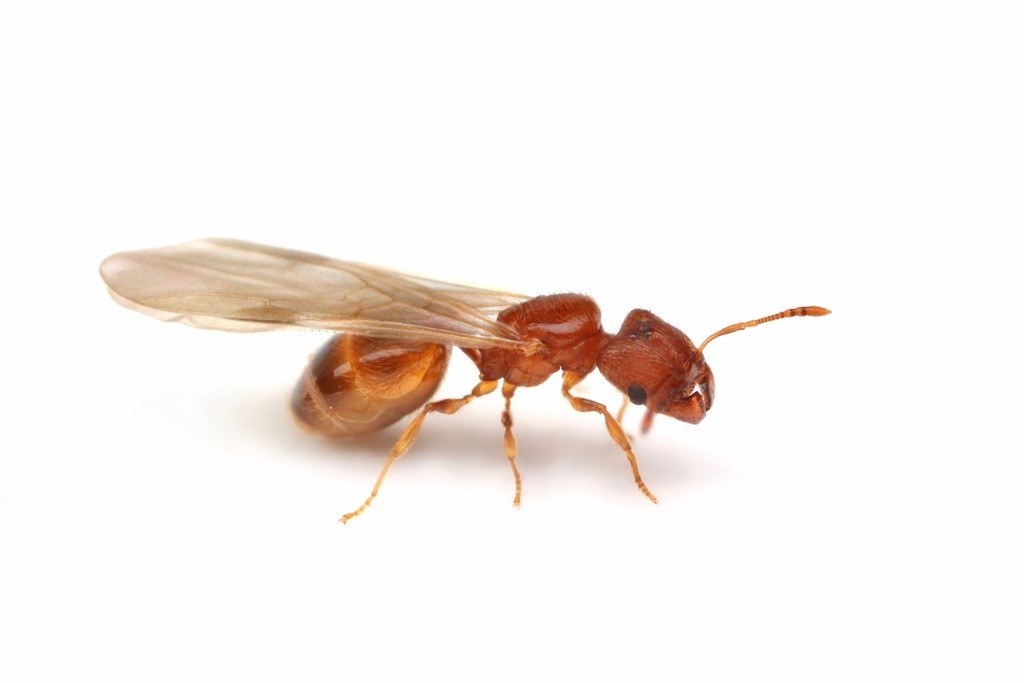
~3 mm · Native
Clean concolorous orange. That is the whole trick at this size. P. adrianoi, P. navigans and P. bilimeki all look plainly brown next to her.
A forest ant, in soil and rotten wood. In dry sandhill she retreats to damp pockets: big rotten stumps, or deep litter in low depressions. Coastal plain, Tennessee and North Carolina down to the Keys. Winged reproductives have been recorded from a South Carolina colony on 9 June.
Confirming An Identification
If the queen alone doesn't settle it, and for the small brown species it usually won't, wait for majors. Nearly all published Pheidole taxonomy is built on them: head sculpture, propodeal spines, postpetiole shape, hypostomal teeth.
Photograph the major full-face, lateral and dorsal. Those are the views the keys and AntWeb use, so they're what you can actually compare against. Then run it through Wilson's Pheidole in the New World, or AntWiki if you don't have the book.
Record the locality while you're at it. County, habitat, soil, date. That narrows the list faster than any single morphological character, and it makes your record useful to somebody else later.
I'll keep adding to this as I catch and rear more of these. If you've got a queen that doesn't fit anything here, or a record that contradicts something above, I'd like to hear about it.