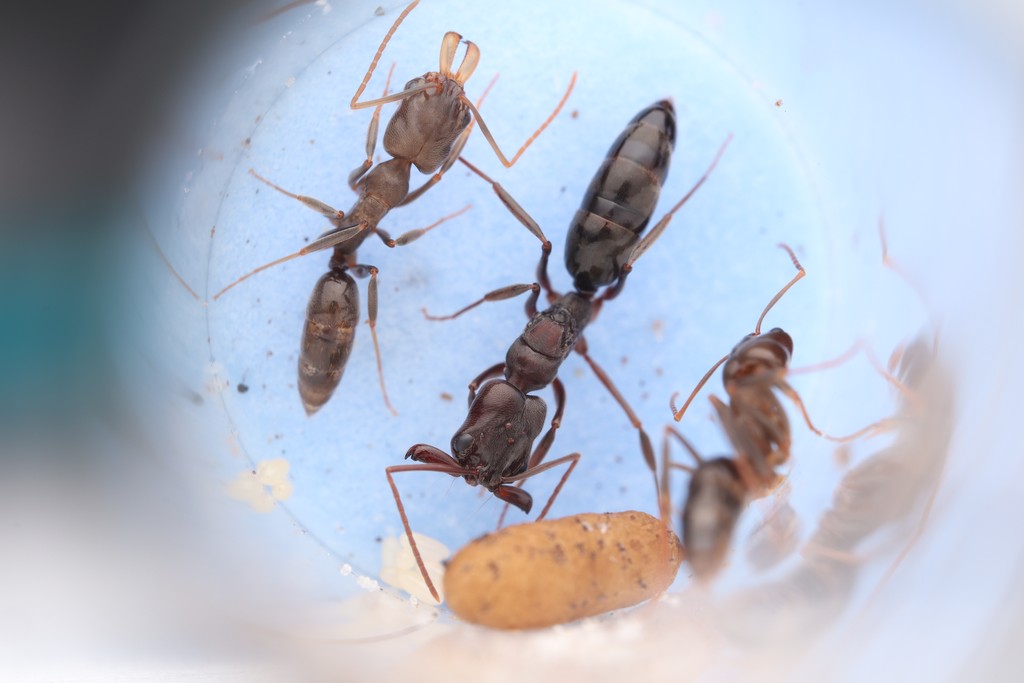
How To Tell A Queen Ant From A Worker
How to tell whether the ant in front of you is a queen or a worker, and which field marks actually hold up.
You caught something big on the sidewalk after a summer rain. Or, you're counting ants through the glass of a colony you just bought, and one doesn't look like the others.
People always want to know if they've caught a queen. Nearly every answer floating around the hobby is size-based, and size is the character most likely to let you down.
Look At The Mesosoma
The middle section of the body is the only trait that works across nearly every ant you'll pick up.
A queen is built to fly, and even after she sheds her wings, she still has the remnants of the physiology required to enable that. Her mesosoma is a stack of separate plates. A large shield called the scutum over the top, a scutellum behind it, small plates called axillae at the corners, and the pronotum squeezed into a narrow collar at the front. How pronounced they are varies, but you can see the 'wing scars' on her mesosoma.
In almost all circumstances, workers have never had flight muscles, so they lack this trait.
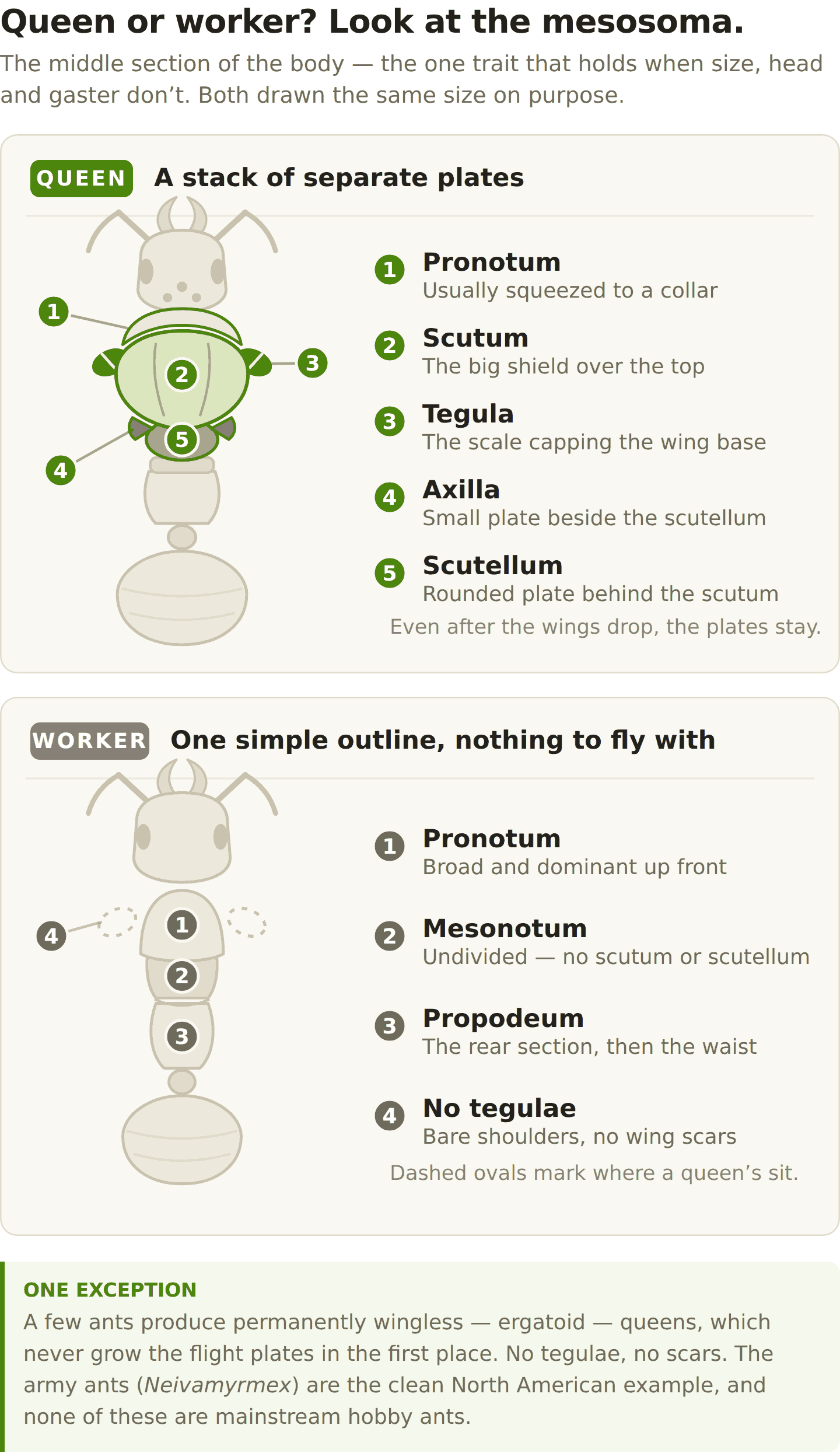
One caveat, a few species never make winged queens at all, so their queens have no tegulae and no 'wing scars'. These are 'ergatoid' queens, and in North America they turn up in the army ants (Neivamyrmex), Monomorium ergatogyna, Hypoponera opacior and Ephebomyrmex imberbiculus. None of them are mainstream hobby ants.
Wings, And What Losing Them Proves
Wings tell you an ant is a reproductive. They don't tell you it's a mated queen.
A winged ant is usually either a virgin queen or a male. Both fly, both end up under your porch light.
Wingless is where people get overconfident. "She dropped her wings, so she's mated" is repeated everywhere and it isn't true. Shedding is triggered by losing contact with her mother queen's pheromone, not only by mating. In a controlled test on Solenopsis invicta, 100% of virgin alates penned with workers and brood dealated inside 108 hours. Every one, unmated.
Size, Head And Gaster Will All Lie To You
These are the three characters beginners gravitate towards, and there are instances where all fail.
Size falls apart in some species. Novomessor cockerelli workers run 8 to 8.5 mm and the queen is only modestly bigger, which catches somebody every season. It does work in the leafcutters, where an Atta queen dwarfs everything she produces, and in Veromessor pergandei, 10 mm queen against 2.5 mm minors. Genus-dependent rather than useless. Know which one you're holding.
Head size is worse. In Camponotus pennsylvanicus the queen has the biggest head in the colony. In Camponotus herculeanus a major beats her. A Pheidole major's head is grotesquely out of proportion to her body, far more so than any queen's. That's what people react to when they call a soldier a queen.
Gaster size is the least reliable of the three. Myrmecocystus repletes hang from the ceiling with gasters swollen to the size of grapes. Workers, full stop, distended with a crop full of sugar rather than ovaries. Meanwhile a queen you caught last night has a slim gaster and won't fill out for months. Fat ant doesn't mean queen. Thin ant doesn't mean worker.
One more. A callow worker is pale, glossy and slow for her first few days out of the pupa, and in a founding tube she gets mistaken for a queen constantly. Judge the mesosoma, never the color.
Ocelli, With One Large Exception
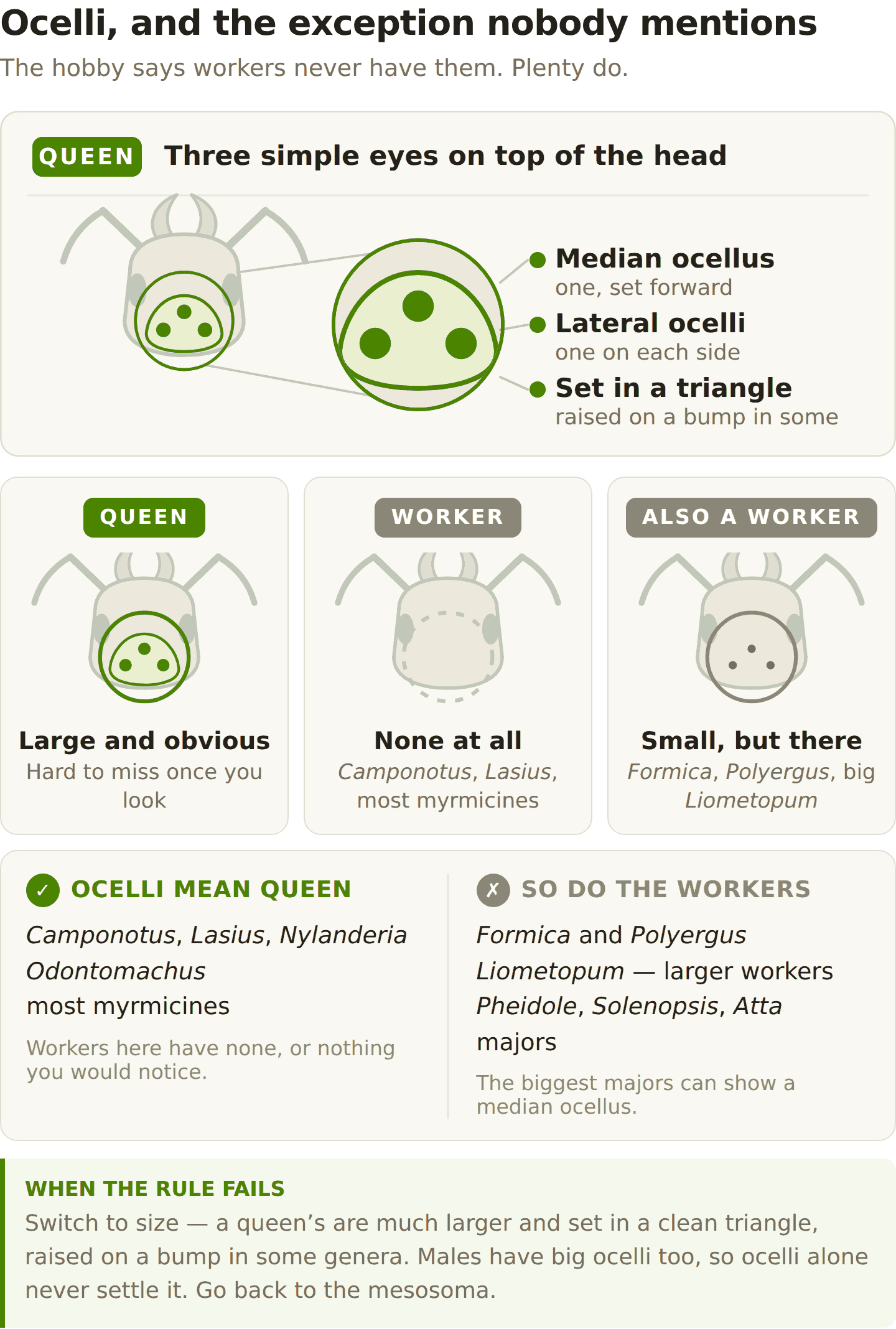
Three simple eyes in a triangle on top of the head, present on queens and males and absent in many workers.
"Many" is doing real work in that sentence. The hobby usually says "all". Formica workers have ocelli. So do Polyergus, and the larger workers of Liometopum. Key a Formica forager on "it has ocelli, so it's a queen" and you'll be wrong every single time.
Where it does hold: Camponotus, Lasius, Nylanderia, Odontomachus, and the myrmicines generally. Where it doesn't, switch to size. A queen's ocelli are much larger and sit on a raised triangle.
Is It A Male?
More winged ants get misidentified as queens than wingless ones do.
A male has a small head, compound eyes taking up most of it, prominent ocelli, and antennae that hang straight instead of elbowing sharply the way a female's do. At the tip of his gaster is a genital capsule, usually reading as a blunt, slightly split end.
Not every male has wings, either. Cardiocondyla and Hypoponera produce permanently wingless males that look worker-like. A wingless ant with a small head, big eyes and a genital capsule is a male.
What We'd Actually Do
The mesosoma is the most characteristic trait.
Get her under a loupe or a phone macro lens, look down at her from above, and ask one question. Is the middle of her body one piece, or several? Then check the shoulders for tegulae. That resolves most cases, including every one where size, head and gaster disagree.
Once she passes, the next question isn't caste, it's species. That's what tells you whether she founds claustrally, whether she needs feeding, and whether she can share a tube. Our Care Advisor walks through it species by species, and we've written up what to expect from her once she's in a tube.