How To Move My Colony To A New Nest?
When your colony is ready to move, the four ways to get them into a new nest and the drawbacks of each.
Part 1: Are They Ready To Move?
The signal to move is crowding, not the calendar.
A test tube is not a waiting room. It's a genuinely good nest, and colonies do fine in one far longer than most keepers are comfortable with. Moving them into too big of a nest too early is one of the most common mistakes new keepers make.
A founding queen should stay in the tube, and so does a colony that has only just raised its nanitics. A colony that arrived in the mail this week stays put too, and we've written up what the first 48 hours should look like.
Mold isn't a reason to move, and neither is a dirty-looking tube. The only two things that force a move on a colony that isn't otherwise ready are a flooded tube and a tube that's run dry. Everything else can be left alone.
Part 2: Preparing The New Nest
The most important part of moving your ants to a new nest, of course, is making sure that you have a good, appropriately-sized nest ready to move them into.
It depends a lot on the species of ant you're moving, and how fast they grow, but generally we suggest ensuring that your colony is able to fill no less than ~25% of the nest that you are moving them into at the time of being moved-in. Check out our Care Advisor if you'd like species-specific guidance on what kind of nest your colony will do best in.
Then setup the new nest a few days in advance. Water it and give the moisture time to work through, get your heat on and confirm it holds the temperature you're actually aiming for, and apply your escape barrier and let it dry.
Lastly, join the two setups with a length of vinyl tubing and leave them connected. Nearly everything below works better when the ants get to make the decision themselves.
Option 1: Dehydration
This is a favorite among new hobbyists and seasoned veterans alike.
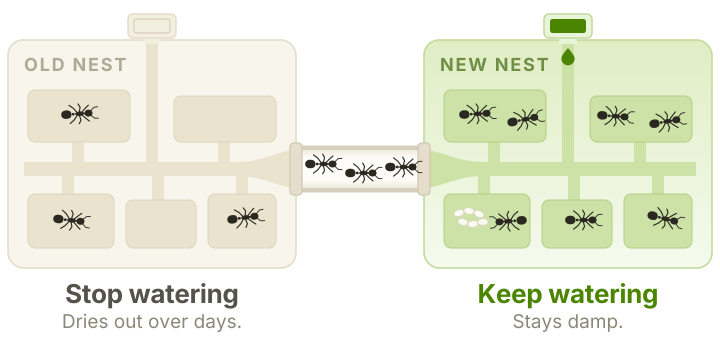
Simply connect the old nest your colony is currently inhabiting to the new one. Begin watering the new nest, while no longer watering the old nest anymore. Over time, the old nest will dry out, and your colony will voluntarily move into their new setup. While you do need to be more patient, this is often the safest and most effective way to get your ants into a new nest.
Let it happen over days, not hours. The advantage here is that the colony gets time to notice and move where they want to.
There can be issues with this methodology, however. Sometimes your colony will be reluctant to move to the extent that them occupying a very dry nest harms the brood and/or queen. Something you definitely need to keep an eye on if you choose to use this method. Even then, if they do eventually move, oftentimes many workers will remain in the old nest and/or frequently visit it. There's no great way to deal with that if so. You can either cull those workers or try to 'dump' them. Regardless, we have yet to find a great solution for the drawbacks that ail this methodology.
Option 2: Darkness
Cover the new nest so it's properly dark and take the cover off the old one. If your colony is light-sensitive, the dark nest starts looking like the better address. There's no version of this that harms them when it fails, and it stacks with Option 1.
The catch is that it often does fail. We keep our established colonies uncovered and in the light on purpose, and colonies kept that way become desensitized to it surprisingly fast. Ants unbothered by light are exactly the ants this won't move. Layer it on top of another method rather than relying on it.
Option 3: Dumping
While this may seem like a more stressful and damaging way to move your ant colony, dumping the colony into the foraging area can sometimes be one of the best strategies.
Whether or not we suggest you employ this methodology is going to depend on what your colony's old nest is like. Are they in a setup which cannot easily be attached to the new one? Does the colony have a workforce of 50+? If so, it's probably best to dump them.
How one goes about 'dumping' a colony can look very different depending on the situation. Sometimes, all that's necessary is putting the old nest in their foraging area, and removing the glass/acrylic lid on it. Other times, you may want to be more forceful. For example, if the colony is in a test tube that is overgrown with mold and other microbial growth. Maybe the nest they're in has external areas the ants get into and cause problems in. There are many reasons. As long as the new nest is set up, ready for the ants, and is a design that works well for the species, you can go about 'dumping' them in whatever way works for your situation.
Two things before you tip anything. Check that your escape barrier is dry, because a dump is when you find out it wasn't. And find the queen first, so you know where the queen is instead of hoping.
Option 4: Heating
This method works by hooking up the old nest to the new and then slowly increasing the temperature of the old nest until it is uncomfortable for your colony to inhabit.
It's basically the heat-version of Option 1. While that may sound like a good idea, we encourage you to avoid it if at all possible.
We generally suggest hobbyists avoid making their colony's old nest uncomfortably warm for them in an effort to get them to move. This can work, it has for some in the past, but the potential for it to go wrong cannot be overstated. Things get a little too hot a little too quick and your entire colony and queen will perish.
The asymmetry is what makes it a bad trade. A nest that's gone too dry is uncomfortable and the colony has days to react. A nest that's gone too hot is fatal and they have minutes. If you do it anyway, run it on a thermostat.
After The Move
Keep the old nest connected for a while. Stragglers go back to it, sometimes for weeks, and forcing them out early just creates a second move you didn't need to make.
If a good chunk of the colony is still in there a couple of weeks later, that isn't stubbornness. That's the colony telling you the new nest isn't what they want. Check its humidity and temperature first.
Conclusion
There is no one best-way to move your ant colony.
The best strategy for every colony is one tailored to them and their specific situation. Hopefully these 4 options gave you a starting-place for ideas, though.
Most of this comes down to making one part of a setup wetter than another and letting the ants sort out the rest. That's part of why our Substratum nests have four separate watering ports. You can run one region dry and another wet inside a single nest.