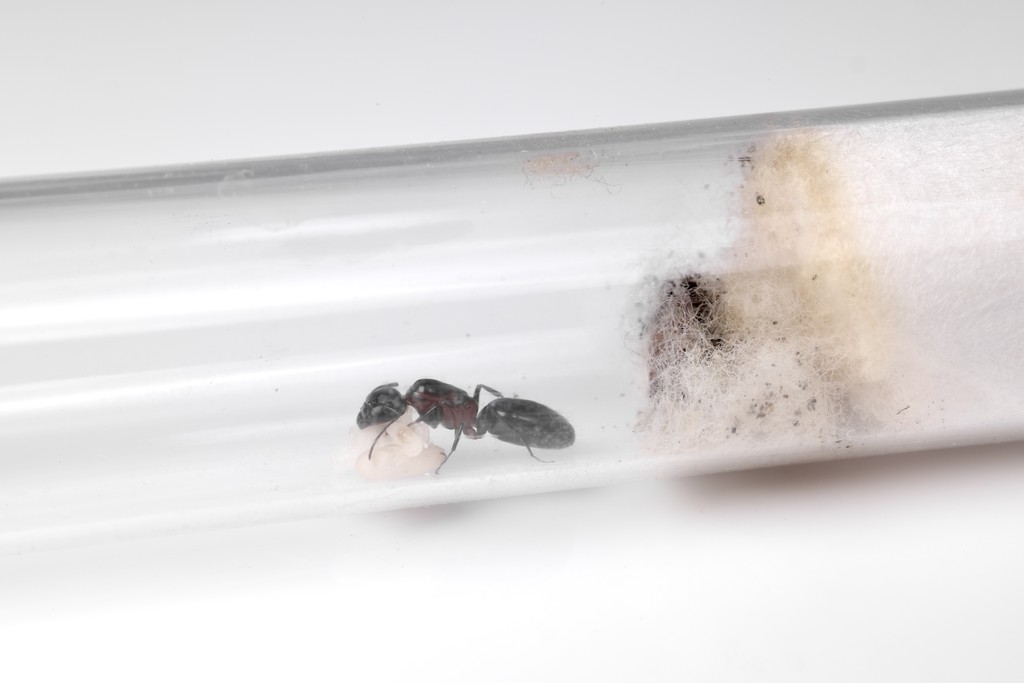
What To Do About Moldy Test Tubes
Why mold in a test tube is usually harmless, when it isn't, and how to keep it down.
Whenever you have colonies in test tubes that have gotten a little moldy, the best thing to do is nothing. I know, this sounds preposterous to most people. However, you are more likely to harm your colony trying to move them to a new tube than the mold is to harm the ants.
If the nest conditions are such that mold would grow to a level that harms the ants, wild colonies have to have evolved some solution. Otherwise they wouldn't exist. So, ants are both extremely resistant to mold and do a good job of keeping things clean.
That resistance isn't passive, either. Ants groom themselves and each other constantly, and they carry corpses and food waste off to a refuse pile away from the brood. Lasius workers have been caught swallowing a droplet of their own formic acid and painting it onto fungus-exposed brood as a disinfectant, and carpenter ants carry antifungal compounds in their venom that appear to do a similar job. Somebody went and sampled the fungi living inside healthy, active Formica mound nests a couple of years back, and Aspergillus was one of the most abundant things in there. Those were thriving colonies. Mold in the nest is the normal state of affairs.
Moving your ants to a new test tube, on the other hand, is not a situation ants are so familiar with. Oftentimes workers are crushed, brood is lost, or the queen can be harmed. The only time you should move your ants to a new tube is if the test tube has flooded or the test tube has run dry. If you're in that spot, our guide on how to move your colony to a new nest walks through the options.
When Mold Is Actually A Problem
There's a difference between mold growing on the cotton and mold growing out of your ants.
The fuzz on a wet cotton plug, on a leftover cricket, or on a dead worker is 'saprophytic'. It eats dead material and has no way into a living ant. That is the overwhelming majority of what keepers panic about. The fungi that actually kill ants, like Metarhizium and Beauveria, grow out through the body of the ant itself and leave a cadaver furred over in spores. Even those are far rarer in the wild than their reputation suggests. In one survey of 3,300 wild ants over a year, three were infected.
So ask yourself what you're actually looking at. Is the growth on the cotton or on old food? Then it's doing its job and your ants will handle their end of it.
A few things are worth acting on. If mold is running rampant on uneaten food, take the food out, and take moldy corpses out of the tube rather than trusting the refuse pile. And if it's growing on a living worker, pay attention, because a colony that has stopped grooming has usually gone quiet for some other reason first. The mold is the symptom there, not the cause. We'd look at temperature, hydration and stress before we blamed the fungus.
Keeping It Down In The First Place
Most tube mold traces back to something you put in the tube, and the cotton is one of them.
Feed on something you can take back out. A scrap of foil or paper works, anything that lets you lift the leftovers away in one motion instead of fishing them off wet glass. Pull uneaten protein after a day or so. Don't keep feeding a founding queen who isn't eating yet, since there's no need and the food is what's going to bloom on you. And handle the tube as little as you can get away with.
Even then some mold is going to show up, and that's fine. There's no keeping a warm, humid, food-bearing tube sterile, and chasing that is how people end up wrecking colonies that were doing perfectly well.
Lastly, this is one of the reasons the TJL Test Tube Sponges are superior to the traditional cotton. They are made out of PVA, a synthetic material unlike cotton, which will not mold on its own.