Your Colony Just Arrived: The First 48 Hours
What to do, and mostly what not to do, in the two days between your colony landing on the porch and settling in.
Hour Zero: Open The Box
Your first job is inspection, and it's on a clock.
Our Live Arrival Guarantee runs on a 2-hour window from the carrier's delivery timestamp. So open the outer box as soon as you have it in hand, even if you don't have time to do anything else that day. Look at the colony through its container. Photograph the colony, the shipping label, the packaging, and the heat or cold pack before you move any of it.
If something looks wrong, file the claim right then and keep the packaging and specimens until it's resolved. If everything looks fine, you're on to setup.
Do Nothing
Beyond water, warmth, and sugar, the best thing you can do for the next 48 hours is nothing at all.
I know how that lands. You just spent money on a colony, you've been refreshing the tracking page for three days, and now it's sitting in a box on your counter and I'm telling you to walk away from it. However, your ants have just spent days being vibrated, tipped, and temperature-swung in the back of a truck. Stillness is the only thing that fixes that.
Find them a spot that's dark, quiet, and doesn't shake. A drawer, a cupboard, or a shelf in a room nobody uses. On top of the refrigerator is one of the worst spots in the house and it's the one people pick most often.
Hydration
Water is the one thing worth confirming before anything else.
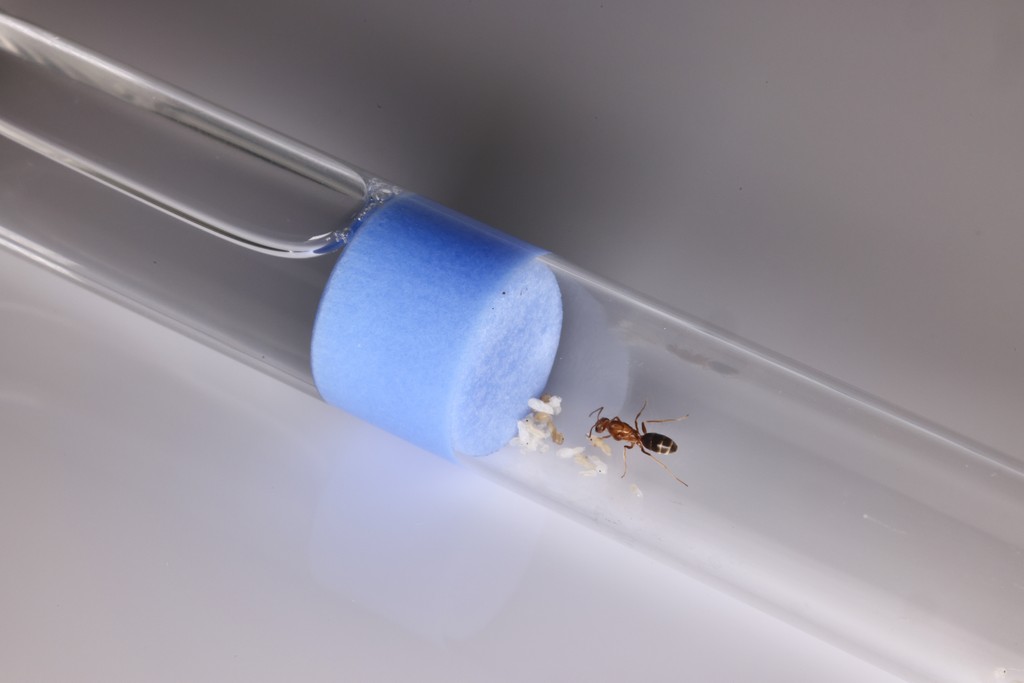
Look at the water reservoir in the tube. You're checking for two failure states and only two: the tube has flooded, or the tube has run dry. Everything in between is fine, including a reservoir that looks lower than you expected it to.
Those two failures are also the only reasons to move a colony out of its shipping tube. If the water has soaked into the nest chamber and the ants are standing in it, or if the sponge or cotton has gone visibly dry and the ants are crowded against it, get in touch with us before you do anything.
Cotton and PVA sponges both hold water. TJL Test Tube Sponges held 92.6–96.7% relative humidity across a 53 day test, they won't mold on their own, and the ants can't tunnel into them looking for more.
Heat
Get them into their species' temperature range as soon as you safely can. There's nothing to gain by leaving them cold for another two days on top of that.
Pull up the Care Advisor and read the temperature section for your ants specifically. Ranges vary enormously between species, and a gradient that's comfortable for one is lethal to another.
Heating cables can cook your ants if you're not careful. Things get a little too hot a little too quick, and the entire colony and queen will perish. So if your heat source isn't already set up and tested, leave them at room temperature while you sort it out. A day at room temperature costs you a little brood development. A day at the wrong temperature costs you the colony.
The First Feeding
Put sugar in front of them on arrival.
Workers burn through their crop reserves in transit and a good number of them land genuinely depleted. Carbohydrates are the fastest thing that helps. Unlike pre-killed insects, a liquid feeder won't foul anything if they ignore it, so there's no cost to offering early. Sugar-water or ant nectar goes in as soon as they're settled in their spot.
Hold the protein until the end of the week. Colonies under stress take carbohydrates readily and ignore protein, and uneaten feeder insects are just something to mold in your outworld.
Remember, you can always remove excess food if you overfeed. So don't be afraid to, within reason.
What Normal Looks Like
A queen on her back, curled tight and unresponsive, is the one thing worth acting on. Photograph her and file inside the 2-hour window regardless of what you think you're looking at.
Then warm her to room temperature and look again. A chilled queen can look exactly like a dead one and come back fine once she's up to temperature. If she does, you withdraw the claim and nothing is lost. Filing costs you nothing. Missing the window does.
What Not To Do
Three things.
After The First 48 Hours
From here it's the ordinary rhythm: water, sugars, protein on a schedule, temperature in range, and patience. Founding queens run 15–60 days to their first workers depending on species, and there is nothing you can do to speed that up that won't also risk the colony.
Everything species-specific lives in the Care Advisor. Read the whole walkthrough for your ants now, while nothing is going wrong. It's a much better read on a calm Tuesday than at midnight when you've convinced yourself something is.