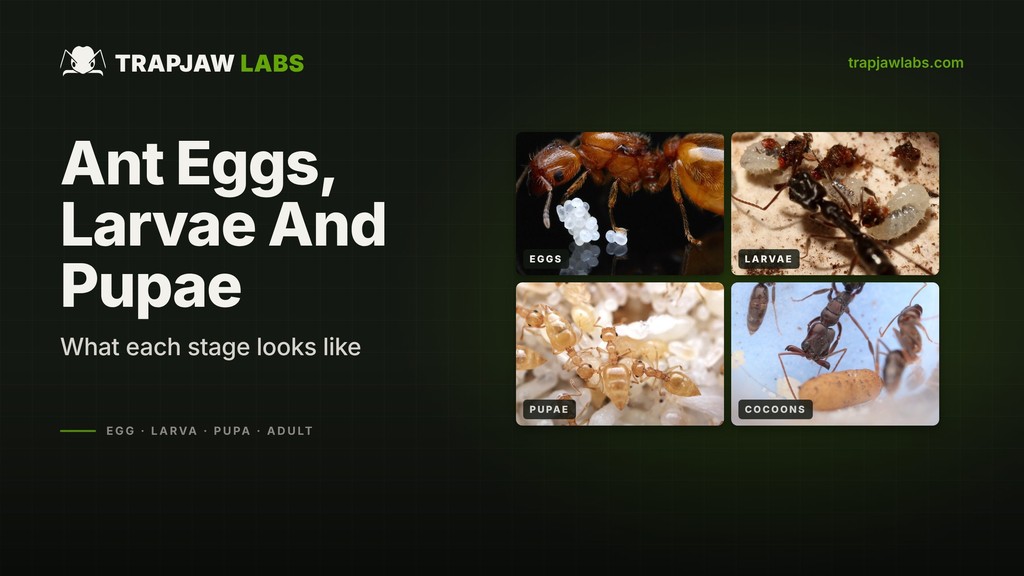
Ant Eggs, Larvae And Pupae: What Each Stage Looks Like
The ant life cycle has four stages: egg, larva, pupa and adult. Ant-Keepers call the first three "brood," and none of them look much like an ant. If you've opened up a nest and found a pile of white specks, grubs and pale lumps, here's how to tell what you're looking at.
Eggs
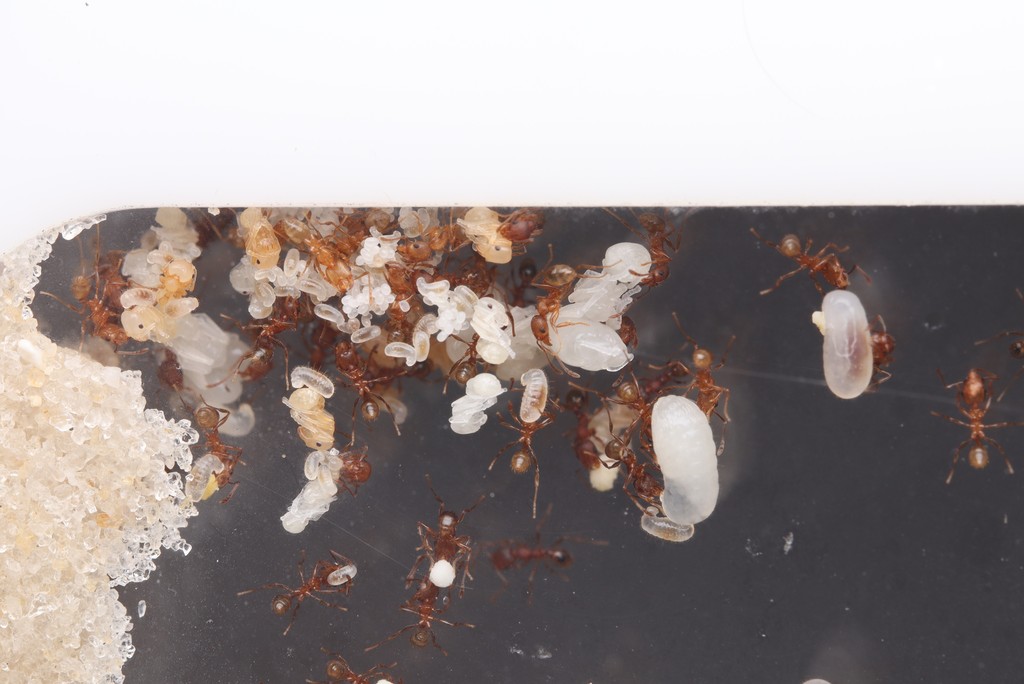
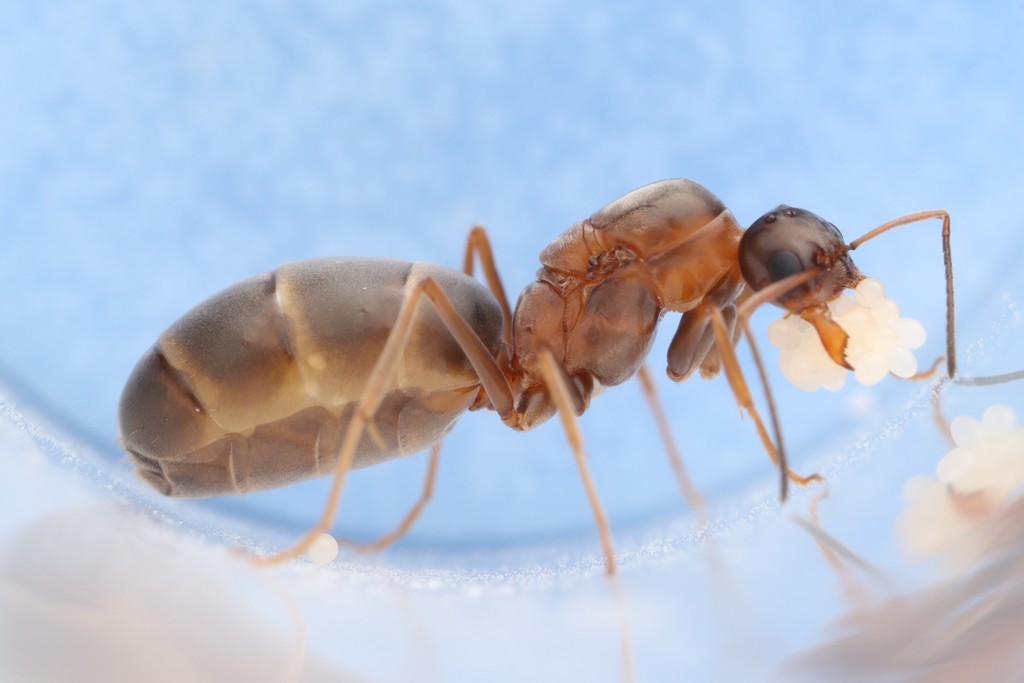
Ant eggs are tiny, white and usually kept together in a clump.
They're smooth and oval, translucent white to cream, and slightly sticky, so they hold together in a pile that workers can pick up and carry in one go. Their shape varies a bit between species. Camponotus spp. eggs, for example, are longer and more sausage-shaped than most.
Fertilized eggs become females, either workers or new queens, and unfertilized eggs become males. Many ants also lay "trophic" eggs, which aren't meant to hatch and get eaten as food. They may do more than feed the colony, though. In a 2025 study of Pogonomyrmex rugosus, larvae that got to eat trophic eggs mostly grew into workers, while larvae without them mostly grew into queens.
If your queen hasn't laid anything yet, Why Isn't My Queen Laying Eggs? covers the usual reasons.
Larvae
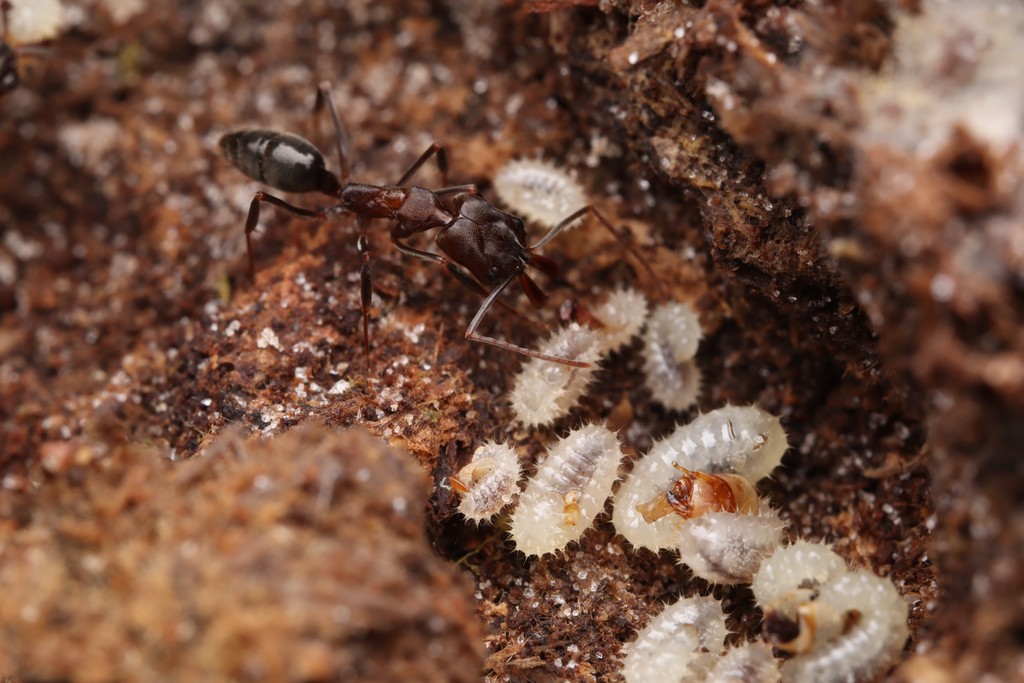
Larvae are legless white grubs, and they're when an ant does all of their growing.
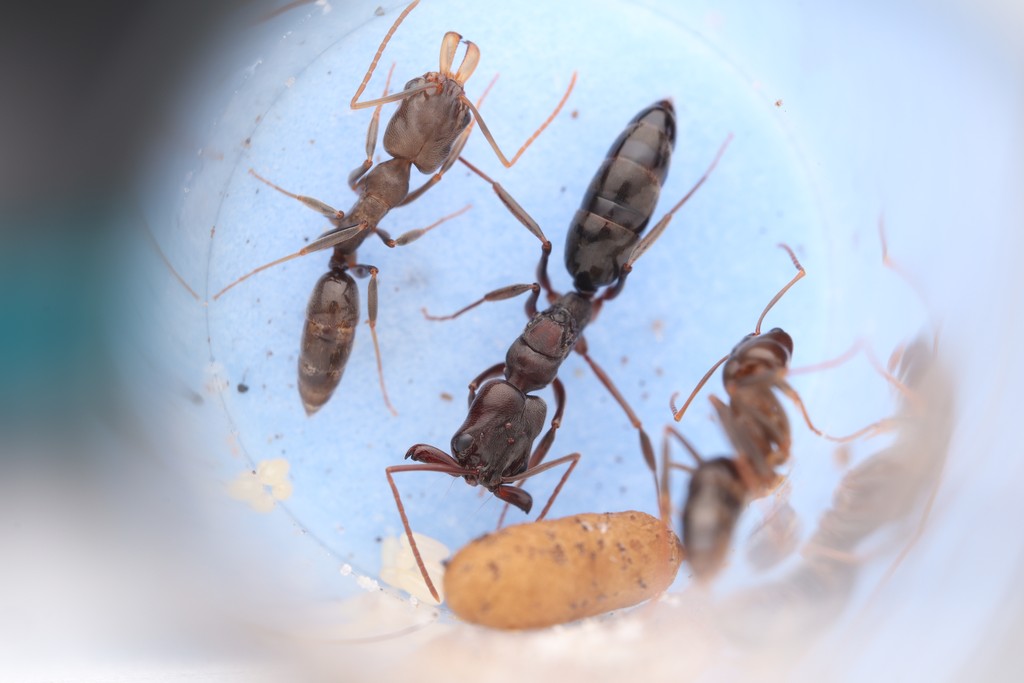
They hatch tiny and see-through, then molt several times on their way to becoming plump, C-shaped grubs with a small head at the narrow end. You can often see their last meal through the skin. In most species, the larvae are completely immobile, so workers carry them around the nest, clean them and feed them. In some species, workers lay pieces of insect right on the larvae, like the Odontomachus brunneus below.
Pupae
Pupae look like pale, motionless ants, unless they're wrapped in a cocoon.
When a larva is done growing, it stops eating, and for species that spin cocoons, it wraps itself in silk. Then it molts into a pupa. The pupa already has the adult's shape, with its legs and antennae folded against its body. It doesn't eat or move, and it slowly darkens as it develops, starting with the eyes.
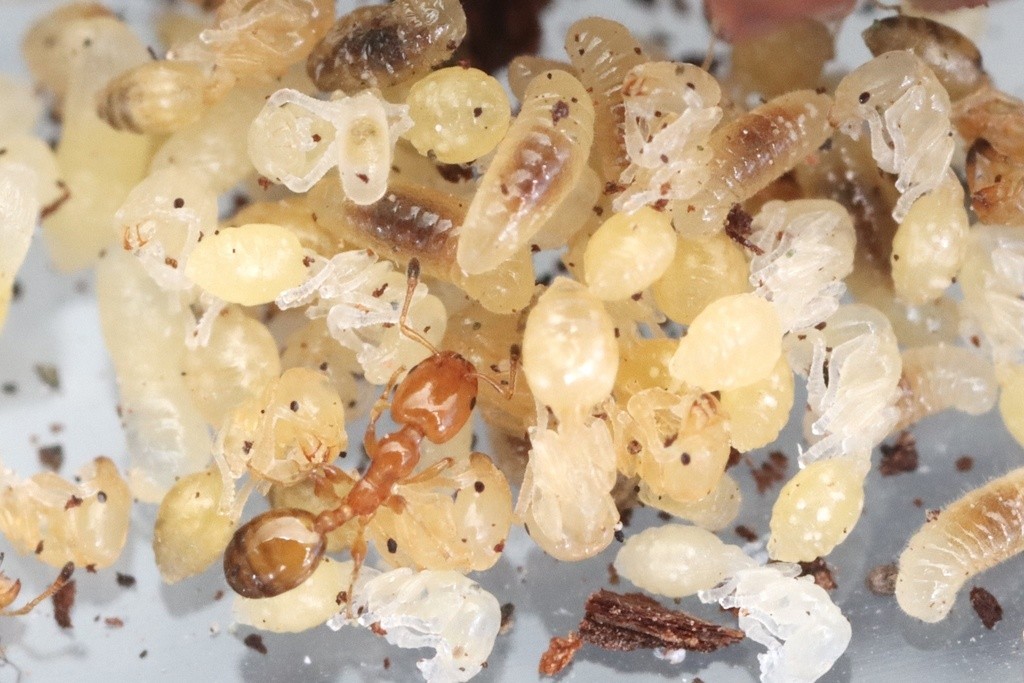
Whether a species spins a cocoon mostly depends on which branch of the ant family tree it belongs to. Camponotus spp., Formica spp. and other formicines usually spin them, and so do Odontomachus spp. and their Ponerine relatives. Solenopsis spp., Pogonomyrmex spp., Crematogaster spp. and other Myrmicines have bare, "naked" pupae, and so do Tapinoma spp. and other dolichoderines. Across ants as a whole, cocoons are the exception: a 2022 study of cocoons across the ant family tree found that most ant species have lost the ability to spin them.
When A Worker Ecloses
A new adult comes out pale and soft, then darkens over the next few days.
Ant-keepers call these new adults "callows." In species that spin cocoons, the workers are required to help a pupa eclose, since they need to remove the cocoon. A new colony's first workers, the nanitics, come out the same way and are smaller than the workers that follow.
How Long It All Takes
Usually a few weeks to a couple of months, depending on the species and the temperature.
Those are Solenopsis invicta numbers. Bigger species like Camponotus spp. take longer, and cold slows every stage down. If you're waiting on a founding queen, How Long Until My Queen Has Workers? gives the time to first workers for each species we keep.
The "Ant Eggs" Might Not Be Eggs.
Most of the time, what people call ant eggs are really pupae or cocoons.
Real eggs are tiny and usually stay deep in the nest. The white or tan grains workers rush to carry off when a nest is disturbed are mostly larvae, pupae and cocoons, which are much bigger and easier to spot.
If you're not sure what you've found, get in touch and send us a photo. We're happy to help you figure out what you've got.