Published August 14, 2026 · Updated August 16, 2026 by Nolan Webb · 7 min read · 427 views
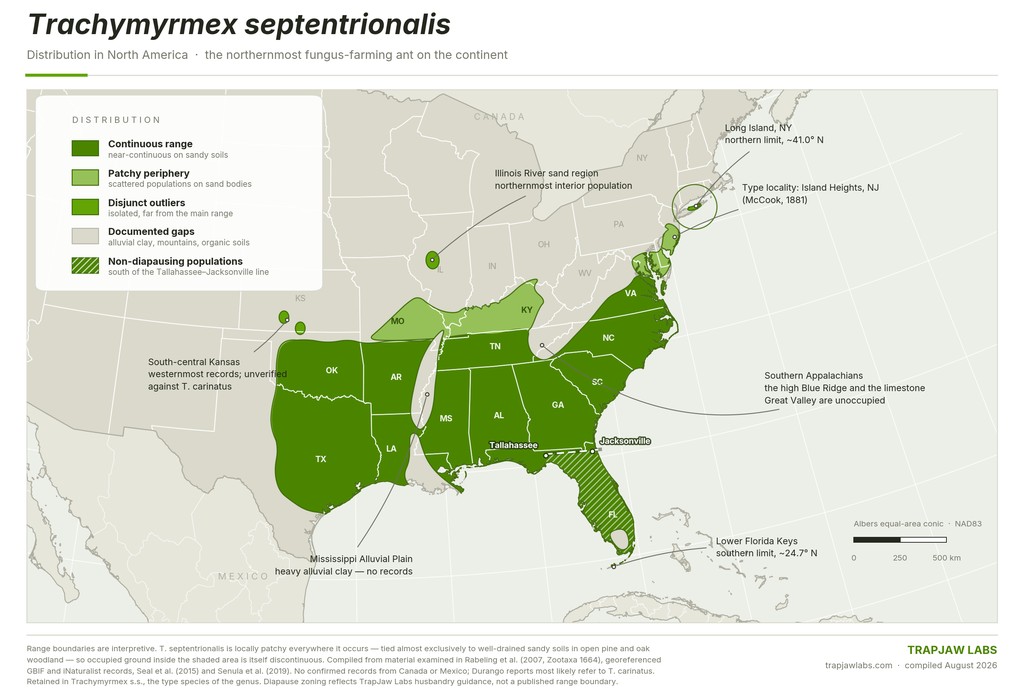
Trachymyrmex septentrionalis is the only fungus-farming ant most ant-keepers in the eastern US will ever turn up in their own yard. They grow a garden, feeds it plant scraps, and eat what the garden produces. They go as far north as Long Island. No other fungus-growing ant on the planet extends as far North.
Taxonomy
Kingdom: Animalia
Phylum: Arthropoda
Class: Insecta
Order: Hymenoptera
Family: Formicidae
Subfamily: Myrmicinae
Tribe: Attini
Genus: Trachymyrmex
Species: Trachymyrmex septentrionalis (McCook, 1881)
McCook described them from Island Heights, New Jersey, on the north bank of the Toms River, in September 1880. The northernmost fungus farmer on Earth was named from the Jersey Pine Barrens.
A note on the genus. In 2019 Solomon and colleagues took Trachymyrmex apart. It was polyphyletic, so they split off Mycetomoellerius and Paratrachymyrmex and left nine species behind.
Identification
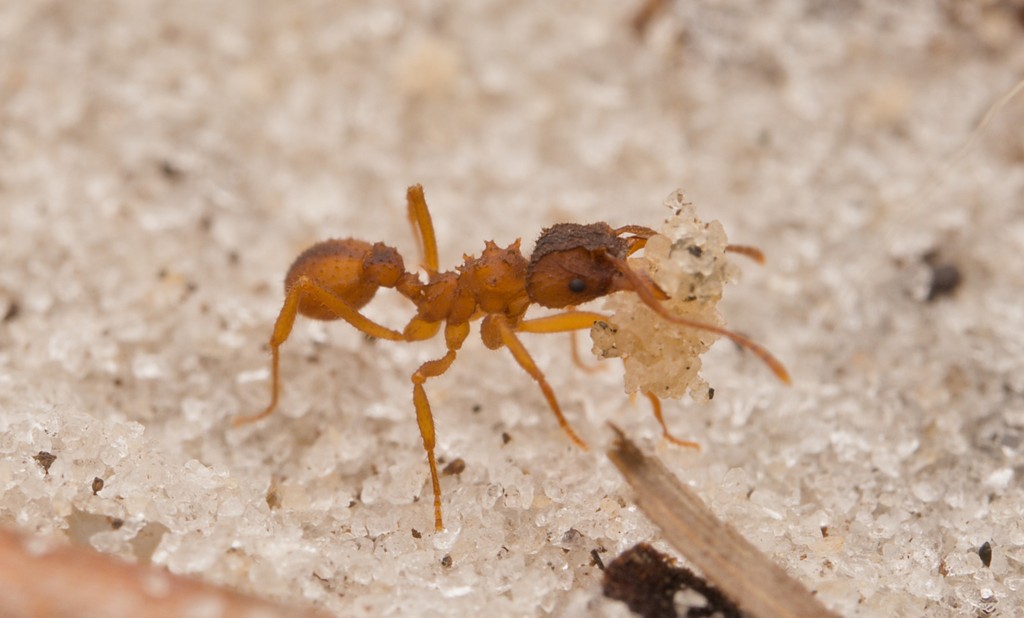
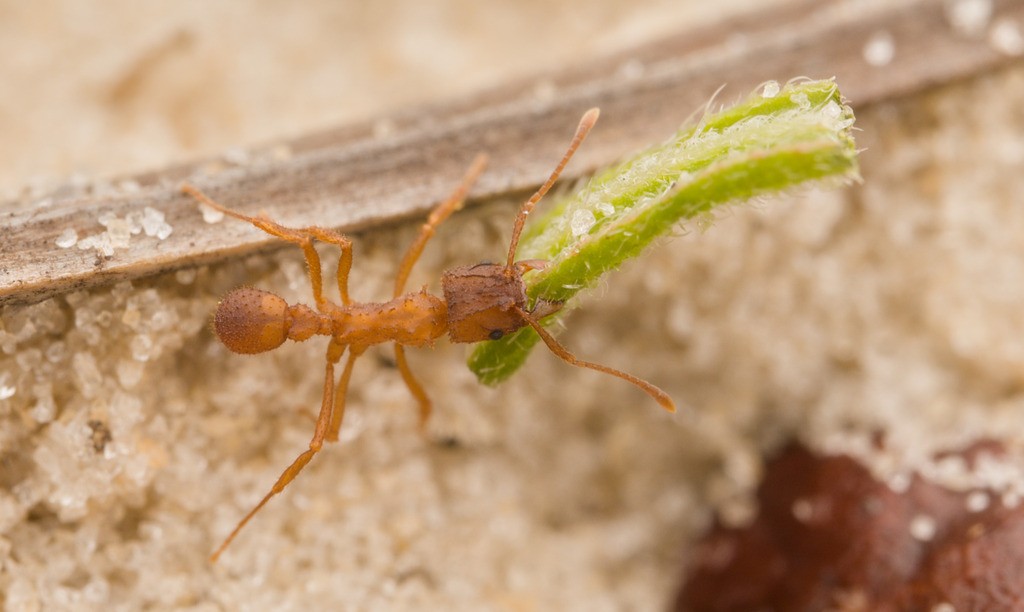
Being the only fungus-farmer in much of their range, it's hard to mistake them for another species.
Workers. Head length 0.84 to 0.96 mm, head width 0.88 to 1.0 mm, mesosoma 1.12 to 1.32 mm. The head is very slightly broader than long. Color runs brownish yellow through medium reddish-brown. The whole ant is covered in tubercles, bumps rather than spines, largest on the posterior corners of the head and on the first gastric tergite.
Queens. Head length 1.05 to 1.2 mm, head width 1.1 to 1.25 mm, mesosoma 1.55 to 1.85 mm. Same coloration as the workers.
Males. Gastric tubercles absent or miniscule, ocelli small and inconspicuous.
Distribution
East Texas to Florida, north to Long Island, inland to central Illinois and southern Ohio.
The northern edge sits around 40 to 41°N. That is the northern limit for fungus agriculture in ants, worldwide. Records from Durango, Mexico are most likely misidentified T. carinatus.
Habitat
T. septentrionalis are omnipresent in areas with sandy soils within their range.
The Nest
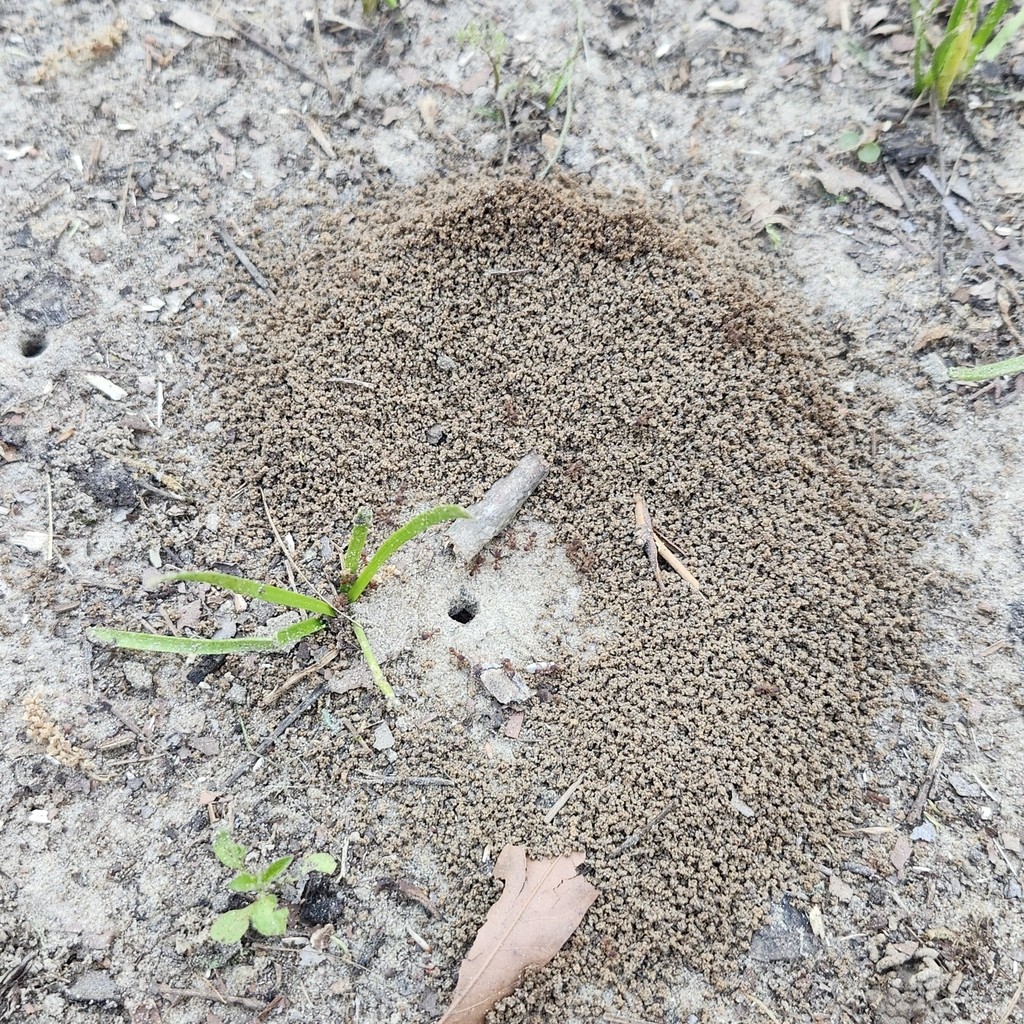
The crescent at the entrance is a tell-tale identifier.
Excavated sand comes out the door in a semi-lunar crescent, in pellets around 1.7 mm across. The ants also set larger 3 to 4 mm bits of charcoal and gravel around the entrance. Entrances get sealed during the hot part of the day.
The garden moves with the season. It sits at 20 to 40 cm in spring and fall and goes deeper than 60 cm in high summer, recorded down to 115 cm. They relocate the entire farm twice a year to keep it in soil that isn't too hot. Keep that in mind if somebody tells you to run a heat cable on this species.
The Fungus
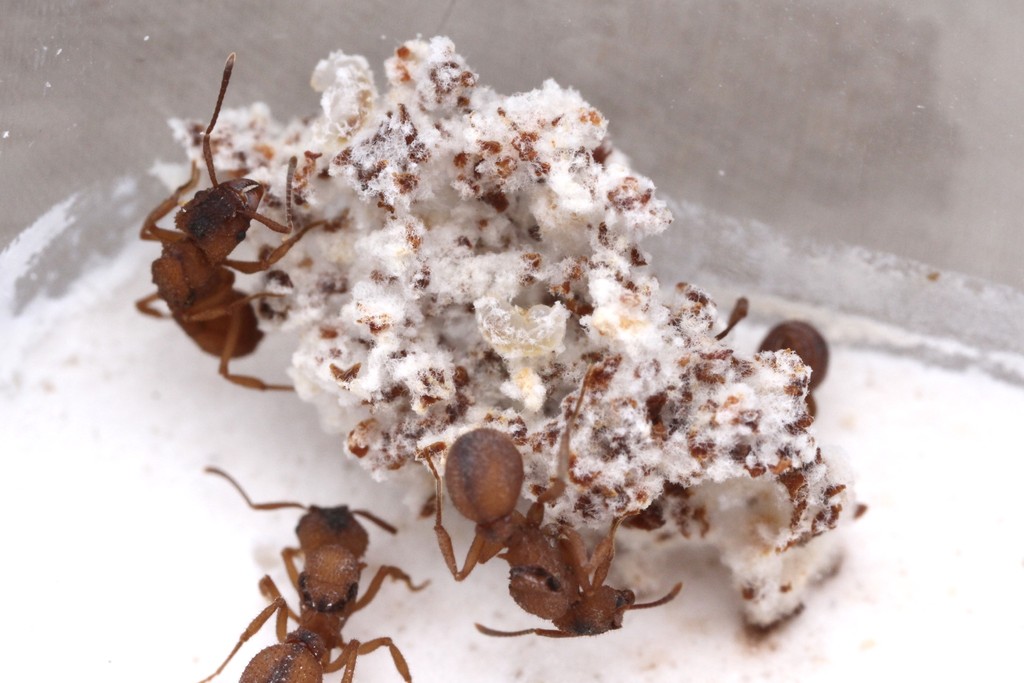
They're a 'higher attine', and that distinction tells us what they grow. The higher attine cultivars split into two sister groups. One is Leucoagaricus gongylophorus, the leafcutter fungus. The other is 'Clade B', and that is what T. septentrionalis grows. 'They grow the same fungus as leafcutters' is the single most repeated wrong thing about this species.
The cold work is my favorite thing in this species' literature. Senula and colleagues compared a Texas population at Bastrop against an Oklahoma population at Norman, about 600 km north. Northern nests were deeper. Northern colonies initially rejected southern fungus. And the northern fungus was more cold-adapted, tested on plates with no ants involved at all. Only one partner needs to be cold-tolerant, though. Northern ants growing southern fungus handled cold about as well as northern ants with their own.
Colony Structure
Queen count. Monogynous. Some populations are suspected of being polygynous but nobody truly knows one way or the other. Functionally, they're monogynous.
Castes. Queen, monomorphic workers, males. There are no majors and no soldier caste.
Behavior
Docile, slow, and patient.
Activity. Mostly dusk through dawn in summer. Warm-climate populations flip to daytime activity in winter.
Defense. No meaningful sting, no aggression worth planning around. Will curl into a ball as a defense mechanism and lay motionless.
Diet
They farm fungus, so what you're really feeding is the fungus.
The substrate list is plant detritus, caterpillar frass, oak catkins, flower parts and dried leaves. They'll cut soft plant material when they have to, but prefer to scavenge materials on the ground that are readily-available.
Seal and Tschinkel ran the substrate experiment in 2007, testing caterpillar feces, oak catkins, oak leaves and huckleberry flowers. Oak catkins were both preferred and the best performer. Then the interesting part. The oak leaves they don't prefer did just as well. Leaves are energetically-expensive to cut, so the ants skip them. It isn't that leaves are worse for the garden.
Reproduction
Nuptial flights. Little is known. Ant-keeper consensus is summer, warm and humid, often after rain.
Founding. Semi-claustral, single or a few queens. The queen digs a chamber, regurgitates her fungal pellet from the infrabuccal pouch, then forages plant detritus and caterpillar frass to grow that pellet into a garden, rearing the first workers at the same time. The founding chamber has to be very humid throughout.
Development. First workers appear around weeks 4 to 8.
Diapause
Whether your colony needs one comes down entirely to where it came from. Florida populations don't diapause. That's where we source ours, and ours stay active year round. Every other population does. New York and New Jersey colonies run a short season, roughly early May to September, while Florida colonies keep working through winter as long as it stays above about 18°C.
Watch the garden. They'll shrink it down into one to four small pellets and stop producing brood as they prepare. Once the garden is down and there's no brood left, keep them at ~55°F for ~3 months.
Keeping Trachymyrmex septentrionalis
The most important thing for them is humidity.
Humidity. High and consistently high. This is the whole ballgame. The ants tolerate dry conditions better than you'd expect, but the fungus does not, and it dies fast when humidity drops. A water-only liquid feeder in the outworld is highly recommended.
Temperature. They do well around 84°F but are perfectly fine at room temperature in most homes. We encourage letting the colony sit at whatever's ambient. Heating cables and heat mats cause condensation inside the nest, and that's dangerous to both the ants and the fungus. A wild colony solves a hot summer by carrying the garden a meter underground. In a captive nest, they can't.
Nest. Substrate or petri-dish style nests. Entrance 3/8" or 1/2". They're small and appreciate the reduced diameter early on, though big colonies will use the extra room.
Food. Fresh plant detritus or dried leaves in the foraging area once a week. Small colonies especially prefer material they don't have to cut. If you're not sure where to start, our TJL Fungus-Farmer diet is built for exactly this. Sliced organic apple or orange with the outer peel removed works well for carbohydrates.
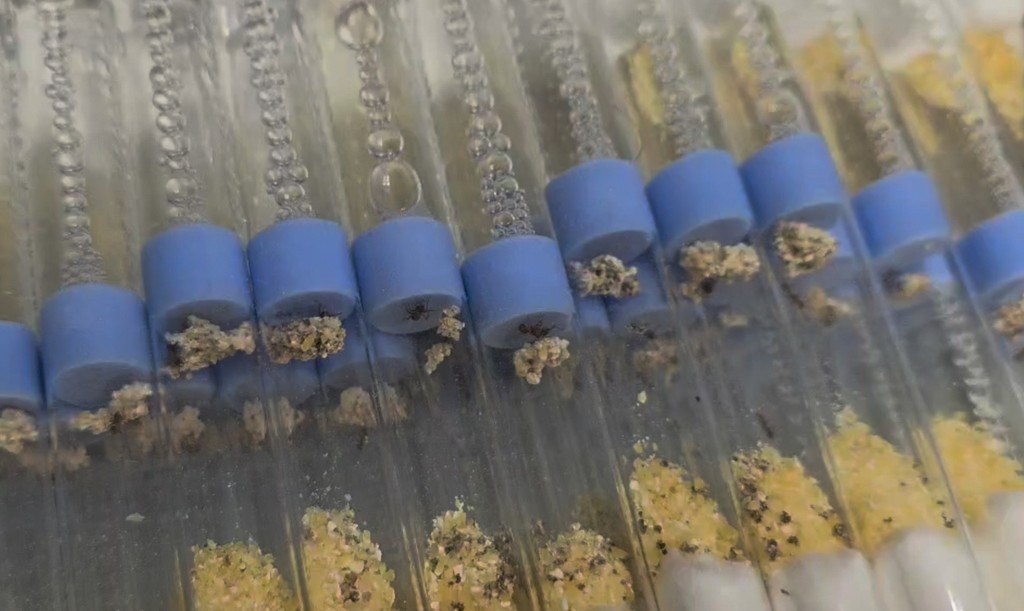
Regarding humidity, this is one of the reasons we use the TJL Test Tube Sponges with this species and suggest against founding them on cotton. PVA is inorganic, so it holds its water without molding on its own. With a fungus garden already in the nest, you don't want a second organism competing in there.
Seal, J. N. & Tschinkel, W. R. 2007. "Complexity in an obligate mutualism: do fungus-gardening ants know what makes their garden grow?" Behavioral Ecology and Sociobiology 61: 1151-1160.
Luiso, J. et al. 2020. "High diversity and multiple invasions to North America by fungi grown by the northern-most Trachymyrmex and Mycetomoellerius ant species." Fungal Ecology 44: 100878.
Senula, S. F. et al. 2022. "Cold adaptations along a range limit in an obligate symbiosis." Functional Ecology 36: 2267-2278.