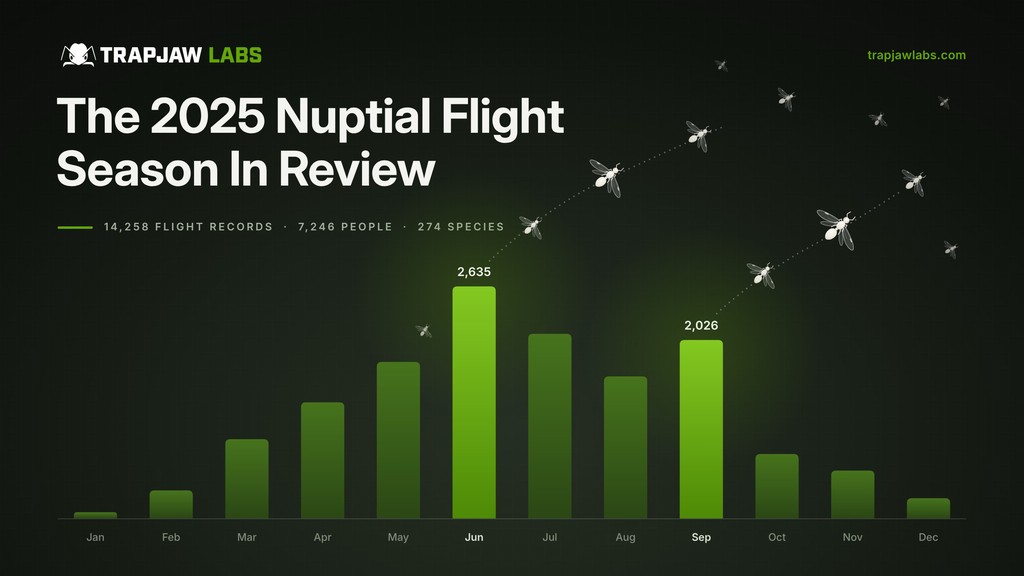
The 2025 US Nuptial Flight Season In Review
Every flight season, thousands of people photograph winged ants on porches, sidewalks, and lit-up sheets. Most of those observations have been added to Ant Nuptials US, an iNaturalist project our team helps curate. Our goal is simple: compile as many US nuptial flight records as possible. Here's how the 2025 season went.
For 2025 alone, the project holds 14,258 flight records from 7,246 different people, with 274 species identified.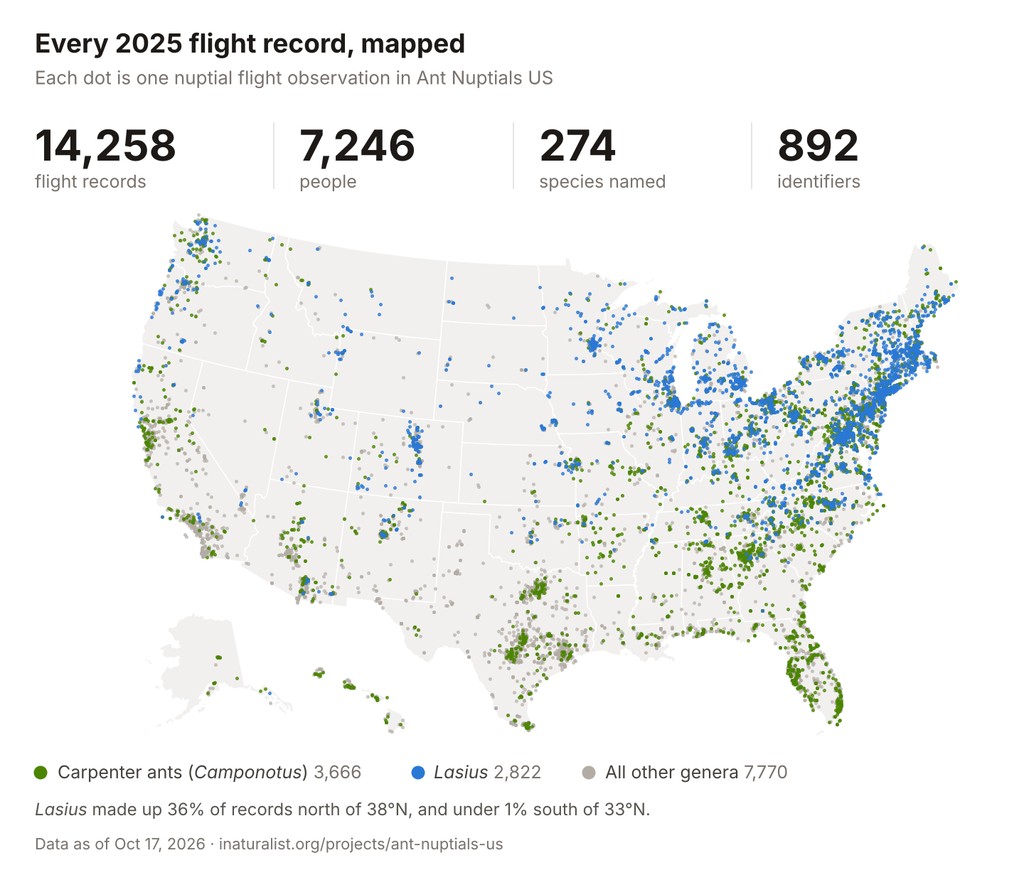
When They Flew
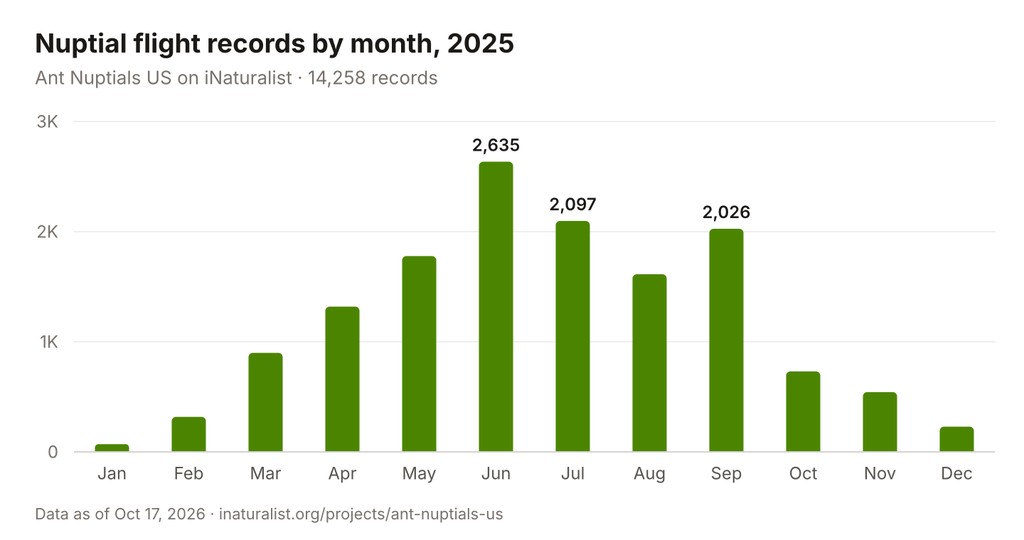
The year had two peaks: June, and a Lasius-heavy September.
June led the way with 2,635 records, and July followed with 2,097. After a dip in August, September climbed back up to 2,026, only 71 records short of July. About half of September's records were Lasius, led by the Turfgrass Ant (Lasius neoniger) with 339 of them.
The season started off slowly, with 70 records in January and 318 in February. It ran pretty late, too. November still brought in 543 records, and even December had 229.
The Busiest Days
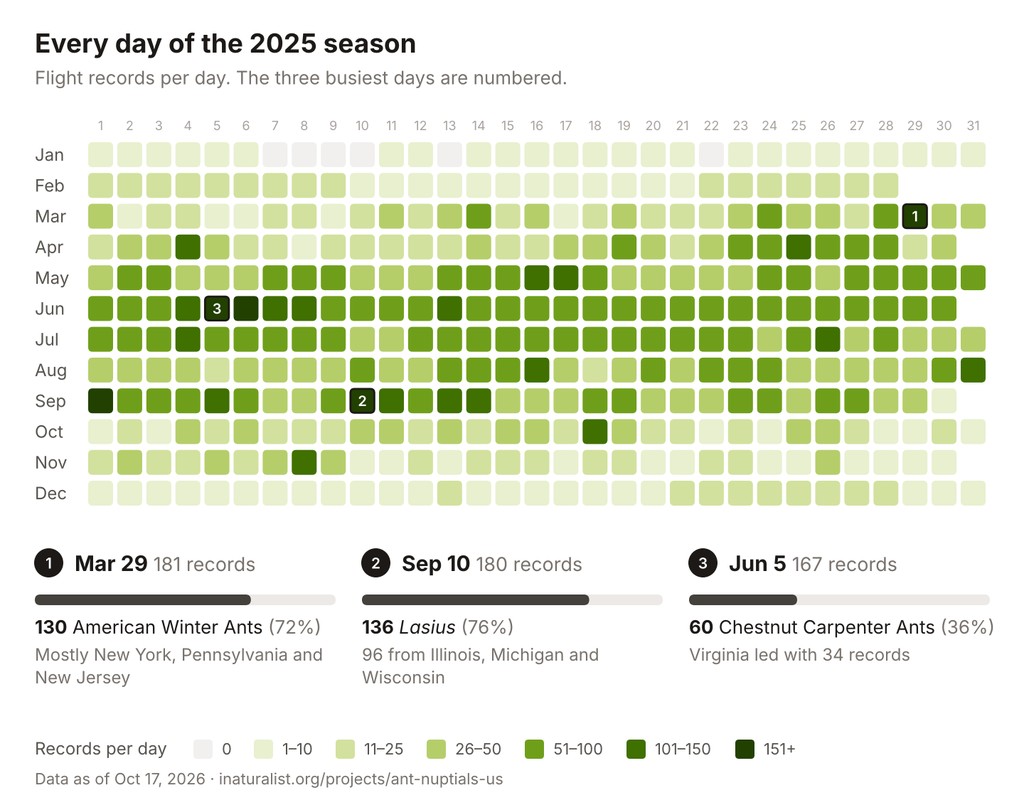
The single biggest day of the year was dominated by Winter Ants.
March 29th produced 181 records alone. American Winter Ants (Prenolepis imparis) made up 130 of those records, with most coming from New York, Pennsylvania, and New Jersey. Texas Leafcutter Ants (Atta texana) were a distant second with 11.
September 10th produced 180 records. As you might expect, it was a big Lasius day: 136 of its 180 records were Lasius, led by 56 Turfgrass Ants. Illinois, Michigan, and Wisconsin alone accounted for 96 of the day's records. June 5 came in third with 167, and 60 of those were Chestnut Carpenter Ants (Camponotus castaneus).
Who Flew
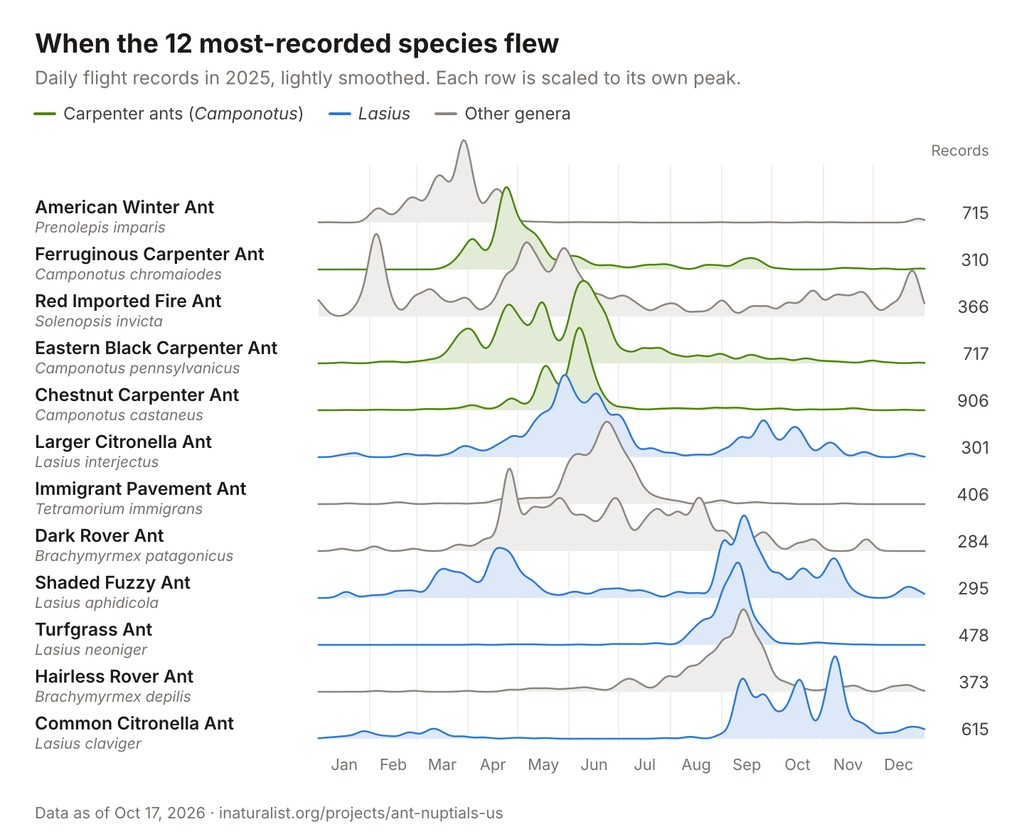
Carpenter ants led the year, but Lasius wasn't far behind.
Camponotus accounted for 3,666 of the year's records, roughly a quarter of the total. Lasius followed with 2,822, and no other genus reached 1,000. When it comes to individual species, these were the five most-recorded:
New To The Project
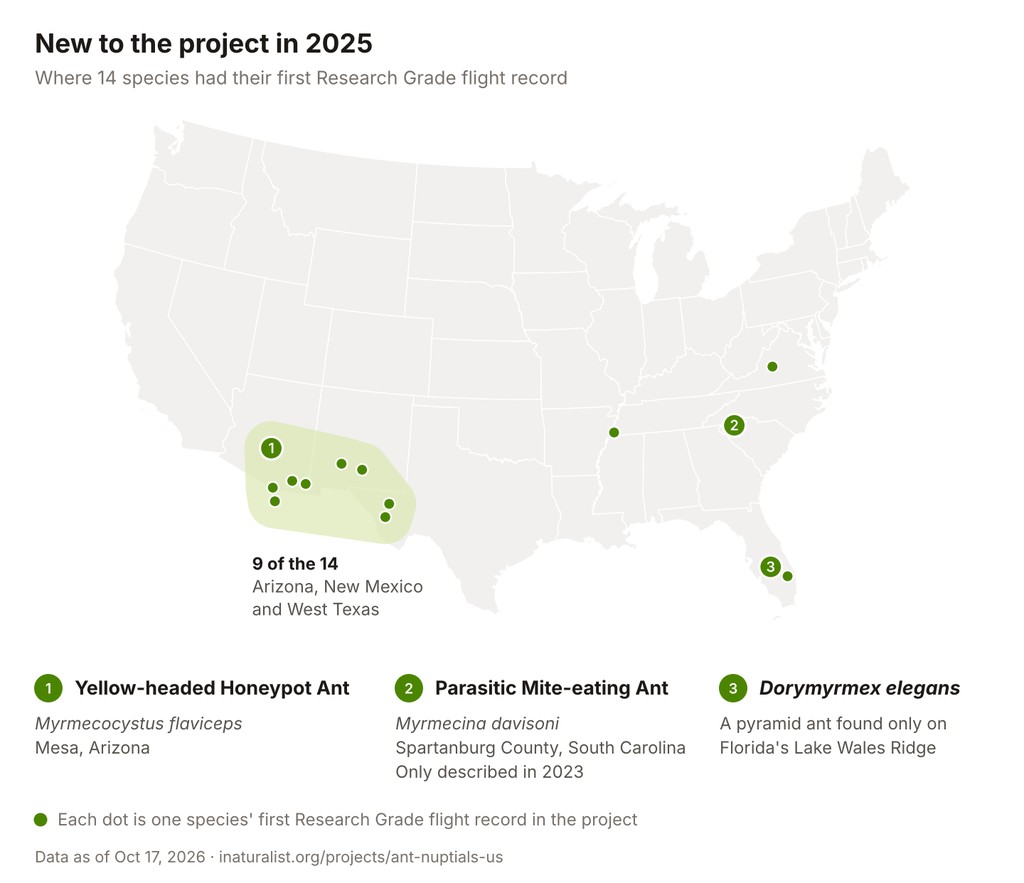
Fourteen species had their first Research Grade flight record in the project in 2025.
Nine of them came from Arizona, New Mexico, and West Texas, including the Yellow-headed Honeypot Ant (Myrmecocystus flaviceps) from Mesa. However, two finds from the eastern US stand out. The first, Myrmecina davisoni, was only described in 2023 and is suspected to be a social parasite of Myrmecina americana. Its record from Spartanburg County, South Carolina, is one of just two observations of the species on iNaturalist. The other, Dorymyrmex elegans, is a pyramid ant found only in the scrub of Florida's Lake Wales Ridge.
The Southeast
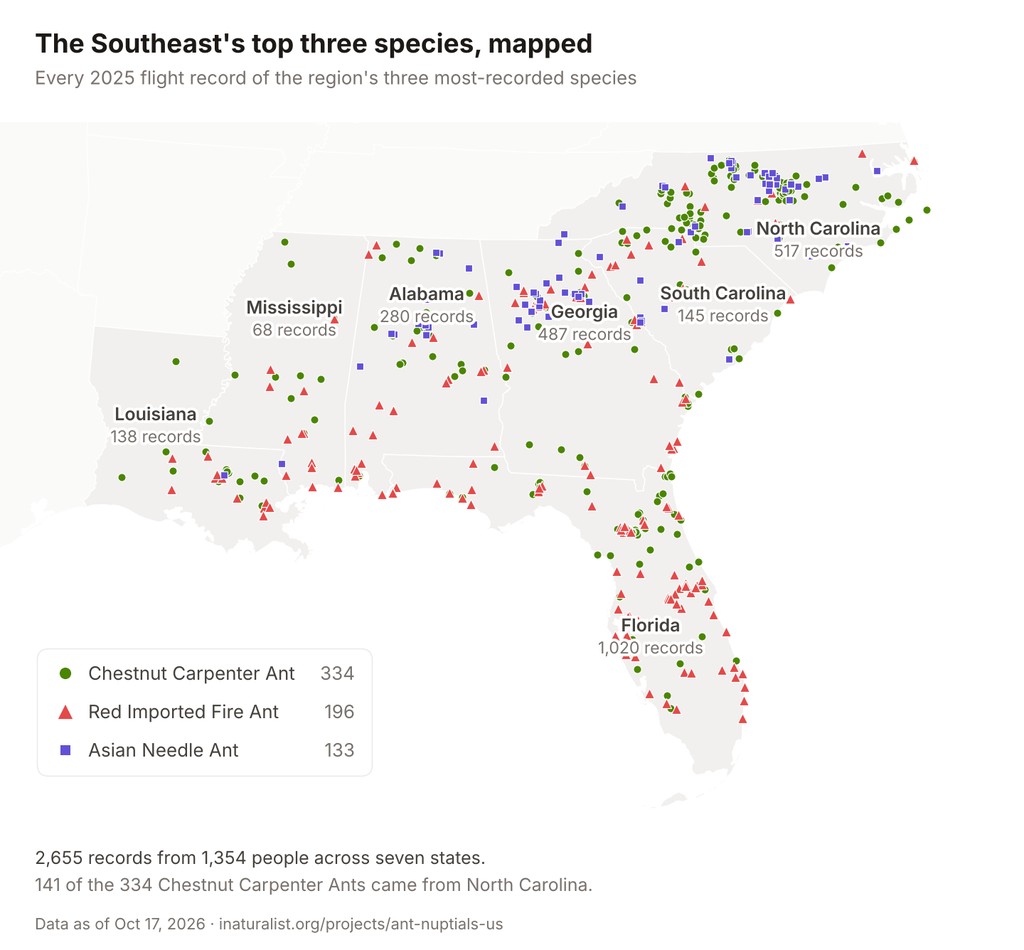
Alabama, Florida, Georgia, Louisiana, Mississippi, and the Carolinas logged 2,655 records from 1,354 people.
May and June alone held roughly 40% of them. Once again, the Chestnut Carpenter Ant came out on top with 334 records, ahead of the Red Imported Fire Ant (Solenopsis invicta) with 196 and the Asian Needle Ant (Brachyponera chinensis) with 133. The busiest day in the Southeast was June 7, when 26 of the day's 50 records were C. castaneus and 11 were Asian Needle Ants.
If you caught a carpenter ant queen in 2025 and still aren't sure which species you have, our Camponotus queen ID guide covers nine Southeastern species.
Thank You
None of this would be possible without the people photographing these flights and the people identifying them.
In total, 7,246 people logged at least one flight in 2025, and 892 people added identifications. A huge thank you to the top identifier: mettcollsuss (2,859 IDs). We'd also like to thank tutankhamunr, who recorded more 2025 flights than anyone else, with 240.
About half of 2025's records have reached Research Grade. That still leaves roughly 7,000 waiting on IDs. If you know your ants, adding IDs is one of the most helpful things you can do for the project.
Next Season
All it takes to log a flight is a single photo.
When you see winged queens or males, simply photograph them, note the time, and post the observation to iNaturalist. Then join Ant Nuptials US and add your observation to the project. Even a single alate buzzing around your porch light counts. Older flights count, too. If you photographed one in 2025 and never added it, it isn't too late.
Some species still have almost no flight data at all. As an example, Pheidole littoralis, a species we've been rearing in our lab, has exactly two flight records in the project, both from 2024. If you're heading out to catch queens next spring, our guide to finding and catching a queen after a nuptial flight is a great place to start.