Why Is My Ant Colony Growing Slowly?
Why a colony can be growing slowly, four things worth checking first, and how much of it is just what early growth looks like.
Your queen has workers, the setup has been in the same spot for two months, and the colony looks about the same as it did when you got it. Nothing is obviously wrong. Nothing is obviously happening either.
This one is for colonies past founding. If you're still waiting on the very first workers, start with how long until your queen has workers.
What Growth Actually Looks Like
Colony growth is exponential, and the early stretch of an exponential curve is hard to tell apart from nothing happening.
Solenopsis invicta or the "Red Imported Fire Ant" colonies raised in a lab averaged 1,926 workers at five months old and 8,076 at six months. Same colonies, one month later. In the field they reach roughly 7,000 by their first fall and about 25,000 by year two, and they don't hit half their eventual size until year three or so.
The queen will increase how fast she's producing eggs as the colony increases in size. Many factors ultimately go into the exact rate at which she lays eggs, and much is still unknown.
Temperature
Temperature is usually the most impactful thing for growth rate.
Linepithema humile or the "Argentine Ant" egg-worker time is about 25 days at 70°F and about 8 days at 86°F, as an example. For most ants, the increase in development speed is remarkable compared to a relatively low change in temperature.
Warmer is not automatically better. Solenopsis invicta's brood development improves up to about 90°F, and past that it reverses and the brood starts dying. Heating cables can cook your ants, and things can sometimes get a little too hot a little too quick.
We suggest finding your species in the Care Advisor before you start heating, if you're new to it.
The Right Diet
What you feed and how often has a big impact on growth.
It's had to make broad statements about what is best for ants as a whole. Each species does best with their own tailored diet. We suggest checking the Care Advisor for guidance if needed.
Diapause
In Camponotus, Formica, Lasius, Myrmica, Aphaenogaster, Crematogaster and Tapinoma, among others, dormancy runs on an internal clock. When these ants are forced to remain at room-temp or high, as sometimes happens in the hobby, they will perpetually wait for a winter that'll never come. Eventually leading to colony collapse entirely.
Watch your ants: larvae stop developing, the queen stops laying, foraging falls off. Our write-up on how to diapause your ants covers doing what you need to in response.
What Usually Isn't The Problem
A couple things frequently get falsely accused of stunting growth:
When It Actually Is A Problem
Of those four, disappearing brood tells you the most.
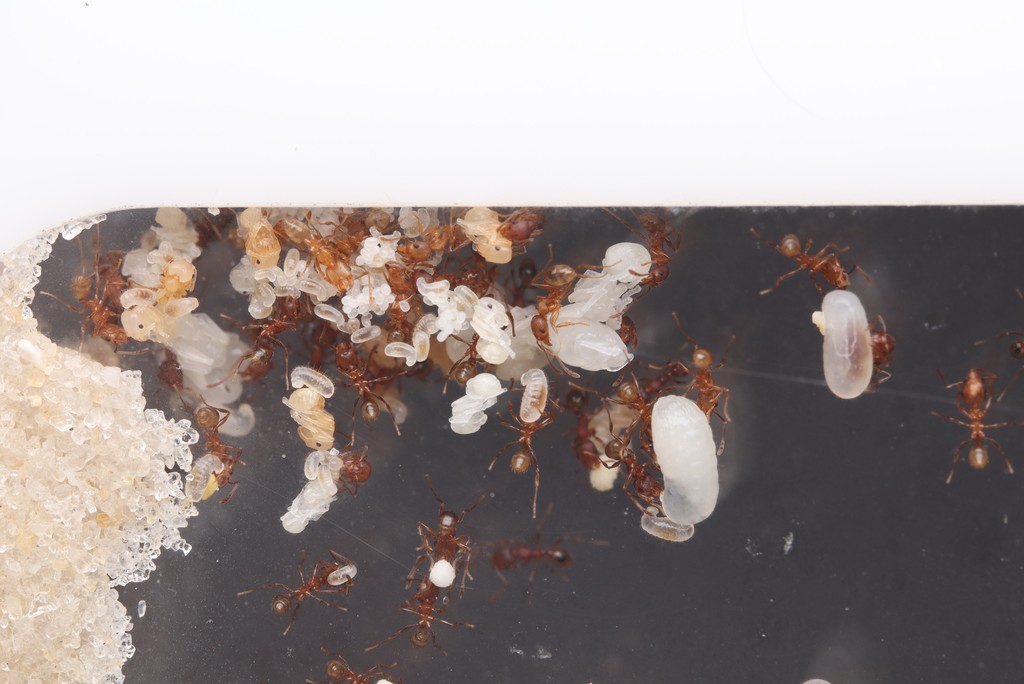
Colonies eat their own brood, or their brood dies and is quickly eaten by the workers, when things start going poorly. Founding Lasius queens will cannibalize fungus-infected larvae while leaving healthy ones alone, for example. Vanishing brood is a signal about conditions, or about the brood itself. It is usually not a lazy queen.
If you're stuck and don't know what to do, get in touch.
Conclusion
Check the temperature first. It's the cheapest thing to fix and it sets the rate for everything else. Most slow colonies aren't sick. They're small or they are in an inadequate setup. Get the setup right, feed them properly, and go from there.